Menu   ≡ ╳
  • News
    • Major Tournaments
    • General News
    • USA Chess
  • Puzzles
  • Improvement
  • Event
  • College
  • Scholastic
  • Women
  • Search

        More results...

        Or you can try to:
        Search in Shop
        Exact matches only
        Search in title
        Search in content
        Search in comments
        Search in excerpt
        Search for News
        Search in pages
        Search in groups
        Search in users
        Search in forums
        Filter by Categories

        Try these: Sicilian Defense, Empire Chess, USA Chess

    • SPICE
    • Videos
    • Susan’s Blog
    • About Us
    • Contact Us
    • SPICE
    • Videos
    • Susan’s Blog
    • About Us
    • Contact Us
    Menu   ≡ ╳
    • News
      • Major Tournaments
      • General News
      • USA Chess
    • Puzzles
    • Improvement
    • Event
    • College
    • Scholastic
    • Women
    • Search

          More results...

          Or you can try to:
          Search in Shop
          Exact matches only
          Search in title
          Search in content
          Search in comments
          Search in excerpt
          Search for News
          Search in pages
          Search in groups
          Search in users
          Search in forums
          Filter by Categories

          Try these: Sicilian Defense, Empire Chess, USA Chess

      Home  >  Chess Improvement • Chess Puzzles  >  Saturday tactic review

      Saturday tactic review

      Chess tactic, Puzzle Solving


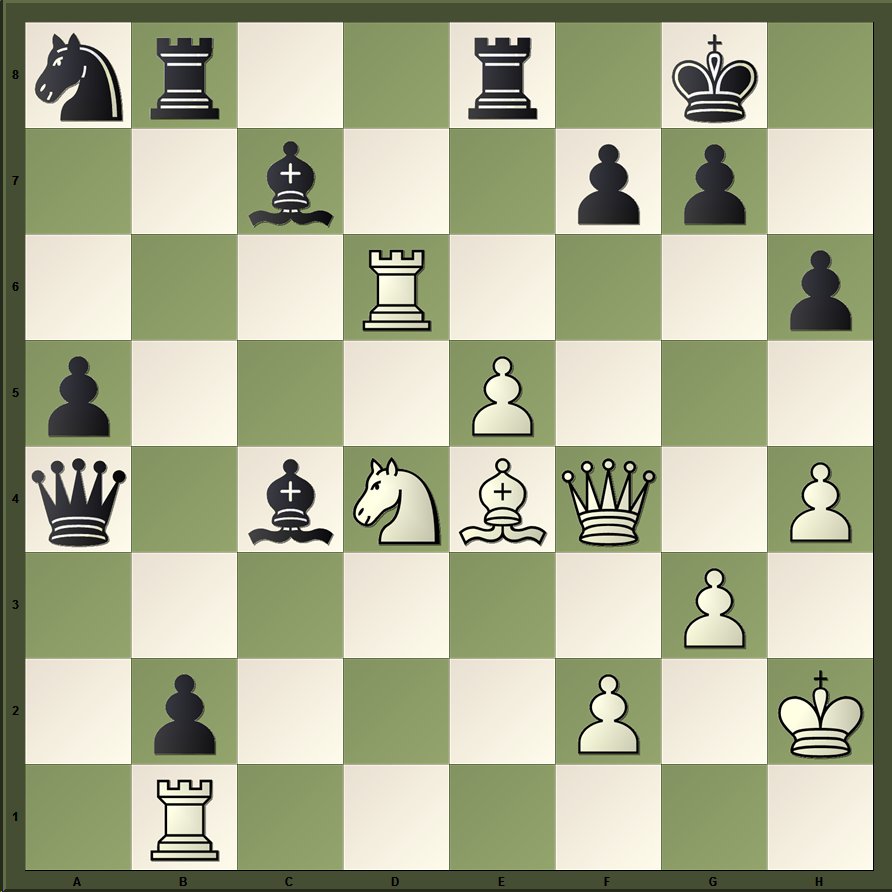
      White to move. How should White proceed?

      nr2r1k1/2b2pp1/3R3p/p3P3/q1bNBQ1P/6P1/1p3P1K/1R6 w – – 0 1

      Chess Daily News from Susan Polgar
      Previous Article Anand making a late move
      Next Article Aeroflot LIVE!

      About Author

      Susan Polgar

      Related Posts

      • More Special Endgame!

        January 3, 2021
      • Precision Chess Tactic

        December 27, 2020
      • Daily dose of tactic!

        December 21, 2020

      4 Comments

      1. Yancey Ward Reply
        February 16, 2013 at 7:42 pm

        Considering the material imbalance, white needs to be quick, and there really is only one quick theme here:

        1. Qf5

        The only potentially forcing move I see for white. Even Rxh6 is clearly losing: [1. Rh6 Be5! 2.Bh7 Kf8! 3.Qg5 Bd4-+]. Continuing:

        1. …..Re5

        I don’t really see a better defense here, but due to time constraints, I have not looked deeply at the alternatives, but they don’t look at all that different anyway:

        2. Qh7! Kf8
        3. Nc6!

        Threatening Qh8#. It also threatens Rd7 (which couldn’t be played at move three due to black’s queen). So, black must either take the knight, or open a hole at f7:

        3. …..f5 (f6 4.Rd7 anyway)
        4. Rd7! Re7 (to clear e5)
        5. Re7 Be5
        6. Qh8 Bg8
        7. Bd5

        And now black can try for a perpetual with Qxh4 or Bg3 (but I think white’s king finds a haven at g1 or g2 in those instances). Taking the knight at c6 is a quicker mate after white plays 8.Rf7 followed by Qxg8#. So, back at move 3, black must take the knight immediately:

        3. …..Qc6
        4. Rc6

        I see nothing better, but have not spent a lot of time either. The rook is en prise, so it seems natural to use it to capture at c6. So, at this point, white has two pieces for a queen and two pawns. Black is in a bit of bind, too, since white is threatening both the bishop at c4 and the bishop at c7 (since N retake at c7 drops the b8 rook to Qh8+). I don’t see how black can hold this- the best looking continuation for black looks like:

        4. …..Re4
        5. Rc7 Nc7
        6. Qh8 Ke7
        7. Qb8 and this just looks completely lost to me for black. Black has enough time to get his pieces under protection, but not the extra two pawns.

      2. Anonymous Reply
        February 17, 2013 at 11:29 am

        from wich game this position is taken?

      3. Anonymous Reply
        February 17, 2013 at 11:30 am

        from wich real game is this position taken?

      4. Anonymous Reply
        February 18, 2013 at 3:48 am

        Q-f5 seems strong. Black can’t take the rook, otherwise, Q-h7 ch and exd6 leave Black in a mating net. If black declines the rook, the queen check followed by N-f5 is strong. Finally, if Black defends with … g6, then White plays Rxg6.

      Leave a Reply

      Cancel reply

      Improvement

      • Important Scholastic Coaching Tips
      • My Chess Quotes Over The Years
      • My kids know chess rules. What’s next?
      • Chess Parenting

      Events

      • My Top 10 Most Memorable Moments in Chess (Part 3) May 13, 2021
      • My Top 10 Most Memorable Moments in Chess (Part 2) May 12, 2021
      • My Top 10 Most Memorable Moments in Chess (Part 1) May 10, 2021
      • About Susan Polgar April 9, 2021
      • About Us
      • Contact Us
      • Daily News
      • My Account
      • Terms & Conditions
      • Privacy Policy

      Anand Armenia Breaking News Chess Club and Scholastic Center of St Louis Chess interview Chess Olympiad Chess tactic Chess tournament chess trivia China FIDE Grand Prix Holland India Khanty-Mansiysk LIVE games Lubbock Magnus Carlsen Moscow National Championship Norway OnlineChessLessons Philippines Puzzle Solving Russia Scholastic chess Spain SPF SPICE SPICE Cup St Louis Susan Polgar Tata Steel Chess Texas Tech Tromsø TTU Turkey Webster University Wesley So Wijk aan Zee Women's Chess Women's Grand Prix Women's World Championship World Championship World Cup

      April 2026
      M T W T F S S
       12345
      6789101112
      13141516171819
      20212223242526
      27282930  
      « Sep