

Official website: http://tashkent2012.fide.com
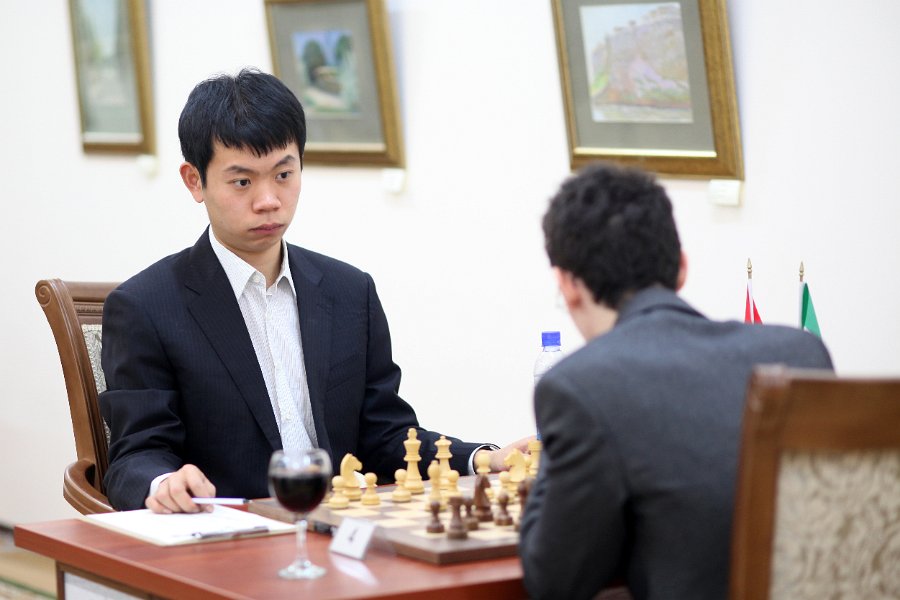
In the ninth round of the FIDE Grand Prix in Tashkent only one game was decisive – Wang Hao managed to outplay one of the leaders Fabiano Caruana. Sergey Karjakin became the sole leader two rounds to go, as all the other games were drawn. The group of players including Alexander Morozevich, Fabiano Caruana, Wang Hao, Rustam Kasimdzanov, Shakhriyar Mamedyarov and Peter Leko are half a point behind the leader.
Wang Hao – Caruana 1-0
Exchange variation seems to become White’s mainline against Slav defense as it’s already third game played with 3.cxd5. In the eighth round Wang Hao played this variation against Morozevich with Black and was ready to try it with white pieces. He chose a fashionable plan with postponed development of g1-knight. A bit artificial 10…Bh5 instead of more common 10…0-0 appeared to be an inaccuracy as with simple moves White got minimal advantage. 21.h3 looks like a nice prophylactics against possible exchange of the bishops. 21…a6-a5 seems to be decisive mistake as Fabiano probably missed 22.b5, and his position became lost after precise play of his opponent. A bit careless 34. Ke2 offered Fabiano an opportunity to eliminate a dangerous pawn on c5 but he missed this chance in a time trouble. It made the task to win easier for Wnag Hao and in few moves the game was over.
Kazimdzhanov – Morozevich 1/2-1/2
Rustam was not ready for a dispute in Dragon Sicilian, which could appear after 3.d4 and went for 3.c3. “ I was not ready for the second move today. If we compare today’s game to the games against Karjakin and Svidler, where I didn’t guess the first moves, we can see there is some progress ”, said former world champion. As his opening preparation failed, White was looking for a safe way to equalize right from the beginning. On the other hand 7.cxd4 instead of Qxd4 looks much more challenging against Black’s set-up. After following exchanges the position simplified a lot and at some point looked very similar to the ending from Karjakin – Morozevich. “Today the position with the same structure, as in the game against Karjakin, happened. It’s useful to train again in such a familiar position. It seems to me the Grand Prix in Tashkent is devoted to the study of this structure if I get it all the time from different openings. Most probably I have such karma here – to learn this endgame,” ironically noticed Alexander Morozevich. The endgame was equal and the only exciting moment happened after Black’s 29…g5. After 30. Re5 both players had to calculate the pawn endgame precisely. Both opponents had to play few only moves in a row to achieve a draw. Players repeated the moves in the position where the only logical attempt to continue the game – c4-c5 would lead to a dead-drawish queens endgame.
Ponomariov – Kamsky 1/2-1/2
Alekhine’s defence had been played in this game and Black went for 4…dxe5 5.Nxe5 c6 – a line which helped Kamsky to score very important victory against Grischuk on Olympiad in Istanbul. Ponomariov went for relatively rare line with 10.Bf4, trying to prevent normal development of black pieces (in majority of the games White continued 10.Nc3 ). After few more moves a position on the board was much more familiar to Kamsky as he explained during the press-conference “I’m used to play this structure from Slav defence”. Despite the fact White had optically better position due to his two bishops and advantage in space, Black’s position was quite solid and the pressure on d4 was really unpleasant. Thus, White’s decision to repeat the position looks logical, also taking into account that Ruslan was short on time. Gata showed a fighting spirit as he continued to play on (30…Qd8 instead of repeating the position after Bh4), but later on he failed to find any possible way to improve his position and finally accepted the draw.
Leko – Svidler 1/2-1/2
Paulsen – Taimanov variation in Sicilian defense used to be one of the main lines in Svidler’s repertoire few years ago. As Peter Leko pointed out during the press-conference, “I don’t know why I always choose e4 against Peter Svidler, who plays many moves on 1.e4. I should definitely think about 1.d4 next time!” White’s 10. e5 indicated an intention to go for the most critical lines, but Russian GM chose less popular 11…Kf8, even he prepared at home the sharp 11…g6 12.Bh6 Rb8 13.Qh3 Rb4 14.Bg7. As he explained during the press-conference he changed his mind to play 11…g6 because “Peter looked too satisfied with the position” and Svidler decided to avoid possible exact preparation from the opponent. After 11…Kf8 game continued in the positional way and, after White’s tempting but not the most precise 18. Nd3, Black easily equalized. Closed character of the position didn’t offer any opponent real chances to break through, both players continued to play solidly, so after threefold repetition a draw was agreed.
Karjakin – Gelfand 1/2-1/2
No one seems to be ready to test Gelfand in Sveshnikov variation, so Kariakin chose 3.Nc3, aiming for a long positional pressure. The structure after 11.Be6 fe6 reminds Anti-Marshall variation of Ruy Lopez, which was already played a couple of times in Tashkent. Boris desperately fought for initiative and sacrificed an exchange with 23…Rxf3, but with precise play (Kh1!) Sergey managed to keep the balance. The game ended in the spectacular way – Black gave a perpetual check being two rooks down!
Dominguez – Mamedyarov 1/2-1/2
Game started as Reti Opening but quite soon was transferred into symmetrical Gruenfeld. Both players played in very original manner and Mamedyarov managed to surprise his opponent with a novelty on 6th move! Lenier found a very strong 9.Qc2 after which Black’s decision to sacrifice a piece with 9…Nc6 looks reasonable. Otherwise White would enjoy typical slight advantage without much counter play for Black. White accepted the challenge and the resulting position appeared to be really complicated. Perhaps 11.Qf4 would put a critical test on Black’s idea, as in the game Shakhriyar had a chance (after 11.Qe3) to play 11…Bg4 with promising complications. Later on White could get an advantage after 16. Be4, but this move was missed by both opponents. Instead Lenier played 16.Nd2, and after strong Bb2 Black got counter play and even started to think of playing for win. Cuban player managed to find 30.Ng4, which led to the repetition as 30…Rf3 31.Rd1 looks too dangerous for Black.
Kamsky is best.