After a quick look, I thought it had to start with 1. Rxg5+ and 2. Qg6+. But after 1. … hxg5 2. Qg6+ Kh8 3. Rc4 looks like it might win after 3. … Nxc4 4. Bd3 Rf7 5. Qxf7 Qe1+ 6. Kh2 any 7. Qh7#. But the problem is that with the Rook already sac’ed Black can just trade off his Queen for the Rook and Bishop: 3. … Qxc4 4. Bxc4 Nxc4 and White has nothing better than perpetual check.
So there has to be a preparatory move to eliminate that option. We get that by changing the move order:
[FEN “1r3rk1/4p3/5p1p/p2PPRp1/1q2Q3/6P1/1n2BPP1/2R3K1 w – – 0 0”] 1. Rxg5+ fxg5 {White sacrifices rook to gain position inside black’s pawn formation.} 2. Qg6+ Kh8 3. Rc6 Rb6 {White threatens Qxh6+, Qxg5+, Rh6#} 4. Rxb6 Qxb6 {White can afford to exchange rooks at this point, especially since he also will gain the black queen. Black has no choice.} 5. Qxb6 Kh7 6. Bh5 Rg8 {Black tries to prevent Qg6.} 7. Qxb2 a4 {White knocks off some ancillary threats to gain safety and time to build mate threat.} 8. Qc2+ Kh8 9. Qxa4 Kh7 10. Qd7 g4 (10… Rg7, 11. Qf5+ Kg8 12. Bg6 Rxg6 {since white threatens Qc8#}) 11. Qxe7+ Kh8 12. Qf6+ Kh7 13. Qf7+ Kh8 14. Bg6 Rxg6 {since white threatens Qh7#} 15. Qxg6 h5 {Now mate is a simple matter of promoting d or e-pawn.} 16. e6 h4 17. e7 hxg3 18. e8=R#
Obviously, white could get a draw with: 1. Rg5+ hxg5 (fxg5 can’t be better I guess) 2. Qg6+ Kh8 3. Qh6+ Kg8 etc. (eternal chess being presumed)
So I guess, this is the idea we have to improve on.
1. Rg5+ hxg5 2. Qg6+ Kh8 3. Qh6+ Kg8
So far so good, and now:
4. Bh5!!
Very boldly played when being down with a rook, but how does black escape here? The plan being Bg6, Qh7 and Qf7, and black should fail to find a tempo!
E. g. 4. … Rfc8 5. Bg6!! Rxc1+ 6. Kh2 Rh1+ 7. Kxh1 Qe1+ 8. Kh2
The very first thing that catches my eye is Rg5 to clear the line to g6, and see if I can make hay that way:
1. Rg5 hg5
The alternatives look worse to me- Kf7 allows Qg6 with mate, and fxg5 allows Qg6 followed by Qxh6, Qg6 again, capped by Rc6 (the line along the sixth rank is now open due to the f-pawn’s capture at g5. I will cover 1. …Kh8 later.
2. Qg6 Kh8
Now, white faces a choice, and I don’t know which is better- Rc7 or an immediate play of d6. When I first looked at this problem, I thought of 3.Kh2 followed by Rh1 and Kg1, but if black plays 3. …Qd4 followed by 4. …Qf2, white can’t clear the king off the h-file, and might have to take the draw by repetition. Let’s look at 3.Rc7:
3. Rc7
There are multiple threats here depending on what black plays on the next move. If black plays 3. …Rbe8 to doubly guard e7, white just captures with exf6 with the threats of Qg7# since black can’t recapture with either the rook or the e-pawn. If black plays a knight move, Bd3 is deadly. If black plays the queen to a3, or plays a4, white just follows with d6 with many of the same latent threats. Finally, if black opposes a rook on the 7th rank, white just captures with exf6 again leading to an unstoppable mate. I think black must either capture at e5, or he must play Rb6:
And black will have to give up the queen for the rook. Now, it is question of whether white has enough compensation for the material. On balance, he has a queen and two pawns for 2 rooks. However, one of those pawns is the d5 passer, and with the open exposure of the black king, I have to believe the advantage is decisive.
So, back at move 3, can black do better with 3. ….Rb6?
3. …..Rb6 4. d6 Rd6
Forced, but ineffective anyway, I think. The threat was Rxe7 which isn’t defended by fxe5. The doubt I have here is what is the cleanest win for white. He can play Rxe7 right now, but I think it makes more sense to force the black king onto g8 first so that a critical tempo is gained at a later point. I think what follows is clearly forced all the way, though it is possible I am overlooking something here
5. Qh6 Kg8 6. Re7 Rd1 7. Bd1 Qe7 8. Bb3!
The point of 5.Qh6. White plays this move with check, now. Continuing:
8. …..Rf7 (what else?) 9. ef6 and I don’t think the mate can even be prevented now.
Now, the last loose thread I see in this is all the way back at move 1 for black, but I can see now I missed that white can force the transposition:
1. Rg5 Kh8 2. Qg6 hg5 and we have now transposed into the previous line.
Presumably black plays pxR, and then Q into the hole with check and pxF6 looks dandy with no possible way to stop the mate. Q and P is hugely strong here.
I didn’t have time yesterday to explore this obvious alternative line to my previous one. That is, what if black replied 1… hxg5 rather than 1… fxg5? Turns out it is a tougher game for white. 1. Rxg5+ hxg5 {White sacrifices rook to gain position inside black’s pawn formation.} 2. Qg6+ Kh8 3. Rc7 fxe5 {else white has a mate threat of exf6, Qg7#.} 4. Qh6+ Kg8 5. Qxg5+ Kh8 6. Rxe7 Qxe7 {White invites queen exchange. Black accepts.} 7. Qxe7 Rfe8 {Now white’s goal is to force black to exchange a rook for his bishop.} 8. Qh4+ Kg7 9. Qg5+ Kh8 10. Bh5 Rf8 11. Qe7 Rg8 12. Qxe5+ Kh7 13. Qf5+ Kh8 14. Bf7 Rb6 {White has a mate threat of Qh5+, Qg6+, Qh6#.} 15. Bxg8 Kxg8 {Now the white queen easily can take black’s remaining pieces and promote the d-file pawn. The end of the game could play out as follows.} 16. Qc8+ Kf7 17. Qc7+ Kg8 18. Qxb6 Nd1 19. Qf6 Nc3 20. Qxc3 a4 21. Qc8+ Kg7 22. d6 a3 23. d7 a2 24. Qc3+ Kg6 25. d8=Q a1=Q+ 26. Qxa1 Kf5 27. Qaf6+ Kg4 28. Qd1#
In the above line, I was playing against Fritz 13 in infinite analysis mode and occasionally using Fritz to check mating combinations. So, the ideas are a combination of mine and Fritz’s. Fritz initially didn’t like my 3. Rc7 idea, but it worked out the best of all the ideas I tried — too many to present here.
may be winning. I don’t think it as strong as the option I outlined, but I think black doesn’t need to cooperate in playing 4. …Rfc8. He can do better by playing a move like Nc4, for example. The idea I have for Nc4 is that it cuts off Rc7 in some lines:
4. …..Nc4 5. Bg6 Rf7 (only move) 6. Bf7
I looked at this for a while, and simply see no other continuation for white that maintains the initiative. Continuing:
6. …..Kf7 7. Qh7
White can draw easily with 7.e6, but that is all he will have, and I am not even sure white can draw with 7.ef6, though black will have trouble escaping the checks without ending up in a mating net. Continuing:
7. …..Ke8 8. d6
On e6, the black king escapes through d8. Black’s reply is pretty well forced now:
8. …..ed6 (Rb7 9.Qg8 Kd7 10.Rc4) 9. e6! Rb7 (what else?) 10.Qg8 Ke7 11.Qf7 Kd8 12.Qf8 Kc7 13.e7 Rb8 14.e8Q Re8 15.Qe8 and white is clearly better, though I am unsure if it is truly decisive.
I neglected to mention in my previous post that Fritz 13 didn’t like the 1. Rxg5+ move either. Fritz preferred the less risky Qc2, which also leads to a winning game, but not nearly as interesting as the game resulting from 1. Rxg5+: 1. Qc2 Kh8 2. d6 a4 3. Rf3 exd6 4. Rxf6 Rxf6 5. exf6 Qb7 6. Qf5 Rf8 7. Bf5 Qh7 8. Bg6 Qb7 9. ff7 Kg7 10. Bh5 Rxf7 11. Qg6+ Kh8 12. Qxh6+ Kg8 13. Bxf7+ Qxf7 14. Rc8+ Qf8 15. Rxf8#
The above line is Fritz 13 playing against itself in infinite analysis mode.
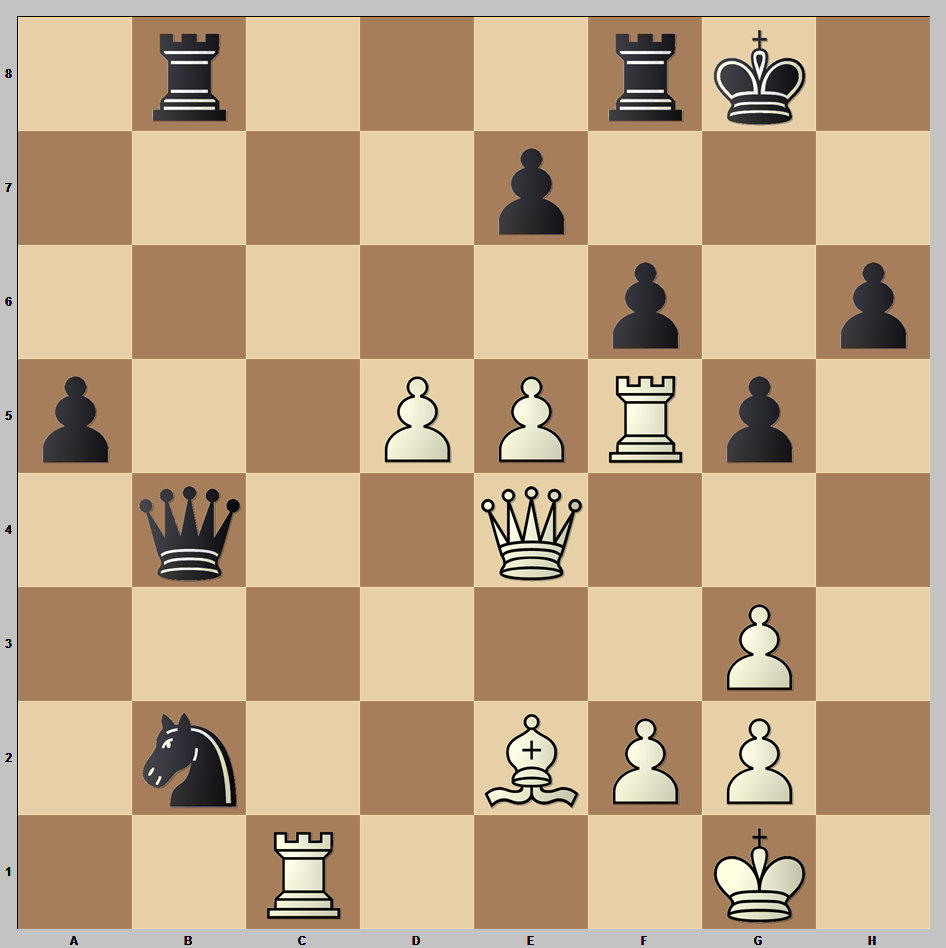


Rxg4+ followed by Q-n6+, Qxh6+, and B-h5 with a winning arrack
After a quick look, I thought it had to start with 1. Rxg5+ and 2. Qg6+. But after 1. … hxg5 2. Qg6+ Kh8 3. Rc4 looks like it might win after 3. … Nxc4 4. Bd3 Rf7 5. Qxf7 Qe1+ 6. Kh2 any 7. Qh7#. But the problem is that with the Rook already sac’ed Black can just trade off his Queen for the Rook and Bishop: 3. … Qxc4 4. Bxc4 Nxc4 and White has nothing better than perpetual check.
So there has to be a preparatory move to eliminate that option. We get that by changing the move order:
1. Rc4 Nxc4
2. Rg5+ hxg5
3. Qg6+ Kh8
4. Bd3 Qe1+
5. Kh2 Rf7
6. Qxf7 any
7 Qh7#
That looks good, there’s still 2. … fxg5 to analyze, and also what if Black just plays 1. … Qe1+ Kh2 Rf7
So maybe I’m completely on the wrong track here; or perhaps if I complete those lines it will turn out to be win after all.
[FEN “1r3rk1/4p3/5p1p/p2PPRp1/1q2Q3/6P1/1n2BPP1/2R3K1 w – – 0 0”]
1. Rxg5+ fxg5 {White sacrifices rook to gain position inside black’s pawn formation.}
2. Qg6+ Kh8
3. Rc6 Rb6 {White threatens Qxh6+, Qxg5+, Rh6#}
4. Rxb6 Qxb6 {White can afford to exchange rooks at this point, especially since he also will gain the black queen. Black has no choice.}
5. Qxb6 Kh7
6. Bh5 Rg8 {Black tries to prevent Qg6.}
7. Qxb2 a4 {White knocks off some ancillary threats to gain safety and time to build mate threat.}
8. Qc2+ Kh8
9. Qxa4 Kh7
10. Qd7 g4 (10… Rg7, 11. Qf5+ Kg8 12. Bg6 Rxg6 {since white threatens Qc8#})
11. Qxe7+ Kh8
12. Qf6+ Kh7
13. Qf7+ Kh8
14. Bg6 Rxg6 {since white threatens Qh7#}
15. Qxg6 h5 {Now mate is a simple matter of promoting d or e-pawn.}
16. e6 h4
17. e7 hxg3
18. e8=R#
Obviously, white could get a draw with:
1. Rg5+ hxg5 (fxg5 can’t be better I guess)
2. Qg6+ Kh8
3. Qh6+ Kg8
etc. (eternal chess being presumed)
So I guess, this is the idea we have to improve on.
1. Rg5+ hxg5
2. Qg6+ Kh8
3. Qh6+ Kg8
So far so good, and now:
4. Bh5!!
Very boldly played when being down with a rook, but how does black escape here? The plan being Bg6, Qh7 and Qf7, and black should fail to find a tempo!
E. g.
4. … Rfc8
5. Bg6!! Rxc1+
6. Kh2 Rh1+
7. Kxh1 Qe1+
8. Kh2
Telling me that Qh6 + Bh5 should be an immensly strong combination…
Well, the case must be more complicated than I assuemd in my first answer, but I don’t think it is absolutely wrong either?
The very first thing that catches my eye is Rg5 to clear the line to g6, and see if I can make hay that way:
1. Rg5 hg5
The alternatives look worse to me- Kf7 allows Qg6 with mate, and fxg5 allows Qg6 followed by Qxh6, Qg6 again, capped by Rc6 (the line along the sixth rank is now open due to the f-pawn’s capture at g5. I will cover 1. …Kh8 later.
2. Qg6 Kh8
Now, white faces a choice, and I don’t know which is better- Rc7 or an immediate play of d6. When I first looked at this problem, I thought of 3.Kh2 followed by Rh1 and Kg1, but if black plays 3. …Qd4 followed by 4. …Qf2, white can’t clear the king off the h-file, and might have to take the draw by repetition. Let’s look at 3.Rc7:
3. Rc7
There are multiple threats here depending on what black plays on the next move. If black plays 3. …Rbe8 to doubly guard e7, white just captures with exf6 with the threats of Qg7# since black can’t recapture with either the rook or the e-pawn. If black plays a knight move, Bd3 is deadly. If black plays the queen to a3, or plays a4, white just follows with d6 with many of the same latent threats. Finally, if black opposes a rook on the 7th rank, white just captures with exf6 again leading to an unstoppable mate. I think black must either capture at e5, or he must play Rb6:
3. …..fe5
4. Qh6 Kg8
5. Qg5 Kh8 (Kf7 6.Bh5#; Kh7 6.Re7)
6. Re7
And black will have to give up the queen for the rook. Now, it is question of whether white has enough compensation for the material. On balance, he has a queen and two pawns for 2 rooks. However, one of those pawns is the d5 passer, and with the open exposure of the black king, I have to believe the advantage is decisive.
So, back at move 3, can black do better with 3. ….Rb6?
3. …..Rb6
4. d6 Rd6
Forced, but ineffective anyway, I think. The threat was Rxe7 which isn’t defended by fxe5. The doubt I have here is what is the cleanest win for white. He can play Rxe7 right now, but I think it makes more sense to force the black king onto g8 first so that a critical tempo is gained at a later point. I think what follows is clearly forced all the way, though it is possible I am overlooking something here
5. Qh6 Kg8
6. Re7 Rd1
7. Bd1 Qe7
8. Bb3!
The point of 5.Qh6. White plays this move with check, now. Continuing:
8. …..Rf7 (what else?)
9. ef6 and I don’t think the mate can even be prevented now.
Now, the last loose thread I see in this is all the way back at move 1 for black, but I can see now I missed that white can force the transposition:
1. Rg5 Kh8
2. Qg6 hg5 and we have now transposed into the previous line.
rc4
rxg4+
Rxg5+
r x g5+ etc with b-h5 to follow
Rxg5+
I would play RxF6
Presumably black plays pxR, and then Q into the hole with check and pxF6 looks dandy with no possible way to stop the mate. Q and P is hugely strong here.
I didn’t have time yesterday to explore this obvious alternative line to my previous one. That is, what if black replied 1… hxg5 rather than 1… fxg5? Turns out it is a tougher game for white.
1. Rxg5+ hxg5 {White sacrifices rook to gain position inside black’s pawn formation.}
2. Qg6+ Kh8
3. Rc7 fxe5 {else white has a mate threat of exf6, Qg7#.}
4. Qh6+ Kg8
5. Qxg5+ Kh8
6. Rxe7 Qxe7 {White invites queen exchange. Black accepts.}
7. Qxe7 Rfe8 {Now white’s goal is to force black to exchange a rook for his bishop.}
8. Qh4+ Kg7
9. Qg5+ Kh8
10. Bh5 Rf8
11. Qe7 Rg8
12. Qxe5+ Kh7
13. Qf5+ Kh8
14. Bf7 Rb6 {White has a mate threat of Qh5+, Qg6+, Qh6#.}
15. Bxg8 Kxg8 {Now the white queen easily can take black’s remaining pieces and promote the d-file pawn. The end of the game could play out as follows.}
16. Qc8+ Kf7
17. Qc7+ Kg8
18. Qxb6 Nd1
19. Qf6 Nc3
20. Qxc3 a4
21. Qc8+ Kg7
22. d6 a3
23. d7 a2
24. Qc3+ Kg6
25. d8=Q a1=Q+
26. Qxa1 Kf5
27. Qaf6+ Kg4
28. Qd1#
In the above line, I was playing against Fritz 13 in infinite analysis mode and occasionally using Fritz to check mating combinations. So, the ideas are a combination of mine and Fritz’s. Fritz initially didn’t like my 3. Rc7 idea, but it worked out the best of all the ideas I tried — too many to present here.
pht,
Your line
1. Rg5 hg5
2. Qg6 Kh8
3. Qh6 Kg8
4. Bh5
may be winning. I don’t think it as strong as the option I outlined, but I think black doesn’t need to cooperate in playing 4. …Rfc8. He can do better by playing a move like Nc4, for example. The idea I have for Nc4 is that it cuts off Rc7 in some lines:
4. …..Nc4
5. Bg6 Rf7 (only move)
6. Bf7
I looked at this for a while, and simply see no other continuation for white that maintains the initiative. Continuing:
6. …..Kf7
7. Qh7
White can draw easily with 7.e6, but that is all he will have, and I am not even sure white can draw with 7.ef6, though black will have trouble escaping the checks without ending up in a mating net. Continuing:
7. …..Ke8
8. d6
On e6, the black king escapes through d8. Black’s reply is pretty well forced now:
8. …..ed6 (Rb7 9.Qg8 Kd7 10.Rc4)
9. e6! Rb7 (what else?)
10.Qg8 Ke7
11.Qf7 Kd8
12.Qf8 Kc7
13.e7 Rb8
14.e8Q Re8
15.Qe8 and white is clearly better, though I am unsure if it is truly decisive.
I neglected to mention in my previous post that Fritz 13 didn’t like the 1. Rxg5+ move either. Fritz preferred the less risky Qc2, which also leads to a winning game, but not nearly as interesting as the game resulting from 1. Rxg5+:
1. Qc2 Kh8
2. d6 a4
3. Rf3 exd6
4. Rxf6 Rxf6
5. exf6 Qb7
6. Qf5 Rf8
7. Bf5 Qh7
8. Bg6 Qb7
9. ff7 Kg7
10. Bh5 Rxf7
11. Qg6+ Kh8
12. Qxh6+ Kg8
13. Bxf7+ Qxf7
14. Rc8+ Qf8
15. Rxf8#
The above line is Fritz 13 playing against itself in infinite analysis mode.