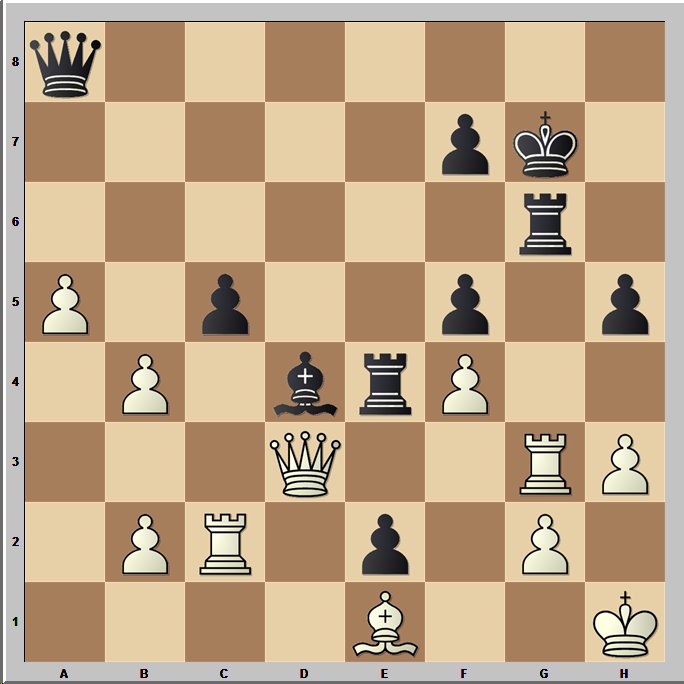
q7/5pk1/6r1/P1p2p1p/1P1brP2/3Q2RP/1PR1p1P1/4B2K b – – 0 1
Black to move. How should Black proceed?

Chess Daily News from Susan Polgar

q7/5pk1/6r1/P1p2p1p/1P1brP2/3Q2RP/1PR1p1P1/4B2K b – – 0 1
Black to move. How should Black proceed?
1…Re3 2.Qxe3
(2.Rxe3 Qxg2#)
2…Bxe3 3.Rxg6+
(3.Rxe3 Qxg2#)
(3.Rxe2 Rxg3 4.Bxg3 Bd4)
3…Kxg6 4.Rxe2 Bxf4 5.Kg1 cxb4 6.Bxb4 Qa7+ 7.Kf1 Bh2 8.Rf2 Qa6+ 9.Re2
Several “good idea” moves here bring nothing just because of the answer Rxg6+ Kxg6 Qg3+ etc. Also Rxg3 Qxg3 is stupid, so what to do with the rooks?
I think it has to be:
1. … Re3!!
splitting the white pieces.
2. Rxg6+ Kxg6
3. Qd2 Rxh3#
or
2. Qd2 Rgxg3 (not Rexg3)
Q+2R against g2.
3. Bxg3 e1=Q+
is up with queen.
Re6 opening the diagonal a8-h1 diagonal followed by threat on Rxa3
1. … Re3!
White must give the queen in order not to be mated:
2. Rxe3 Qg2#
2. Rxg6+ fxg6
3. Qd2 Rxh3#
2. Qd2 R6xg3
3. Bxg3 Rxg3 and the mate treats Qxg2# and Rxh3# cannot both be met.
2. Qxe3 Bxe3
3. Rxg6+ fxg6 and although the white queenside-pawns are strong Black should win:
A
4. Rxe2 Qa6
5. Rxe3 Qf1+
6. Kh3 Qxf4+
7. Rg3 h4 -+
B
4. bxc5 Qa6
5. c6 Qd3
6. Rc3 Qd1 -+
Black’s winning move: Re3 !
Simply has to start with Re3 to clear the long diagonal to g2 for the black queen:
1. …..Re3
2. Rg6
Of course, 2.Re3 loses to Qg2#, and 2.Qe3 will lose too much material to hold as we will see below. Continuing:
2. …..Kg6
3. Qe3
Black was threatening Rxh3# since the g2 pawn is pinned to the king. Continuing:
3. …..Be3
4. Re2 Bf4
5. b5 Qb7
6. b6 Qa6
7. Rf2 Bg3
Or, alternatively at move 6, white might try 6.Bc3:
6. Bc3 Qb5
7. Re1 Bg3
8. Rg1 Qe2
And white is almost in a sort of zugzwang at this point, and clearly lost.
1…Re3 is the killing move
If 2.Rxe3 Qxg2#
If 2.Rxg6+ fxg6 and, if 3.Qd2 Rxh3#
We can see here that g3 was not the only weak square. In fact, all white king’s shield is ill.
what if Black plays Re3, opening up the long diagonal for the Black queen (and pin the g2 pawn).
I can’t see white being able to defend the two possible mating patterns (Qxg2# or Rxh3#) without having to lose the white queen for a lesser piece.
Re3 Rxg6+. fxg Qe2. Rxh3# looks unstoppable
Re3
I’m surprised that no-one has listed what to me is an obvious, not difficult and best response to 1. Re6 namely … Q*f5. This does not show a clear win for black. It may run e.g.
1. Re6 Q*f5
2. Rg*g3 B*g 3
and now neither the immediate retake at R*g3 (not as good?) or 3. e8 =Q) B*e1 4. R*e1+ do not provide significant advantage. e.g. 4. Kh3 Bg1+ 5. Kh1 Be3+ is a likely draw by repetition.
psyche.
psyche (I will assume you meant Re3 in place of Re6). You are right, Qf5 is a more interesting defense, but still losing I think:
1. …..Re3
2. Qf5 Reg3!
3. Bg3 e1(Q)
4. Be1 Qa6!
5. Rf2
I see no adequate defense to the threat of Qf1+ and Qg1#. I can even see that black probably does even better at move 3 with a move like Qe8 which allows Qe3 with the same threats with Qg1 ultimately. Continuing:
5. …..Bf2
6. Qe5 Kh7!
7. Qh5 Kg8!
In this line, these last two king moves are the only way to prevent a three-fold repetition draw. Now, white is toast. He will have to take the rook at g6 just to prevent the mate.
You’re right Yancey on two accounts.
I was writing the note in my head and being someone who has grown up with and still prefers Descriptive to Algebraic notation I momentarily erred.
And more importantly, I had assumed that both rooks would go and almost wrote either ‘2. …Re*g3 or Rg*g3″. The one draws and the other (as you point out) wins because that g fie blocks the king’s outlet. And, indeed, that move 3. … Qe8 is both elegant and very succesful too.
The lesson, look at both options even if they look the same.
I have great admiration for your analyses Yancey and still regard your analysis of 3 May 2012, “Endgame improvement” as the best I’ve seen on this columnn.
Psyche