Unless I am missing something more forcing, black should be able to make hay with a move like h5 or f5. The white knight is very weak, and has no safe squares if a pawn can reach f4 or h4 attacking it. If it goes to h1, black can attack g2 with the rook, or even play Ng4 to drive the white king away from protecting it.. However, there are a lot of different lines here, and I am not really sure what white’s best defense might be. Let’s take a look at some of the variations:
1. …..h5 2. h4
To prevent h4, but black now pushes the other pawn:
2. …..f5
I don’t know if it makes any difference which pawn black pushes first. I mostly just chose h5 first since I might want to put the king at h6 without blocking this pawn. Continuing:
3. Rc7 Kh6 4. Rc6
I find nothing else here. If white tries Rf7 to hold up the f-pawn, black can play Ng4+ followed by Re3 pinning the knight, and then play Ne5 and Kg7 to drive the white rook off of the f-file: [4.Rf7 Ng4 5.Kh3 Re3 6.c4 Ne5 7.Rf6/f8 Kg7 should win]. If white tries pushing the c-pawn, black just proceeds with the f-pawn push: [4.c4 f4 5.Kh3 (or 5.Nh1? Ng4 6.Kh3 Rh1#) 5. …fg3-+]. Continuing:
4. …..f4 5. Kh3
Or, 5.Ra6 Ng4 6.Kh3 Re3! will mate. Continuing:
5. …..fg3 6. Kg3 Re2 and black should win, though he/she will have to play carefully to do so.
I get the feeling I am missing something clearer here.
One try at a win is 3 …Re3. The threat is 4…. Nf2+ 5. Kh2, Rxg3 6. Kxg3 Ne4+ winning the rook and the game. However, after 3… Re3 4. Rc7, it’s hard to see a win. White is a pawn up, and could win.
3. … f5 (threat is … f4 and … Rh1#)
4. Rc4 Re3 (close to a zugzwang) 5. Rb4 Rc3 6. Rd4 Rxc2
now the threat is 7… Rf2 and 8… f4 also, … Ne3 threatening the g2 pawn. 0-1
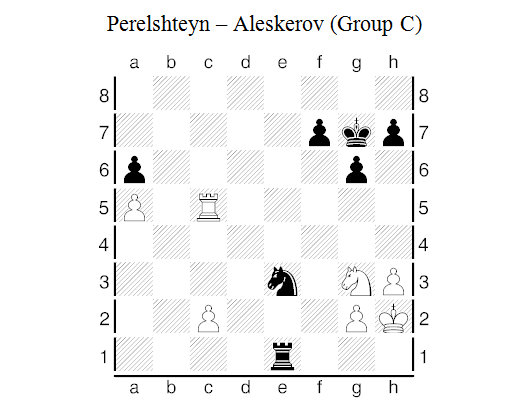


Unless I am missing something more forcing, black should be able to make hay with a move like h5 or f5. The white knight is very weak, and has no safe squares if a pawn can reach f4 or h4 attacking it. If it goes to h1, black can attack g2 with the rook, or even play Ng4 to drive the white king away from protecting it.. However, there are a lot of different lines here, and I am not really sure what white’s best defense might be. Let’s take a look at some of the variations:
1. …..h5
2. h4
To prevent h4, but black now pushes the other pawn:
2. …..f5
I don’t know if it makes any difference which pawn black pushes first. I mostly just chose h5 first since I might want to put the king at h6 without blocking this pawn. Continuing:
3. Rc7 Kh6
4. Rc6
I find nothing else here. If white tries Rf7 to hold up the f-pawn, black can play Ng4+ followed by Re3 pinning the knight, and then play Ne5 and Kg7 to drive the white rook off of the f-file: [4.Rf7 Ng4 5.Kh3 Re3 6.c4 Ne5 7.Rf6/f8 Kg7 should win]. If white tries pushing the c-pawn, black just proceeds with the f-pawn push: [4.c4 f4 5.Kh3 (or 5.Nh1? Ng4 6.Kh3 Rh1#) 5. …fg3-+]. Continuing:
4. …..f4
5. Kh3
Or, 5.Ra6 Ng4 6.Kh3 Re3! will mate. Continuing:
5. …..fg3
6. Kg3 Re2 and black should win, though he/she will have to play carefully to do so.
I get the feeling I am missing something clearer here.
1…h5 with the idea of h4 seems to be a serious threat winning the knight. White can’t play
2. h4 Ng4+ 3. Kh3 Nf2+ 4. Kh2 Rh1#
1…f5 (threatening 2..f4) looks crushing
well, it looks like the white knight is in trouble…
1. …. h5
1… h5
2. h4 Ng4+
3. Kh3
now, black can get a perpetual with …Nf2+.
One try at a win is 3 …Re3. The threat is 4…. Nf2+ 5. Kh2, Rxg3 6. Kxg3 Ne4+ winning the rook and the game. However, after 3… Re3 4. Rc7, it’s hard to see a win. White is a pawn up, and could win.
3. … f5 (threat is … f4 and … Rh1#)
4. Rc4 Re3 (close to a zugzwang)
5. Rb4 Rc3
6. Rd4 Rxc2
now the threat is 7… Rf2 and 8… f4
also, … Ne3 threatening the g2 pawn.
0-1
1…Rc1 wins the c pawn.
h5
Interesting and important information. It is really beneficial for us. Thanks
Nice.
1. f5!
Will win the knigt, since black can’t prevent f4, and he also can’t find/create a place to put the knight.
Ne4 Nf1+ also looses the knight.
Re5? Nf1+ looses rook.
Nh1?? Nf1 mate.
1. … Nxf5
2. gxf5
and black is out of ideas, i suppose.
There must be a way to trap that white knight.
1. …, f5,
2. Rc6, f4(Rc7+ doesn’t add much)
3. Rxa6 (the Knight does not have any place to go and Nh1 exposes the g2 square), fxg3
4. Kxg3, Nxc2
From here I am lost as it is still a tricky position for Black particularly the threat of the now cleared pawn on the a file
1… Ra1
Ra1
White’s sequence of Nd1, Nf2 with
a mate threat by Rh1 forces black to give up the knight.
Hi Susan Polgar,
Well,others had already,almost discussed the possible line of approach for this chess puzzle.
To me,Black wins the game[Variations exist]
Example
=======
1… Nd1
2.Nh1 h5
3.Rc6 h4
4.R*a6 Ne3
5.Nf2 Nf1+
6.Kg1 Ng3+
7.Kh2 Rf1
8.Ra8 R*Nf2
9.Kg1 Rf1+
10.Kh2 Rh1++ Mate
Black wins the game [ Variation exist,even if White goes for h4,Black can win the game. ]
By
Venky [ India – Chennai ]