
By Chess Coach William Stewart (FIDE 2234, USCF 2256)
Will’s original article on chess prodigies available here.
Why are some kids so good at chess? How do some chess prodigies that are barely 8,7 or even 6 years old manage to play chess at a master level with little formal chess coaching? How have they managed to accelerate their intellectual development in this specific field at such an exceptional rate? How can we learn from these prodigies and their secrets that we can use to teach better chess to all children? It is difficult to determine exactly which cultural, biological, and/or environmental factor plays the greatest role in this phenomenon.
Samuel Reshevsky, Bobby Fischer & More …

- 8 yr-old Reshevsky dominates simul
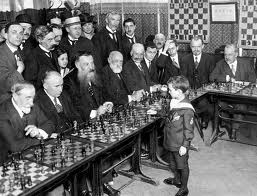
In the early 20th century, Samuel Reshevsky began dominating simultaneous exhibitions against experienced masters before he turned 10. In 1958, Bobby Fischer won the US Championship when he was only 14. Yet these achievements have been overshadowed by the increasing number of child prodigies who are becoming the dominant force in the changing face of modern chess. The term chess prodigy traditionally referred to a young master who was competing on equal footing with experienced professionals, however in the 21st century a true prodigy must be a junior that is capable of competing for the World Championship in the near future.
Natural Intelligence or Cultural/Environmental Factors (A look at the Polgar sisters)
- Early Polgar Family Photo

Human’s haven’t evolved too much in the last 100 years so we must look to cultural and environmental factors to explain this type of elite specialization. Well before having children, Laszlo Polgar wrote Bring Up Genius! where he explained “Genius equals work and fortunate circumstances” and “Geniuses are made, not born”. Laszlo went on to prove his theory by raising three exceptional female chess players – Susan Polgar achieved the GM title at 21, Judit Polgar at 15, and sister Sofia is a strong IM. While Laszlo certainly maintains an above-average IQ, biological predisposition alone cannot explain these results. The Polgar sisters developed their impressive chess skills in a favorable environment conducive to very diligent, hard work.
Lots of Tutoring or Naturally Gifted? – The 10,000 Hour Rule
The article Developing Young Chess Masters: What are the Best Moves? by Kiewra & O’Connor presents a detailed study confirming hard work and a positive environment are necessary requisites to create genius in chess. Referring to young chess masters, they state “These youngsters, on average, practiced chess about 20 hours per week for eight years before attaining master status. Even if they were born with incredible gifts, it still required about 8,000 practice hours to realize those gifts.” That doesn’t quite meet the criteria for Malcolm Gladwell’s “10,000 Hour Rule”, however this estimate certainly comes close. Practice alone is not enough, it must occur in a favorable environment to achieve optimal results. The article also discusses the financial investment parents make “Most spend about $5,000 – $10,000 annually on lessons, tournament registrations, travel, and materials.” While it is not 100% mandatory for success, nearly all rising chess masters had been working with titled players for multiple years prior to exemplary achievement.
Effect of Technology on Chess Prodigies
While improvements in genius creation techniques have raised the global Prodigy Per Capita (PPC?!) rate and parents have become more financially and emotionally supportive of their rising stars, there is one more significant factor in this equation – technology. Google Translate wasn’t available in the 50s and 60s, so Fischer taught himself how to read Russian so that he could study recently published games and annotations in Russian chess magazines. Not only does Chessbase 11 with the Mega Update maintain a database of nearly 5 million games, you can use 4 different and highly powerful chess engines (simultaneously!) to analyze technical perfection. The invention of the internet and relevant technologies have made information sharing immediate, and the development of young chess players has been exponentially impacted.
No Substitute For Hard Work
There are a plethora of contributing factors to the development of chess genius at a comparatively young age – and that “young age” is decreasing daily. Biological predisposition and technology have definitely accelerated the learning curve, however an intensively favorable environment yields the most effective results. The true secret to success is theoretically simple yet operationally difficult: Long Hours of Hard Work.

For the Original Article on Chess Prodigies please visit William’s Website
There are two kinds of people who make it in this world.
People who are talented and work hard.
and people who work hard.
Thats a simple truth.
…also people who inherit it from daddy or have friends in high places.