A very tricky position. There are some obvious tries that don’t work, but it is sometimes hard to spot the reason they don’t.
1. Rxf6? would be good for White only if Black played 1. … Bxf6? 2. Qh7+ Kf8 3. Qxf7#, but 1. … exf6! is the refutation.
1. Bxd6? is refuted simply by 1. … Qxd6+ (but not by 1. … exd6?, which although it leads to some interesting play, is not the correct move).
1. e5? is interesting. The best reply is 1. … Nh5+, which leads to a really neat struggle. Another reply is 1. … dxe5, after which White is also lost, but Black has to be careful after 2. Rxf6 and must play 2. … Qxf6! [2. … Bxf6? 3. Qh7+ Kf8 4. Qxf7#] [2. … exf6 3. Qh7#]
The only other try for a win by White should be clear at this point, but I won’t spoil things by pointing that out here, and I am still struggling with the variations.
I guess I would like to get rid of black’s knight so the queen can penetrate to h7, but with the bishop at g7, this is often useless, and appears so here, too:
1. Rf6? ef6 (Bf6? 2.Qh7 Kf8 3.Qf7#) 2. Qh7 Kf8 3. Ne6 fe6 4. Qg6 Qd8 and now, 5.Bd6+ is worthless since black’s king just plays to g8 safely. I don’t really see anything in this line for white.
I have to say, I don’t immediately see this. Nice puzzle!
Now I think I see it. Be8 double attacking f7- the bishop is immune since Nxe8 allows Qh7+ followed by Rxf7#. and the other bishop is immune since Ra3 allows Bf7+:
1. Be8 Ra3 2. Bf7 Kf8 3. Qh7!
The queen is immune since the exchange of the knight for the queen is mate. White has multiple threats like Ne6, Bg6, and Rf6. Black needs escape holes for his king, and all I see other than delaying moves is moving the e-pawn:
3. …..e5 (e6 no different) 4. Bg6
I am pretty sure 4.Rf6 wins, too, since black’s Rc3 is adequately met by Kh2. With 4.Bg6, white is still threatening Rf6 or Ne6. All black really has is to try to escape the mate by moving the king:
4. …..Ke7 (Qb8 5.Ne6 Ke7 6.Qg7#) 5. Qg7 and white is going to be up at least 2 pieces even if there is no quick mate here.
Did black have anything better at move 1? If he does, I don’t really see it. About the best I can see is to try to clog up the h-file with the knight:
1. Be8 Nh5 2. Kg4
An only move since Kh2 is mate after Qg1. Continuing:
2. …..f5
Here, Nf6 is met by Rf6 with a white win: [2. …Nf6 3.Rf6 ef6 4.Bf7 Kf8 5.Qh7 with what looks like an unstoppable mate starting with 6.Qg8+]. Continuing:
3. Rf5
Here, 3.ef5 allows black to escape with a perpetual with Nf6+ and white will have to accept the draw or get himself mated. Continuing:
3. …..gf5
I don’t see anything much better. Black could try Rg1 or Qg1, but white just proceeds with Bf7: [3. …Rg1 4.Bf7 Kh8 (or 4. …Kf8 5.Nh7#) 5.Bg6 and white will just capture at h5 with the king on Rg2+]. Continuing:
4. Kh5 and is there any defense at all for black here? White is threatening Bf7 combined with Kg6 and Nh7#.
After rejecting the 3 tries that I mentioned in my previous post, I became convinced that the correct first move is:
1. Be8!
This threatens Bxe7+, opens up the f-file, opens up a hole on e6 for a knight check. If Black does nothing useful on his first move, the following will happen to him:
1. … a5 2. Bf7+ Kf8 3. Qh7 [threat: 4. Qg8+ Nxg8 5. Ne6#] 3. … e5 [3. … Nxh7 4. Ne6#] 4. Bxg6 [threats: 5. Ne6+ Ke7 6. Qxg7# and 5. Rxf6+ Ke7 6. Qxg7+ Kd8 7. Rf8# ] and Black’s goose is just about cooked:
4. … Ke7 5. Qxg7+ Kd8 7. Kh4 Qe1+ 8. Kh5 Qe2+ 9. Nf3 and Black has run out of counterplay.
So Black must fight back on his first move. He has these tries:
1. … Nxe8? 1. … Rxa3? 1. … Nh5+
1. … Nxe8? 2. Qh7+ Kf8 3. Rxf7#
1. Rxa3? is similar to 1. … a5 given above. It accomplishes nothing useful here.
I arrived too late but I post my analysis of the position (I had not seen the other comments). White has a piece of advantage, but black can exploit the exposed position of White King. example 1… Nh5+ 2. Kg4 Ra2 3. g3 f5+ 4. Rxf5 Qe3 and Black advantage.
White must play vigorously to win. The first idea: 1. Rxf6? is good only If Black responds with 1… Bxf6
example 1. Rxf6? Bxf6?? 2. Qh7+ Kf8 3. Qxf7# But it does not work if White plays 1… exf6
example 1. Rxf6? exf6 2. Qh7+ Kf8 3. Ne6+ fxe6 4. Qxg6 Qd8 5. dxe6 Qe7 And I think black wins.
An interesting move for white is 1. Be8
example 1. Be8!! Rxa3? 2. Bxf7+ Kf8 3. Qh7 (with the threatening 4. Qg8+ Nxg8 5. Ne6#)
So (after 1. Be8) Black can not play 1…Nh5+
example 1. Be8 Nh5+ 2. Kg4 Rxa3 3. Bxf7+ Kh8 4. Bxg6 Bh6 5. Qxh5 black wins. 0r
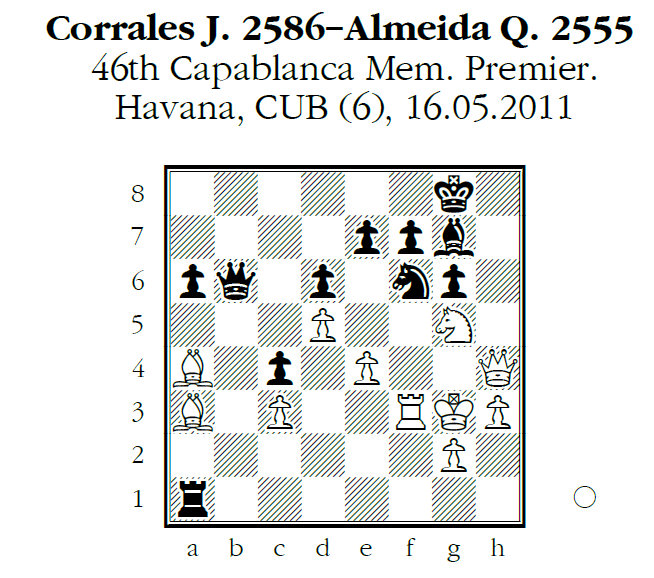


Be8!
I’d play R#f6 without even thinking about it.
1. e5 dxe5
2. Rxf6 Bxf6 (exf6 3. Qh7++)
3. Qh7+ Kf8
4. Qxf7++
Must be something I am missing out … late Saturday night is not the best time to solve chess puzzles.
Hi Susan Polgar,
Nice puzzle – White wins the game,variation exist but still White wins the game.
Example One
===========
1.Be8 Nh5+
2.Kg4 Nf6+
3.R*Nf6 e*Rf6
4.Qh7+ Kf8
5.Bf7 f*Ng5
6.Qg8+ Ke7
7.Qe8+ Kf6
8.Qe6++ Mate.
Example Two
=============
1.Be8 Qb8
2.Bf7+ Kf8
3.B*g6 Qb1
4.Nh7+ Kg8
5.N*Nf6+ B*Nf6
6.Qh7+ Kf8
7.Qf7++ Mate
By
Venky [ India – Chennai ]
A very tricky position. There are some obvious tries that don’t work, but it is sometimes hard to spot the reason they don’t.
1. Rxf6? would be good for White only if Black played 1. … Bxf6? 2. Qh7+ Kf8 3. Qxf7#, but 1. … exf6! is the refutation.
1. Bxd6? is refuted simply by 1. … Qxd6+ (but not by 1. … exd6?, which although it leads to some interesting play, is not the correct move).
1. e5? is interesting. The best reply is 1. … Nh5+, which leads to a really neat struggle. Another reply is 1. … dxe5, after which White is also lost, but Black has to be careful after 2. Rxf6 and must play 2. … Qxf6! [2. … Bxf6? 3. Qh7+ Kf8 4. Qxf7#] [2. … exf6 3. Qh7#]
The only other try for a win by White should be clear at this point, but I won’t spoil things by pointing that out here, and I am still struggling with the variations.
I guess I would like to get rid of black’s knight so the queen can penetrate to h7, but with the bishop at g7, this is often useless, and appears so here, too:
1. Rf6? ef6 (Bf6? 2.Qh7 Kf8 3.Qf7#)
2. Qh7 Kf8
3. Ne6 fe6
4. Qg6 Qd8 and now, 5.Bd6+ is worthless since black’s king just plays to g8 safely. I don’t really see anything in this line for white.
I have to say, I don’t immediately see this. Nice puzzle!
1. Be8 R:a3
2. B:f7+ Kf8
3. Qh7 N:h7
4. Ne6++
Now I think I see it. Be8 double attacking f7- the bishop is immune since Nxe8 allows Qh7+ followed by Rxf7#. and the other bishop is immune since Ra3 allows Bf7+:
1. Be8 Ra3
2. Bf7 Kf8
3. Qh7!
The queen is immune since the exchange of the knight for the queen is mate. White has multiple threats like Ne6, Bg6, and Rf6. Black needs escape holes for his king, and all I see other than delaying moves is moving the e-pawn:
3. …..e5 (e6 no different)
4. Bg6
I am pretty sure 4.Rf6 wins, too, since black’s Rc3 is adequately met by Kh2. With 4.Bg6, white is still threatening Rf6 or Ne6. All black really has is to try to escape the mate by moving the king:
4. …..Ke7 (Qb8 5.Ne6 Ke7 6.Qg7#)
5. Qg7 and white is going to be up at least 2 pieces even if there is no quick mate here.
Did black have anything better at move 1? If he does, I don’t really see it. About the best I can see is to try to clog up the h-file with the knight:
1. Be8 Nh5
2. Kg4
An only move since Kh2 is mate after Qg1. Continuing:
2. …..f5
Here, Nf6 is met by Rf6 with a white win: [2. …Nf6 3.Rf6 ef6 4.Bf7 Kf8 5.Qh7 with what looks like an unstoppable mate starting with 6.Qg8+]. Continuing:
3. Rf5
Here, 3.ef5 allows black to escape with a perpetual with Nf6+ and white will have to accept the draw or get himself mated. Continuing:
3. …..gf5
I don’t see anything much better. Black could try Rg1 or Qg1, but white just proceeds with Bf7: [3. …Rg1 4.Bf7 Kh8 (or 4. …Kf8 5.Nh7#) 5.Bg6 and white will just capture at h5 with the king on Rg2+]. Continuing:
4. Kh5 and is there any defense at all for black here? White is threatening Bf7 combined with Kg6 and Nh7#.
yancey is a chess god
After rejecting the 3 tries that I mentioned in my previous post, I became convinced that the correct first move is:
1. Be8!
This threatens Bxe7+, opens up the f-file, opens up a hole on e6 for a knight check. If Black does nothing useful on his first move, the following will happen to him:
1. … a5
2. Bf7+ Kf8
3. Qh7 [threat: 4. Qg8+ Nxg8 5. Ne6#]
3. … e5 [3. … Nxh7 4. Ne6#]
4. Bxg6 [threats: 5. Ne6+ Ke7 6. Qxg7# and 5. Rxf6+ Ke7 6. Qxg7+ Kd8 7. Rf8# ]
and Black’s goose is just about cooked:
4. … Ke7
5. Qxg7+ Kd8
7. Kh4 Qe1+
8. Kh5 Qe2+
9. Nf3 and Black has run out of counterplay.
So Black must fight back on his first move. He has these tries:
1. … Nxe8?
1. … Rxa3?
1. … Nh5+
1. … Nxe8? 2. Qh7+ Kf8 3. Rxf7#
1. Rxa3? is similar to 1. … a5 given above. It accomplishes nothing
useful here.
1. … Nh5+ is the only valiant try:
1. … Nh5+
2. Kg4 [and White is threatening 3. Bxf7+ Kh8 (3. … Kf8 4. Ne6#) 4. Bxg6 Bh6 (4. … Kg8 5. Bf7+ Kh8 6.Qxh5+ Bh6 7. Qxh6# ) 5. Qxh5 Kg7 6. Ne6+ Kg8 7. Qxh6 any 8. Bf7#] [2. Kh2?? Qg1#]
2. … f5+ [A fighting try. No better is 2. … f6 3. Bf7+ Kh8 4. Bxg6 etc, or 2. … e6 3. Bxf7+ Kh8 4. Bxg6 Bh6 5. Qxh5 Kg7 6. Nxe6+ Kg8 7. Qxh6 etc]
3. Rxf5! Qe3 [3. … gxf5+ 4. Kxh5 with White king threatening to come to g6]
4. Bf7+ Kh8 [4. … Kf8? 5. Ne6#]
5. Rf3 [and everything is in control defending the White king, Black being helpless to stop Bg6]
for instance:
5. … Qe2
6. Bxg6 Qxg2+
7. Kf5 Bh6
8. Qxh5 Qxg5+
9. Qxg5 Bxg5
10. Kxg5 winning.
There may be some improvements (for both sides), but 1. Be8 is the way to go.
I arrived too late but I post my analysis of the position (I had not seen the other comments).
White has a piece of advantage, but black can exploit the exposed position of White King.
example
1… Nh5+ 2. Kg4 Ra2 3. g3 f5+ 4. Rxf5 Qe3 and Black advantage.
White must play vigorously to win.
The first idea: 1. Rxf6? is good only If Black responds with 1… Bxf6
example
1. Rxf6? Bxf6??
2. Qh7+ Kf8
3. Qxf7#
But it does not work if White plays 1… exf6
example
1. Rxf6? exf6
2. Qh7+ Kf8
3. Ne6+ fxe6
4. Qxg6 Qd8
5. dxe6 Qe7 And I think black wins.
An interesting move for white is 1. Be8
example
1. Be8!! Rxa3?
2. Bxf7+ Kf8
3. Qh7
(with the threatening
4. Qg8+ Nxg8
5. Ne6#)
So (after 1. Be8) Black can not play 1…Nh5+
example
1. Be8 Nh5+
2. Kg4 Rxa3
3. Bxf7+ Kh8
4. Bxg6 Bh6
5. Qxh5 black wins.
0r
1. Be8 Nh5+
2. Kg4 f5+
3. Rxf5 gxf5+
4. Kxh5 Rxa3
5. Bf7+ Kf8
6. Kg6 and 7. Ne6#
The rest is not a “tree of analysis” but a forest. 🙂
Best regards
Stef
Yes, Yancey Ward analyzes the positions very well.
🙂
Best regards
Stef
1. Be8 Qg1 ( .. Rxa3 is meaningless here) 2. Bxf7+ Kf8 3. Qh7 doesn’t work after 3 .. Qe1+ :
4. Kh2 Qh1 repeats
4. Kf4 Nxh7 wins for black
4. Rf2 Qxf2+ (4 .. Qe3+ might be even better) 5. Kxf2 Nxh7
So what instead of 3. Qh7?