

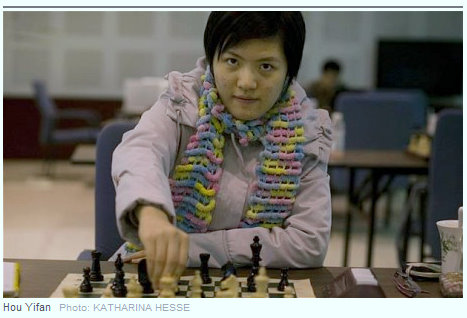
World’s youngest ever women’s chess champion: ‘I’m just a normal teenager’
Hou Yifan, the 16-year-old chess prodigy, tells Peter Foster about training, travelling – and Oliver Twist.
By Peter Foster
Beijing 9:00PM GMT 29 Jan 2011
There is nothing in the slightest bit ordinary about the achievements of Hou Yifan, the Chinese chess prodigy who stunned the world just before Christmas by becoming the youngest ever women’s world chess champion at the age of just 16.
And yet, in appearance at least, it is a quintessentially ordinary Chinese teenager that shuffles in through the door at the Chinese Chess Association in Beijing, feet clad in Nike trainers, colourful scarf draped around her neck and a trendy purple beret holding back neatly bobbed hair.
As her mother looks on, Miss Hou greets us with a bright but bashful smile and an easy-going “hiya” showing off the English language skills she’s picked up from her travels on the international chess circuit where she has been playing since the age of nine.
The story of Miss Hou’s ascent to the upper echelons of world chess is both the chronicle of single-minded ambition and the everyday tale of a Chinese only child born to hardworking parents who would sacrifice everything for their child’s achievements.
Miss Hou is both a genius – she became the youngest ever female chess grandmaster at the age of 14, earlier even than her hero Bobby Fischer – and a typical Chinese teenager who, like millions of nameless others, has worked almost unimaginably hard to make the most of her talents and opportunities.
But asked the sacrifices required for her daughter’s success, Miss Hou’s mother, a 42-year-old nurse, chooses to stress the ordinariness of her daughter’s start in the provincial city of Xinghua, 200 miles north of Shanghai where her father was an official in the local justice department.
“We weren’t rich, but we weren’t poor either,” says Wang Qian, “but you will have heard of China’s one-child policy, and like every other parent we were always thinking of ways of to improve our child’s development.
“There was no dream or great plan, but one day when Yifan was aged five a neighbour’s older child taught her how to play draughts (checkers). After only being taught once, Yifan was winning easily against the older child, so we decided to pick on board-games to broaden her thinking.
“We took her to a local games club but she always showed fascination in the Western pieces, the horses and the castles,” adds Mrs Wang, “so we decided that chess was the one for her. But back then it was only about broadening her mind, and helping her education, we never dreamed we would come so far.”
By the age of seven, aided by the extra night shifts worked by her mother to free up time to guide her daughter, Miss Hou had already outgrown her local chess club in Xinghua and the family moved north to Shandong province where a bigger club helped with coaching and living expenses.
At that age she attended a full day at school, came home to complete her homework and then at 5pm went to played chess, sometimes for five or six hours at a stretch, although Miss Hou herself says it never seemed that long.
“I had such an interest in the game, a passion you could say, that meant I never got bored with it. I never tried to get out of playing. I think that is what has helped me succeed, I always wanted to keep playing, to keep learning more,” she says.
She dismisses the suggestion that her mother was a “Tigermom” in the mould of Amy Chua, the Yale Law professor, whose unapologetic paeon to tough Chinese parenting, Why Chinese Mothers Are Superior caused such furore recently.
“My parents always gave me a choice about playing, but they said that if I wanted to play chess, then I should focus on it completely,” she says, adding that such attitudes and parental expectations are simply the norm for Chinese children. The difference is her success.
Full article here.
She’s a nice girl and a great player.
Normal? I wouldn’t bet on it. The chess knowledge inhabits parts of her brain where a normal personality is supposed to be living.