white queen to e1. black has no move but king to b2. then white queen takes the black night then the queen goes to a1. white pawn may proceed to be promoted freely without any opposition…
Now, because white must be careful to not stalemate black and bring his king forward, we have the white king walk down the b and c files until he can reach a3, with each move onto the b-file providing black a move to b1:
6. Kb6 Kb1 7. Kc5 Ka1 8. Kb4 Kb1 9. Ka3 and either the pawn falls or it is mate on the next move. And, if
There are a few variations in this second line, but I think white can counter all of them. The key is that the white king can now reach b4 and b3 with the white queen ready to deliver a check on the second rank in between. The key is to take b1 away from black at the right time.
This is a real toughie. I do not have the time or the ability to analyze it all, but I will get the ball rolling.
1. Qe1+ forces Kb2
But now 2. Q:e5+ Ka2 3. Q:a1+ leads to stalemate so that is not the right road. Similarly, 2. Q:a1+ K:a1 3. b7 Nc6 leads to a known draw, so it is necessary to leave the Queens on the board.
What about 2. Q:e5+ Ka2 3. Qe2+? It seems that black cannot play Qb2 here because 4. Q:b2+ K:b2 5. b7 a3 6. b8Q+ Ka1 (6…Ka2 7. Qb4 wins) 7. Qh8+ and white can eventually force either the above winning position or a position where his Q is at c1 and Black’s K is at a2 and must move to b3 allowing Qa1 winning.
So after 1. Qe1+ Kb2 2. Q:e5+ Ka2 3. Qe2+ black must play either Ka3, blocking his own pawn, or put his K on the b-file which again allows queening with check.
White also has the option of 1. Qe1+ Kb2 2. Q:e5+ Ka2 3. Qe2+ Ka3 4. Qd3+ Ka2 5. Qd2+ Ka3 6. b7 and Black doesn’t appear to have enough checks, with the threat of an eventual Qd6+ as an interposition.
I am sure I am missing some things, but this seems to be the most promising start to me.
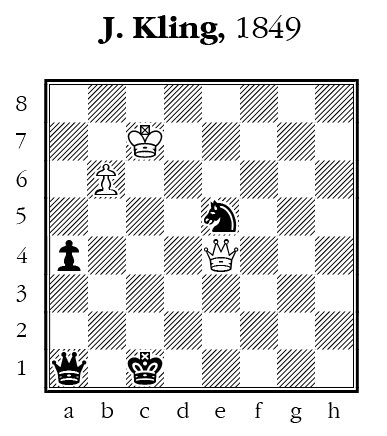


1 Qe1+ forces Kb2 (to hold the Q on a1)
2 Qxe5+ picks up the knight
white’s move Qe1..ultimately to capture the knight
white queen to e1. black has no move but king to b2. then white queen takes the black night then the queen goes to a1. white pawn may proceed to be promoted freely without any opposition…
qe1 and qxe5
The first moves seem obvious:
1. Qe1 Kb2
2. Qe5 Kb1
3. Qa1 Ka1
4. b7 a3
5. b8(Q)a2
Now, because white must be careful to not stalemate black and bring his king forward, we have the white king walk down the b and c files until he can reach a3, with each move onto the b-file providing black a move to b1:
6. Kb6 Kb1
7. Kc5 Ka1
8. Kb4 Kb1
9. Ka3 and either the pawn falls or it is mate on the next move. And, if
7. …..Kc1
8. Qa7 Kb1
9. Qb6 Kc1
10.Qa5 Kb1
11.Qb4 Kc1
12.Qa3 Kb1
13.Qb1 Ka1
14.Qd3 Kb2
15.Kb4 a1(Q)
16.Qd2 Kb1
17.Kb3 Kc1
18.Qc2#
There are a few variations in this second line, but I think white can counter all of them. The key is that the white king can now reach b4 and b3 with the white queen ready to deliver a check on the second rank in between. The key is to take b1 away from black at the right time.
Qh1+ followed by a trading of Queens, then white’s pawn promotion is unstoppable.
Sam
After exchanging pieces, White wins the pawn race, avoids a stalemate, and enters a known ending.
1. Qe1+ Kb2
2. Qxe5+ Ka2
3. Qxa1+ Kxa1
4. b7 a3
5. b8(Q) a2
6. Kb6 Kb1
7. Kc5+ etc.
One approach:
7. … Kc1
8. Qa8 Kb1
9. Qe4+ Kb2
10. Qd4+ Kb1
11. Qd1+ Kb2
12. Kb4 a1(Q)
13. Qd2+ Kb1
14. Kb3 and Black’s queen is powerless to stop the pending mate.
12. … a1(N)
13. Qd2+ Nc2+
14. Ka4 Kb1
15. Kb3 Na1+
16. Kc3 Nc2
17. Qxc2+ Ka1
18. Qb2#
Is this for real?
1. Qh1+ Kb2
2. Qxa1+ Kax1
3. b7
gets a Queen and wins easily…?
This is a real toughie. I do not have the time or the ability to analyze it all, but I will get the ball rolling.
1. Qe1+ forces Kb2
But now 2. Q:e5+ Ka2 3. Q:a1+ leads to stalemate so that is not the right road. Similarly, 2. Q:a1+ K:a1 3. b7 Nc6 leads to a known draw, so it is necessary to leave the Queens on the board.
What about 2. Q:e5+ Ka2 3. Qe2+? It seems that black cannot play Qb2 here because 4. Q:b2+ K:b2 5. b7 a3 6. b8Q+ Ka1 (6…Ka2 7. Qb4 wins) 7. Qh8+ and white can eventually force either the above winning position or a position where his Q is at c1 and Black’s K is at a2 and must move to b3 allowing Qa1 winning.
So after 1. Qe1+ Kb2 2. Q:e5+ Ka2 3. Qe2+ black must play either Ka3, blocking his own pawn, or put his K on the b-file which again allows queening with check.
White also has the option of 1. Qe1+ Kb2 2. Q:e5+ Ka2 3. Qe2+ Ka3 4. Qd3+ Ka2 5. Qd2+ Ka3 6. b7 and Black doesn’t appear to have enough checks, with the threat of an eventual Qd6+ as an interposition.
I am sure I am missing some things, but this seems to be the most promising start to me.