Standard policy is that moves which may depend on the game’s history (castling and e.p. captures) are legal, but that the 50-move counter is at zero. A FEN string (in this case, 7r/P2k4/8/8/8/8/p6p/R3K3 w Q – 0 1) would tell us explicitly, but that would be kind of a giveaway.
Castlings are legal if retroanalysis doesn’t prove they are impossible, in other words if retroanalysis does not conclude that king and/or rook need to have moved before.
But en passant captures are only legal if retroanalysis proves that the required pawn move of the opponent has just been made. AFAIK that are the regulations for chess problems.
Castling is allowed as long as the opposite can’t be proved. So retro analyses have to show that a special move was made (king or rook move), not that those moves were _not_ made (which is impossible to show).
For en passent we _also_ have to show that a special move (the double move of the pawn) was made, en passant is only allowed if you can show this by retro analysis.
So retro analysis always has to show that a move was made but never that a move was not made (in castling cases these moves are “negative”, in e.p. cases they give a positive result).
You should find it anywhere on the web, googling after ‘retro analysis en passant’ e.g. this German site (by an author that I know): http://members.chello.at/stummerer/problem.htm (second paragraph)
Best wishes Jochen (problem chess compositor in earlier days)
For en passent we _also_ have to show that a special move (the double move of the pawn) was made
“Was made”? Or “could have legally been made”? Thanks for the link, Jochen, but perhaps I’ve bluffed you into thinking that my German is better than it really is.
Let’s look at a real example from the not-too-distant past. On 2007.10.15 (yes, I freely admit that you Europeans write dates in far more sensible fashion than we USAns do) Susan gave us this Troitzky composition. (Interesting how the FEN string conspicuously omits the telltale “b6” token.)
Suppose you were given only the diagram, not the FEN string. Would you accept 1.cxb6 as a legal move for White?
“Suppose you were given only the diagram, not the FEN string. Would you accept 1.cxb6 as a legal move for White?” No, as you can not proove b7-b5 was the last move.
With “was made” I meant “was made” (or “has been made” – is this better english?), not “could be made”. Look at the castling again: A king move and/or rook move can always “could have legally been made” – so castling would never be allowed then. So you can’t look out for things that could have been, but sometimes you can proove that they _must_ have been (if a king move must have been, there is no castling, if the double step of the pawn must have been in the last move then there is en e.p. strike).
Here is one simple example (I just composed) in which the e.p. strike is possible: w: Kf5, Nf6, Ph7h6h5 b: Kh8, Pg5 white to move Only g7-g5 can have been the last move as all others give illegal positions – so white can capture e.p.
Put the king to e5 than white can’t e.p. – the last move could have been g6-g5 or g7-g5 and as you can’t proove the latter you mustn’t play hxg6 e.p.
For the german link: Googling finds others in english, but as my english isn’t as good as my German I googled for the german version. 🙂
“Convention for en passant captures Sometimes it’s simply not possible to deduce by retro analysis whether a potential en passant is legal or not. Rather than be up in the air as to what moves are legal in a position, a convention has been developed to remove any uncertainty at a stroke.
The default convention is that, in a given position, if you can’t deduce whether a potential en passant is legal or not, then it is not permitted. I.e., if uncertainly exists, you may assume that the last move was not the relevant double pawn move.”
I think that, on a composition, you cannot assume anything that has not been stated. So, in this case, castling right for white cannot be proved, so it cannot be used.
Other thing is when castling is a defensive resource for black. Then, in this case, retroanalysis is needed to prove that black can NOT castle.
The following codex was adopted in Rotterdam/portoroz Codex [1991/1997):
(1) Castling is deemed to be permissible unless it can be proved that it is not permissible. An en-passant capture is permissible on the first move only if it can be proved that the last move was the double-step of the pawn to be captured [20].
(2) In case of mutual dependency of castling rights of each party, the party exercising this right first is entitled to do so. Other conventions (which also affect other rights to move) should be expressly stipulated, for example:
(a) If an en-passant capture in the course of the solution has to be legalized by a subsequent castling (for example AP).
—— The point of this convention is that, since you can never prove by retroanalysis that castling is legal, it would remove a great deal of interest from retroanalysis if you adopted any other convention
“In case of mutual dependency of castling rights of each party
Okay, I’m dumb. Can someone present a simple illustration of this possibility?”
The trouble is there aren’t “simple” illustrations of this possibilty. The idea is simple: white can only castle on the assumption that black has already moved either rook or king, so that white by castling “proves” black can’t. Obviously you need fairly hairraising positions to satisfy that condition, but a number of composers of retroanalytic problem did construct such problems.
The most straightforward source I know for discussing this is Tim Krabbe’s book *Chess Curiosities”.
Jochen, my guess is that the ranking goes about like this:
— your German and my English, roughly comparable;
(small gap)
— your English;
(very large gap)
— my German (two years at university level but minimal recent practice other than when German tourists come to visit New York in the summer; I do enjoy practicing my German and am grateful for your patience when I try)
I’m continually grateful to non-native English speakers who make the effort to communicate in my native tongue. You guys need never apologize to any USAn for your English.
A simple example of “mutual dependency of castling rights” would be provided by the following:
White, Ra1 Ke1,
Black: Rh8, Ke8, Pawns, a6, b7, c7, d7
(White to move).
Black’s last move was either 1) a7-a6, or 2) the capture of a white piece by either his rook or king. – imagine here a white bishop has just captured a black bishop on h8.
In case (1) White must on his last move have moved either his rook or king, so cannot now castle.
In case (2) Black clearly cannot castle.
By castling, White “proves” that case (2) obtains, depriving Black of the right to castle.
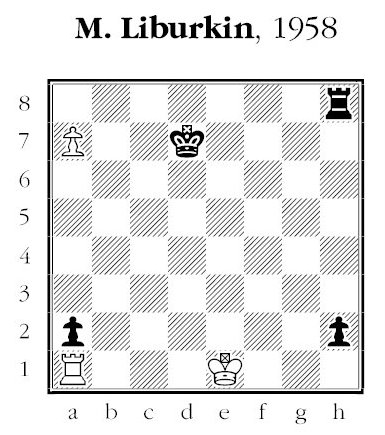


Without probing any deeper, 0-0-0+ is bound to be the key move.
How do you know if the king or rook has moved ie that castling is legal? Are you to assume it?
Standard policy is that moves which may depend on the game’s history (castling and e.p. captures) are legal, but that the 50-move counter is at zero. A FEN string (in this case, 7r/P2k4/8/8/8/8/p6p/R3K3 w Q – 0 1) would tell us explicitly, but that would be kind of a giveaway.
Kf2
Castlings are legal if retroanalysis doesn’t prove they are impossible, in other words if retroanalysis does not conclude that king and/or rook need to have moved before.
But en passant captures are only legal if retroanalysis proves that the required pawn move of the opponent has just been made. AFAIK that are the regulations for chess problems.
It looks like 1.O-O-O+ is indeed the solution.
But en passant captures are only legal if retroanalysis proves that the required pawn move of the opponent has just been made.
Got a cite for that? My understanding is otherwise. No, I don’t have a cite on which to base that opinion.
Anonymous said…
How do you know if the king or rook has moved ie that castling is legal? Are you to assume it?
Sunday, August 24, 2008 12:51:00 PM CDT
We weren’t told if any of the rook or king moved, so…it is fair to assume 0-0-0 is possible.
Ano 4:06 is right.
Castling is allowed as long as the opposite can’t be proved.
So retro analyses have to show that a special move was made (king or rook move), not that those moves were _not_ made (which is impossible to show).
For en passent we _also_ have to show that a special move (the double move of the pawn) was made, en passant is only allowed if you can show this by retro analysis.
So retro analysis always has to show that a move was made but never that a move was not made (in castling cases these moves are “negative”, in e.p. cases they give a positive result).
You should find it anywhere on the web, googling after ‘retro analysis en passant’ e.g. this German site (by an author that I know): http://members.chello.at/stummerer/problem.htm (second paragraph)
Best wishes
Jochen (problem chess compositor in earlier days)
For en passent we _also_ have to show that a special move (the double move of the pawn) was made
“Was made”? Or “could have legally been made”? Thanks for the link, Jochen, but perhaps I’ve bluffed you into thinking that my German is better than it really is.
Let’s look at a real example from the not-too-distant past. On 2007.10.15 (yes, I freely admit that you Europeans write dates in far more sensible fashion than we USAns do) Susan gave us this Troitzky composition. (Interesting how the FEN string conspicuously omits the telltale “b6” token.)
Suppose you were given only the diagram, not the FEN string. Would you accept 1.cxb6 as a legal move for White?
(Maybe this link to the Troitzky puzzle is more convenient.)
“Suppose you were given only the diagram, not the FEN string. Would you accept 1.cxb6 as a legal move for White?”
No, as you can not proove b7-b5 was the last move.
With “was made” I meant “was made” (or “has been made” – is this better english?), not “could be made”.
Look at the castling again: A king move and/or rook move can always “could have legally been made” – so castling would never be allowed then.
So you can’t look out for things that could have been, but sometimes you can proove that they _must_ have been (if a king move must have been, there is no castling, if the double step of the pawn must have been in the last move then there is en e.p. strike).
Here is one simple example (I just composed) in which the e.p. strike is possible:
w: Kf5, Nf6, Ph7h6h5
b: Kh8, Pg5
white to move
Only g7-g5 can have been the last move as all others give illegal positions – so white can capture e.p.
Put the king to e5 than white can’t e.p. – the last move could have been g6-g5 or g7-g5 and as you can’t proove the latter you mustn’t play hxg6 e.p.
For the german link:
Googling finds others in english, but as my english isn’t as good as my German I googled for the german version. 🙂
First link googling for ‘retro analysis en passant’:
http://www.janko.at/Retros/Glossary/EnPassant.htm
“Convention for en passant captures
Sometimes it’s simply not possible to deduce by retro analysis whether a potential en passant is legal or not. Rather than be up in the air as to what moves are legal in a position, a convention has been developed to remove any uncertainty at a stroke.
The default convention is that, in a given position, if you can’t deduce whether a potential en passant is legal or not, then it is not permitted. I.e., if uncertainly exists, you may assume that the last move was not the relevant double pawn move.”
Best wishes
Jochen
I think Kf2 is ok, but the idea needs to be clarified:
Kf2 Ra8
Kg2 Ra7
Kh1! and then Ra2 next with the stalemate trick that wins the pawns a2 and h2.
What if:
1.Kf2 h1=Q
2. Rxh1 Rxh1
3. a8=Q a1=Q
?
I think that, on a composition, you cannot assume anything that has not been stated. So, in this case, castling right for white cannot be proved, so it cannot be used.
Other thing is when castling is a defensive resource for black. Then, in this case, retroanalysis is needed to prove that black can NOT castle.
The following codex was adopted in Rotterdam/portoroz Codex [1991/1997):
(1) Castling is deemed to be permissible unless it can be proved that it is not permissible. An en-passant capture is permissible on the first move only if it can be proved that the last move was the double-step of the pawn to be captured [20].
(2) In case of mutual dependency of castling rights of each party, the party exercising this right first is entitled to do so. Other conventions (which also affect other rights to move) should be expressly stipulated, for example:
(a) If an en-passant capture in the course of the solution has to be legalized by a subsequent castling (for example AP).
——
The point of this convention is that, since you can never prove by retroanalysis that castling is legal, it would remove a great deal of interest from retroanalysis if you adopted any other convention
In case of mutual dependency of castling rights of each party
Okay, I’m dumb. Can someone present a simple illustration of this possibility?
“In case of mutual dependency of castling rights of each party
Okay, I’m dumb. Can someone present a simple illustration of this possibility?”
The trouble is there aren’t “simple” illustrations of this possibilty. The idea is simple: white can only castle on the assumption that black has already moved either rook or king, so that white by castling “proves” black can’t. Obviously you need fairly hairraising positions to satisfy that condition, but a number of composers of retroanalytic problem did construct such problems.
The most straightforward source I know for discussing this is Tim Krabbe’s book *Chess Curiosities”.
my english isn’t as good as my German
Jochen, my guess is that the ranking goes about like this:
— your German and my English, roughly comparable;
(small gap)
— your English;
(very large gap)
— my German (two years at university level but minimal recent practice other than when German tourists come to visit New York in the summer; I do enjoy practicing my German and am grateful for your patience when I try)
I’m continually grateful to non-native English speakers who make the effort to communicate in my native tongue. You guys need never apologize to any USAn for your English.
A simple example of “mutual dependency of castling rights” would be provided by the following:
White, Ra1 Ke1,
Black: Rh8, Ke8, Pawns, a6, b7, c7, d7
(White to move).
Black’s last move was either 1) a7-a6,
or 2) the capture of a white piece by either his rook or king. – imagine here a white bishop has just captured a black bishop on h8.
In case (1) White must on his last move have moved either his rook or king, so cannot now castle.
In case (2) Black clearly cannot castle.
By castling, White “proves” that case (2) obtains, depriving Black of the right to castle.