By a process of elimination, Kf5 looks like the only candidate move.
1 Kg7 Re7 pinning the pawn and RxP next. 1 Kh-any Rf6 and RxP next. 1 Kf5 Re1 with Rf1 and RxP or RxQ next. Hence Kg5 is the only try. So can white dance the king and rook down until the black rook can’t skewer the king and pawn? Yes.
1 Kg5 Re5+ 2 Kg4 Re4+ (not 2 Kf4? Re1!) 3 Kg3 Re3+ 4 Kf2 and the rook can’t cover the promotion square and white queens the pawn.
Another try for black would be 1 Kg5 Re2 2 f8Q Rg2+ and keep checking on the g and h files; the white K can’t move to the f file because of Rf2+ and Rxf8. Except that the white king can escape the checks by dancing down the board and go through f3.
Am I correct in thinking this position would be a draw with the black K on g1 instead of h1?
I seen the Saavadra problem discussed many times and it is quite a remarkable way for white to win in the given position. Does anyone know if this technique has ever been used to win an actual game at the grandmaster (or near grandmaster) level?
There is a whole discussion ‘out there’ somewhere as to whether the the Saavedra position is based on a otb game, as claimed, or not. There was also a claim that there was some Irish background to this position too, but I think A J Roycroft dismissed that.
London, 1875. William Norwood Potter, a very strong master, who had played matches with Steinitz, Zukertort (the latter won 8:6), Blackburne and MacDonnell, was playing odds games against an amateur named Fenton (no relative, one assumes, to yesterday’s composer). In one of these games the following position arose: Fenton – W.N.Potter, London, 1875 [snip] At this point Fenton’s famous opponent offered a draw, which White respectfully accepted. We do not know what exactly the logic of the draw or acceptance was – the most common story has Potter then showing Fenton how he could have won, while others tell of Zukertort finding the win and publishing it in The City of London Chess Magazine.
After this, for twenty years, nothing happened. Then on March 13, 1895, William Norwood Potter died. The director of the chess column in the Scottish newspaper Weekly Citizen, G. E. Babier, dedicated an article to the great chess player. Babier, a poet and professor for French, had lived in London in 1875 and had either witnessed the Fenton-Potter game himself or read about it in Zukertort’s column. Not remembering the game precisely he gave a modified version of the position.
G.E.Babier, Glasgow, Weekly Citizen, 1895 Black to play, White to win
According to Babier Potter had offered the draw, Fenton had accepted, and then Potter had shown him the win.
The position appeared in the Weekly Citizen on April 27, 1895. But Babier continues playing around with the position and suddenly discovered that if the black king was on a1 there was a pretty draw for Black. He published this as a study in his next column a week later.
G. E. Babier, Glasgow, Weekly Citizen, 1895 Black to play and draw
[Bl K=a1; Bl R=d5; Wh K=b6; Wh P=a7] The solution to Babier’s study was 1…Rd6+ 2.Kb5 Rd5+ 3.Kb4 Rd4+ 4.Kb3 Rd3+ 5.Kc2 Rd4! Now the white pawn promotion draws: 6.c8Q Rc4+ 7.Qxc4, as do other tries: 6.Kb3 Rd3+; 6.Kc3 Rd1. So Black has saved the game.
Saavedra’s move
The study appeared in the May 4th issue of the Weekly Citizen, and the solution in the next column on May 11. And this is where our hero enters. Fernando Saavedra, a Spanish priest in the Order of Passionists, had solved the study during the week of May 4–11. But then he studied the position again and a few days later went to the Glasgow Chess Club, where he met Babier. There he showed the editor what he had discovered: White can win by underpromoting to a rook on move six! Babier was so impressed that in his next column he published the above position one more time with the stipulation “Black to play, White to win” and giving the win that was pointed out to him by a member of his chess club: 6.c8R! Ra4 7.Kb3 and Black has no defence.
Saavedra had never before stood in the limelight. Apart from finding this move, 6.c8R!, he has done nothing worthy of mention in the chess world. As Tim Krabbé writes: “Saavedra was a mediocre chess player whose name, through chance, will live forever in chess literature.” If it wasn’t for this move the name would have been completely unknown today. Here is the final version of the study. [Bl K=a1, Bl R=d5; Wh K=b6; Wh P=c6]
The solution, as we know, is 1.c7 Rd6+ 2.Kb5 Rd5+ 3.Kb4 Rd4+ 4.Kb3 Rd3+ 5.Kc2 Rd4! 6.c8R!! Ra4 7.Kb3 1-0. The above position has probably been published more often than any other study in chess history.
http://www.gadycosteff.com/eg/eg122.pdf on Selman and Saavedra. By the way, why was the Saavedra position switched left to right – the usual, unsuccessful attempt to disguise?
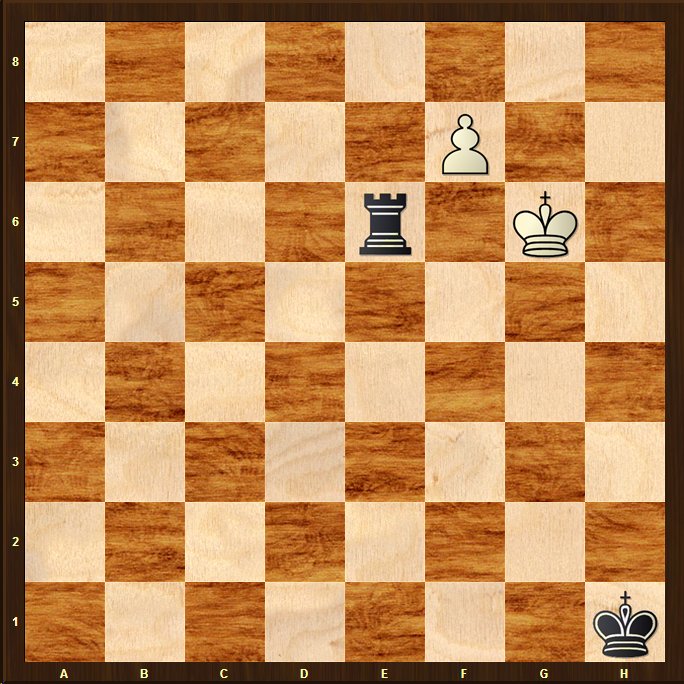


By a process of elimination, Kf5 looks like the only candidate move.
1 Kg7 Re7 pinning the pawn and RxP next.
1 Kh-any Rf6 and RxP next.
1 Kf5 Re1 with Rf1 and RxP or RxQ next.
Hence Kg5 is the only try. So can white dance the king and rook down until the black rook can’t skewer the king and pawn? Yes.
1 Kg5 Re5+
2 Kg4 Re4+ (not 2 Kf4? Re1!)
3 Kg3 Re3+
4 Kf2 and the rook can’t cover the promotion square and white queens the pawn.
Another try for black would be
1 Kg5 Re2
2 f8Q Rg2+
and keep checking on the g and h files; the white K can’t move to the f file because of Rf2+ and Rxf8.
Except that the white king can escape the checks by dancing down the board and go through f3.
Am I correct in thinking this position would be a draw with the black K on g1 instead of h1?
No, tvtom. After 4. Kf2 Re4! 5. f8Q?? 6. Rf4+! Qxf4 you have a stalemate.
So the you must play 5.-f8R! with Rh4 6. Kg3 +-
This is Saavedra’s study (1895), but with a mirror position
arnfinn said…
“No, tvtom. After 4. Kf2 Re4! 5. f8Q?? 6. Rf4+! Qxf4 you have a stalemate. So the you must play 5.-f8R! with Rh4 6. Kg3 +-“
Good heavens — that’s brilliant!
I continue my losing streak of botching every problem. (Sigh). Never saw the stalemate coming. An underpromotion to avoid stalemate. Wow.
“This is Saavedra’s study (1895), but with a mirror position”
Cool. I’d never heard of it before. Thanks.
I seen the Saavadra problem discussed many times and it is quite a remarkable way for white to win in the given position. Does anyone know if this technique has ever been used to win an actual game at the grandmaster (or near grandmaster) level?
There is a whole discussion ‘out there’ somewhere as to whether the the Saavedra position is based on a otb game, as claimed, or not. There was also a claim that there was some Irish background to this position too, but I think A J Roycroft dismissed that.
Ok, I googled it and found the following:
http://www.chessbase.com/puzzle/christmas2003/chr03-6a.htm
London, 1875. William Norwood Potter, a very strong master, who had played matches with Steinitz, Zukertort (the latter won 8:6), Blackburne and MacDonnell, was playing odds games against an amateur named Fenton (no relative, one assumes, to yesterday’s composer). In one of these games the following position arose:
Fenton – W.N.Potter, London, 1875
[snip]
At this point Fenton’s famous opponent offered a draw, which White respectfully accepted. We do not know what exactly the logic of the draw or acceptance was – the most common story has Potter then showing Fenton how he could have won, while others tell of Zukertort finding the win and publishing it in The City of London Chess Magazine.
After this, for twenty years, nothing happened. Then on March 13, 1895, William Norwood Potter died. The director of the chess column in the Scottish newspaper Weekly Citizen, G. E. Babier, dedicated an article to the great chess player. Babier, a poet and professor for French, had lived in London in 1875 and had either witnessed the Fenton-Potter game himself or read about it in Zukertort’s column. Not remembering the game precisely he gave a modified version of the position.
G.E.Babier, Glasgow, Weekly Citizen, 1895
Black to play, White to win
According to Babier Potter had offered the draw, Fenton had accepted, and then Potter had shown him the win.
The position appeared in the Weekly Citizen on April 27, 1895. But Babier continues playing around with the position and suddenly discovered that if the black king was on a1 there was a pretty draw for Black. He published this as a study in his next column a week later.
G. E. Babier, Glasgow, Weekly Citizen, 1895
Black to play and draw
[Bl K=a1; Bl R=d5; Wh K=b6; Wh P=a7]
The solution to Babier’s study was 1…Rd6+ 2.Kb5 Rd5+ 3.Kb4 Rd4+ 4.Kb3 Rd3+ 5.Kc2 Rd4! Now the white pawn promotion draws: 6.c8Q Rc4+ 7.Qxc4, as do other tries: 6.Kb3 Rd3+; 6.Kc3 Rd1. So Black has saved the game.
Saavedra’s move
The study appeared in the May 4th issue of the Weekly Citizen, and the solution in the next column on May 11. And this is where our hero enters. Fernando Saavedra, a Spanish priest in the Order of Passionists, had solved the study during the week of May 4–11. But then he studied the position again and a few days later went to the Glasgow Chess Club, where he met Babier. There he showed the editor what he had discovered: White can win by underpromoting to a rook on move six! Babier was so impressed that in his next column he published the above position one more time with the stipulation “Black to play, White to win” and giving the win that was pointed out to him by a member of his chess club: 6.c8R! Ra4 7.Kb3 and Black has no defence.
Saavedra had never before stood in the limelight. Apart from finding this move, 6.c8R!, he has done nothing worthy of mention in the chess world. As Tim Krabbé writes: “Saavedra was a mediocre chess player whose name, through chance, will live forever in chess literature.” If it wasn’t for this move the name would have been completely unknown today. Here is the final version of the study.
[Bl K=a1, Bl R=d5; Wh K=b6; Wh P=c6]
The solution, as we know, is 1.c7 Rd6+ 2.Kb5 Rd5+ 3.Kb4 Rd4+ 4.Kb3 Rd3+ 5.Kc2 Rd4! 6.c8R!! Ra4 7.Kb3 1-0. The above position has probably been published more often than any other study in chess history.
http://www.gadycosteff.com/eg/eg122.pdf on Selman and Saavedra.
By the way, why was the Saavedra position switched left to right – the usual, unsuccessful attempt to disguise?
“By the way, why was the Saavedra position switched left to right – the usual, unsuccessful attempt to disguise?”
Nah, just yet another case of chysslexia.