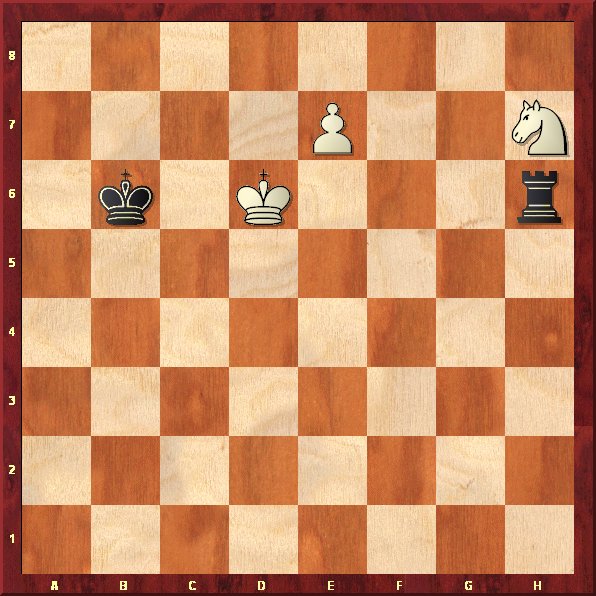
White to move. This is a famous study by Troitsky in 1912. How should White proceed?
8/4P2N/1k1K3r/8/8/8/8/8 w – – 0 1


White to move. This is a famous study by Troitsky in 1912. How should White proceed?
8/4P2N/1k1K3r/8/8/8/8/8 w – – 0 1
A classic, yes, with a slight dual at the fourth move, still very instructive!
1. Kd5 (or Ke5) Rh5+
2. Ke6 Rh6+
3. Nf6 Rh8
4. Nd7+ Kc7
5. Nf8 Rh6+
6. Kf7
The first instinct of a lot of players is going to be Kd7, but this draws quickly:
1. Kd7? Rh7 and the pin on the e-pawn means black can sacrifice for it instantly and draw the game.
So, to win, white must try either a block of the check with the knight, or play Kd5 or Ke5. Let’s discuss Ke5 first because this is also clearly a draw:
1. Ke5? Rh1
Rh2 is also a draw, I believe, but a move like Rh3 is not: [1. …Rh3?? 2.Kd4! and we will discuss this sort of position in a few minutes.] With 1. …Rh1, black is threatening Re1+ skewering the king and the e-pawn/queen and drawing the game. So the white king must either move off of the e-file, or bring the knight to g5 to block Re1+ with Ne4. Continuing:
2. Ng5
Any king move and black plays Re1 followed by Rxe7/e8 to draw. However, with the knight off of h7, black has time for a different reply:
2. …..Rh8! (an only move)
And there is no way to prevent 3. …Re8 followed by Rxe7 drawing the game. The point is this- white gives up an important tempo when he puts the king on the e-file on move 1. This leaves 1.Nf6 and 1.Kd5 as possible alternatives. Let’s discuss 1.Kd5 next:
1. Kd5
This is now threatening e8Q. There are no moves to the 1st-3rd ranks that can threaten any skewers when white queens. The black king is too far away to stop the pawn. This leaves the only potential defense to be repeated checks from the h-file:
1. …..Rh5
2. Kd4
Here, Kd6 is a return to the starting position (Kd6 wins, but we will come back to it in a few minutes). Continuing:
2. …..Rh4
3. Kd3
This is a subset of the position in the 1.Ke5 line where black replies with 1. …Rh3 instead of Rh2 or Rh1. The black rook can’t reach the e-file since the white king coverers the squares available (so white can’t play KcX). White can still win here by reversing back up the d-file, but let’s continue down this sideline to show white has no other alternatives to win here:
3. …..Rh3
4. Kd2 Rh2
5. Kd1 Rh1
6. Ke2
This is safe now since the rook can’t get behind the king on the e-file for a skewer.
6. …..Rh2
7. Kd3 Rh3 etc. To win this, white must return the king to the starting position. So we can just back up the move 1 and find a shorter line. 1.Nf6 was the correct approach all along:
1. Nf6! Rf6 (Rh8 is below)
2. Kd5!
The only win. Kd7 draws as before when black pins the e7 pawn to the king, this time with Rf7 followed by Rxe7. 2.Ke5 also draws for the same reasons we saw earlier- black plays the rook to the 1st or second rank, and then skewers the king and queen if white queens the pawn, or simply plays to e1 or e2 if white moves the king off the e-file, and then captures at e7 to draw. Continuing from move 2 immediately above:
2. …..Rf5 (nothing better)
3. Kd4 Rf4
4. Kd3
Here, as Cortex points out, Ke3 also wins. I can’t say for certain that it is the same number of moves since the resulting Q vs R ending is just slightly different due to the position of the white king. Continuing:
4. …..Rf3
5. Ke2 and the black rook can’t get to the 8th rank or the e-file, and no longer can safely check the white king. White will queen his pawn safely. The win from this point isn’t trivial- Q vs R endings rarely are, and black does have time to reconnect his king and rook before white can queen and set up a quick double attack to win the rook. My quess is the win is at least 25 moves away, and probably more with proper play.
1.N-f6, Rxf6
2.K-e5 winning the game
1. Nf6 Rh8
2. Nd7+ Kb7
3. Nf8 Ra6+
4. Kd5 Ra5+
5. Kd4 Ra4+
6. Kd3 Ra3+
7. Ke2 Ra2+
8. Kf3 Ra3+
9. Kf4 Ra4+
10. Kf5 Ra5+
11. Kf6 Ra6+
12. Kf7
1-0
nf6
I think white wins with 1.Kd4! black cannot capture the Knight, so only can play checks along the h colun. (If 1.Ke4 Rh1! following Re1 with draw.)
1….Rh4+ 2.Kd3 Rh3+ 3.Kd2 Rh2+ 4.Ke1 and finaly de white king can aproximate de black rook and stop the checks.
I realized that I forgot a first move alternative for black in the Nf6 line:
1. Nf6 Rh8
2. Nd7+ Kanywhere
3. Nf8 Rh6
4. Kd7 and the pawn will queen.
Hi Susan Polgar,
Well,white’s draw is a cake walk but win is not eluded.
“Anonymous” moves sounds fitting – that is “Ke5”.
“Nf6” leads to draw – Given below throws,just a light on my view.
Example [ “Nf6” leads to draw – Variation ]
========
1.Nf6 R*Nf6
2.Ke5 Rf1
3.Kd6 Re1
4.Kd7 R*e7 [ Variations exist ] – Draw.
By
Venky [ India – Chennai ]
1. Nf6 Rf6+
2. Kd5 Rf5+
3. Kd4 Rf4+
4. Kd3 Rf3+
5. Kd2 Rf2+
6 Ke1!
2 Ke5 is wrong, because after 2…Re1! , black draws.