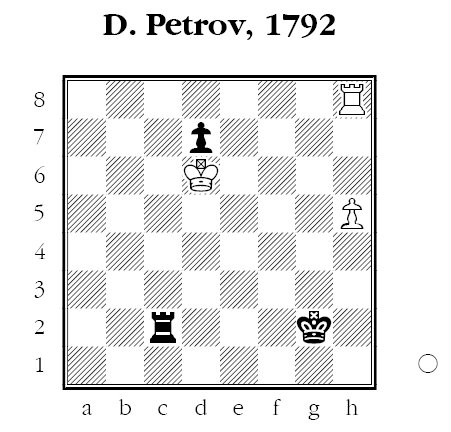
White to move. Is this a win or draw for White? How should White proceed?
Source: ChessToday.net

Chess Daily News from Susan Polgar

White to move. Is this a win or draw for White? How should White proceed?
Source: ChessToday.net
Don’t trust informations, and always verify them.
In this case, this correct and tricky Study is from
Petrov, D, RSFSR tourney, 1964, first honourable mention
FYI, the wrong date 1792 was the default date from Van der Heijden everytime a study was without any data in his second version (widely spread by Chessbase) of his fabulous study database.
His fourth version is available only on internet here
This is an insanely difficult puzzle.
Well, my instinct tells me this has to be drawn, but then why would this be a puzzle if white cannot win it? So, I have to assume we are looking for a white win. Now, Kd7 does surely have to be a draw after black replies with Kg3:
1. Kd7 Kg3
There may be other draws here like Kh3 or Ra2 (to harass from the a-file. However, a move like Kf3 is probably going to lose as the black king let’s white steal a march on him: [1. …Kf3?? 2.h6! Kg4 3.h7 Rd2 4.Ke6 Re2 (of course, 4. …Rh2 5.Rg8+ wins for white) 5.Kd5 Rd2 6.Ke4 Re2 7.Kd3 and white will win the rook with Rg8+ followed by h8Q]. Continuing from 1 above:
2. h6
I doubt there are other moves that win. White must push the pawn to have a chance to win this with an 8th rank check followed by h8Q. However, we should now see how black defends this:
2. …..Ra2!
Surely the only drawing move now. Continuing:
3. h7
There is no way to win this, but this is the most relevant line. We will now see that white can no longer walk the rook down successfully in order to play Rg8+ followed by h8Q. Continuing:
3. …..Ra7
4. Kc6
Or just allow the lateral checks endlessly. Continuing:
4. …..Kh4!
Removes the threats of the check from the 8th rank. Continuing:
5. Kb6 Rg7
Keeps the white rook tied to the h-pawn’s defense. The rest is just to show the futility of white’s attempts to win:
6. Kc6 Kh5
7. Kd6 Kh6 and black will liquidate the pawn.
So, clearly white cannot take the d-pawn. In my next comment, I will look to make use of the tempo of the first move in another, but still obvious way.
In my first comment, I outlined how black draws if white captures at d7 on the first move. The method involved putting the black rook on the a-file for lateral harassing checks, and putting the black king, in time, on the h-file so that white cannot ever check from the 8th rank to win the tempo for h8Q. Clearly, if white is to win, time is of the essence, and so h6 can be the only possible winning move:
1. h6
So, now we have to ask if black can employ the previous defense of hiding the king behind the h-pawn and checking from the a-file (or from the back? To be honest, it isn’t clear to me right now. Let’s play it out a bit:
1. …..Kh3
2. h7 Rc6!
This might be the only draw here, but I am not going to look too deeply here since I can clearly see this line is a draw. This is an easy move to spot if you understand how the draw unfolded in my previous comment. This check forces white to make a decision- if he takes at d7, black puts the rook on h6: [3. Kd7 Rh6 4.Ke7 Rh4 5.Kf6 Rf4 and white won’t be able to support the pawn with the king without facing endless checks from the 4th rank]. In addition, if white tries to move towards the pawn, then black still can hold the draw: [3.Ke5 Rh6 4.Kf5 Rh4 and again white won’t escape the checks from the 4th rank. So, if 1.h6 is the correct first move, then 2.h7 is not correct (we will see why in a moment the pawn must remain on h6 for a while). From the top:
1. h6 Kh3
2. Ke5
I think white will win with Ke7 here, but will have to make a couple of extra moves to set up the position I have in mind, but I don’t think black has a defense now:
2. …..Re2
Black must either check, put eyes on the pawn, or he must push his pawn. I am forced to cover these ideas separately. Continuing:
3. Kf5 Rf2
4. Kg5 Rg2
5. Kh5! Rg4
Here, trying for lateral checks isn’t going to help: [5. …Rc2 6.h7 Rc5 7.Kh6 Rc6 8.Kg7 Rc1 (or 8. …Rc7 9.Rf8 d5 10.Rf7+-) 9.Rg8 Rg1 10.Kf7 Rf1 11.Ke7 Re1 12.Kd8+-]. Continuing:
6. Rf8 Rh4
7. Kg6 Rg4
8. Kf5! Rh4
9. Rf6!
And now white has the position he was looking for- the pawn supported from the side by the rook. Without the black pawn on the board, this is clearly won. We need only look for now at the pawn push lines to be sure white has a win:
9. …..d5 (Rh5 10.Kg6+-)
10.Kg6 d4 (Rg4 11.Kf7 Rh4 12.Kg7)
11.h7 d3
12.Rf3 Kg2 (Kg4 13.Rd3 Rh1 14.Rd8)
13.Rd3 Kf2 (Rg4 14.Kh5+-)
14.Rd8 Rg4
15.Kf5 wins.
So, now, I think we need to go all the way back to black’s 2nd move to see if there were any other relevant defenses. From the top:
1. h6 Kh3
2. Ke5 Rc6
3. Kf5
White intends the same method as above. Continuing:
3. …..d5
4. Kg5
And now the white rook has time to come to d8:
4. …..d4
5. Rd8! d3 (Rc5 6.Kg6 Rc6 7.Kg7)
6. h7 Rc5
7. Kf4 Rc4 (Rh5 8.h8Q)
8. Kf3 d2 (Rh4 9.h8Q Rh8 10.Rh8+)
9. h8Q Rh4
10.Qh4 Kh4
11.Rd2
I can’t see a defense for black after 1.h6 and 2.Ke5. If I have left holes in this, I will let the other commenters point them out and try to address them if I can.
A few loose ends:
1. h6 Kh3
2. Ke5 d6
3. Kf6 d5
4. Rd8 Rc7
5. Kg6 Rc6
6. Kg7 Rc7
7. Kg8 Rc2
8. h7 Rg2
9. Kf7 with Ke7-Kd7 coming.
and 1. h6 Kh1!