It is not difficult for White to take the pawn (particularly on a black square). Exchanging a Knight for the Bishop can make White win with a Knight and Bishop.
The first move is not Be4 to protect the knight which can be countered by Bd5 but to play Ng5.
1…Bd5 2.Ne4+ Kc6 (2…Kd7 3.Nf6+ Kc6 4.Nxd5 Kxd5) 3.Ke5 Bc4 4.Nd2 Ba2 5.Be4+ Kd7 and the knight is protected
Complete sources: Liburkin, 64, 1931, #573, third prize
But not as wonderful as this one Liburkin, Shakhmaty v SSSR, 1931, #540, second prize FEN: 8/8/2P5/1Pr5/8/8/N7/k2K4 w – – 0 1 Two variations await the solvers!
This was one of the toughest puzzles I have seen, mainly because nothing really jumped out to me as a beginning, and it took a deeper think to find the breadcrumb trail. First things first- white cannot trade bishop for bishop since the resulting ending K+2N vs K is a technical draw. So, it appears that white must either find a way to mate black with the black bishop still on the board, or force the trade of knight for bishop. I decided it had to the latter right from the start.
Now, what are the issues for white? Mainly, he has a trapped knight at a8 that black can threaten to win with Bd5, and white can’t prevent this with Be4 for the reason I mentioned above- he cannot trade bishop for bishop. So, this suggests the first move has to be with the knight at h3. This reasoning is how I found the correct thread to follow. Let’s get into it, though I know I don’t yet have a complete solution here:
1. Nf2!
How does this solve the problem of the a8 knight? Later, I will show you why 1.Ng5 fails. Let’s look at the reply with Bd5:
1. …..Bd5 2. Ne4! Kd7
Here, black cannot exchange at e4 since the ending is a technical win- the bishop at e4 protects the knight, and black cannot both approach the knight and block this coverage by playing c6. White will eventually bring the king to bear on the pawn and win it with a double attack if necessary. The other alternatives to Kd7 I will cover later. Continuing from 2. ..Kd7 above:
3. Nf6 forks and wins the bishop for a knight leading to the technically won position I described above. Trivially, at move 2, Ke6 is also a winning fork after Nc7+ since black cannot either protect his bishop, nor attack white’s. Or at move 2:
2. …..Ke7 3. Nc7 has freed the knight. If I have more time later tonight, I will outline how to win this sort of ending. It isn’t terribly difficult to force the knight for bishop trade- the three white pieces and the king are just too much to handle- white will either mate or force black to make the trade, and the trade will come with black king already hemmed to the edge of the board. Or, at move 2:
2. …..Kc6 3. Nf6
I think 3.Ke5 is also ok here for white, though I haven’t looked deeply at it. Continued in my next comment.
3. …..Bmove (Kb7 4.Nxd5 wins) 4. Ne8 double attacks and wins the c-pawn while freeing the a8 knight.
So, clearly black cannot play 1. …Bd5 and hold. Let’s consider the alternatives at move 1, now:
1. Nf2 Kc6 (king going for kill) 2. Nd3!
The hardest move to find, at least for me. This prevents Bd5 by threatening the fork from b4. So, now, if the black king tries Kb7-Ka8, white has the following line in his back pocket:
2. …..Kb7 3. Be4+ c6 (nothing better) 4. Nb4! Ka8 5. Nc6! and the black king cannot escape the discovered check, and the black bishop cannot find any square that cannot be attacked by the knight on white’s next move except for h7 where white just captures him with his bishop. So, at move 2 in this line, what can black do? If black moves the bishop to d5, c4, or a2, white forks with the knight from b4 or e5. If black moves the bishop to e6 or b3, white plays Ke5:
2. …..Bb3 3. Ke5 Kb7 4. Be4 c6 (nothing better) 5. Nc5 forks and wins. Or
2. …..Be6 3. Ke5 Bd7 (what else?) 4. Be4 Kb5 5. Nc7 frees the knight. Or, at move 2 in this line, black could try moving the king:
2. …..Kd6 (Kb5/d5 3.Nc7 wins) 3. Nb4
Only winning move I find here. Continuing:
3. …..c5
Here, c6 is met the same way as follows, and I will cover Bc4 following this line. Continuing:
4. Na6 c4 (what else now?) 5. N8c7 c3 (freeing c4) 6. Nb5 Kc6 (what else?) 7. Nc3 Kb6 (what else?) 8. Nb4 and white has won the pawn and freed the knight. And, at move 3 in this line:
3. …..Bc4 (preventing Na6) 4. Ke3 Bb5 (what else different?) 5. Be4 c6 (prevent Nd5, lure Nb6) 6. Nc2 and the other knight is going to escape through c7 or b6.
This analysis isn’t quite complete, but I think it deals with the key highlights. Finally, at the first move for white, Ng5 is going to fail:
1. Ng5 Kc6! (only move)
Now, how does white save the a8 knight? Be4+ isn’t going to work since the reply Bd5 cannot be overcome by a fork from b4 like it was above.
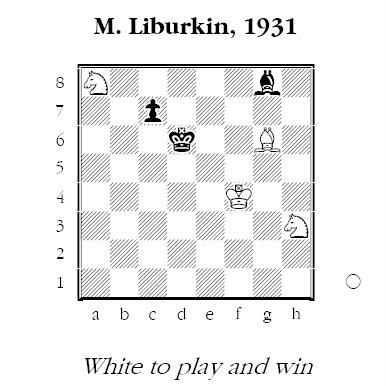


It is not difficult for White to take the pawn (particularly on a black square). Exchanging a Knight for the Bishop can make White win with a Knight and Bishop.
The first move is not Be4 to protect the knight which can be countered by Bd5 but to play Ng5.
1…Bd5
2.Ne4+ Kc6
(2…Kd7 3.Nf6+ Kc6 4.Nxd5 Kxd5)
3.Ke5 Bc4
4.Nd2 Ba2
5.Be4+ Kd7 and the knight is protected
Wonderful study!
Complete sources:
Liburkin, 64, 1931, #573, third prize
But not as wonderful as this one
Liburkin, Shakhmaty v SSSR, 1931, #540, second prize
FEN: 8/8/2P5/1Pr5/8/8/N7/k2K4 w – – 0 1
Two variations await the solvers!
This was one of the toughest puzzles I have seen, mainly because nothing really jumped out to me as a beginning, and it took a deeper think to find the breadcrumb trail. First things first- white cannot trade bishop for bishop since the resulting ending K+2N vs K is a technical draw. So, it appears that white must either find a way to mate black with the black bishop still on the board, or force the trade of knight for bishop. I decided it had to the latter right from the start.
Now, what are the issues for white? Mainly, he has a trapped knight at a8 that black can threaten to win with Bd5, and white can’t prevent this with Be4 for the reason I mentioned above- he cannot trade bishop for bishop. So, this suggests the first move has to be with the knight at h3. This reasoning is how I found the correct thread to follow. Let’s get into it, though I know I don’t yet have a complete solution here:
1. Nf2!
How does this solve the problem of the a8 knight? Later, I will show you why 1.Ng5 fails. Let’s look at the reply with Bd5:
1. …..Bd5
2. Ne4! Kd7
Here, black cannot exchange at e4 since the ending is a technical win- the bishop at e4 protects the knight, and black cannot both approach the knight and block this coverage by playing c6. White will eventually bring the king to bear on the pawn and win it with a double attack if necessary. The other alternatives to Kd7 I will cover later. Continuing from 2. ..Kd7 above:
3. Nf6 forks and wins the bishop for a knight leading to the technically won position I described above. Trivially, at move 2, Ke6 is also a winning fork after Nc7+ since black cannot either protect his bishop, nor attack white’s. Or at move 2:
2. …..Ke7
3. Nc7 has freed the knight. If I have more time later tonight, I will outline how to win this sort of ending. It isn’t terribly difficult to force the knight for bishop trade- the three white pieces and the king are just too much to handle- white will either mate or force black to make the trade, and the trade will come with black king already hemmed to the edge of the board. Or, at move 2:
2. …..Kc6
3. Nf6
I think 3.Ke5 is also ok here for white, though I haven’t looked deeply at it. Continued in my next comment.
Continued from my previous comment:
3. …..Bmove (Kb7 4.Nxd5 wins)
4. Ne8 double attacks and wins the c-pawn while freeing the a8 knight.
So, clearly black cannot play 1. …Bd5 and hold. Let’s consider the alternatives at move 1, now:
1. Nf2 Kc6 (king going for kill)
2. Nd3!
The hardest move to find, at least for me. This prevents Bd5 by threatening the fork from b4. So, now, if the black king tries Kb7-Ka8, white has the following line in his back pocket:
2. …..Kb7
3. Be4+ c6 (nothing better)
4. Nb4! Ka8
5. Nc6! and the black king cannot escape the discovered check, and the black bishop cannot find any square that cannot be attacked by the knight on white’s next move except for h7 where white just captures him with his bishop. So, at move 2 in this line, what can black do? If black moves the bishop to d5, c4, or a2, white forks with the knight from b4 or e5. If black moves the bishop to e6 or b3, white plays Ke5:
2. …..Bb3
3. Ke5 Kb7
4. Be4 c6 (nothing better)
5. Nc5 forks and wins. Or
2. …..Be6
3. Ke5 Bd7 (what else?)
4. Be4 Kb5
5. Nc7 frees the knight. Or, at move 2 in this line, black could try moving the king:
2. …..Kd6 (Kb5/d5 3.Nc7 wins)
3. Nb4
Only winning move I find here. Continuing:
3. …..c5
Here, c6 is met the same way as follows, and I will cover Bc4 following this line. Continuing:
4. Na6 c4 (what else now?)
5. N8c7 c3 (freeing c4)
6. Nb5 Kc6 (what else?)
7. Nc3 Kb6 (what else?)
8. Nb4 and white has won the pawn and freed the knight. And, at move 3 in this line:
3. …..Bc4 (preventing Na6)
4. Ke3 Bb5 (what else different?)
5. Be4 c6 (prevent Nd5, lure Nb6)
6. Nc2 and the other knight is going to escape through c7 or b6.
This analysis isn’t quite complete, but I think it deals with the key highlights. Finally, at the first move for white, Ng5 is going to fail:
1. Ng5 Kc6! (only move)
Now, how does white save the a8 knight? Be4+ isn’t going to work since the reply Bd5 cannot be overcome by a fork from b4 like it was above.