Menu   ≡ ╳
  • News
    • Major Tournaments
    • General News
    • USA Chess
  • Puzzles
  • Improvement
  • Event
  • College
  • Scholastic
  • Women
  • Search

        More results...

        Or you can try to:
        Search in Shop
        Exact matches only
        Search in title
        Search in content
        Search in comments
        Search in excerpt
        Search for News
        Search in pages
        Search in groups
        Search in users
        Search in forums
        Filter by Categories

        Try these: Sicilian Defense, Empire Chess, USA Chess

    • SPICE
    • Videos
    • Susan’s Blog
    • About Us
    • Contact Us
    • SPICE
    • Videos
    • Susan’s Blog
    • About Us
    • Contact Us
    Menu   ≡ ╳
    • News
      • Major Tournaments
      • General News
      • USA Chess
    • Puzzles
    • Improvement
    • Event
    • College
    • Scholastic
    • Women
    • Search

          More results...

          Or you can try to:
          Search in Shop
          Exact matches only
          Search in title
          Search in content
          Search in comments
          Search in excerpt
          Search for News
          Search in pages
          Search in groups
          Search in users
          Search in forums
          Filter by Categories

          Try these: Sicilian Defense, Empire Chess, USA Chess

      Home  >  Chess Improvement • Chess Puzzles  >  A difficult challenge review

      A difficult challenge review

      Chess tactic, Puzzle Solving


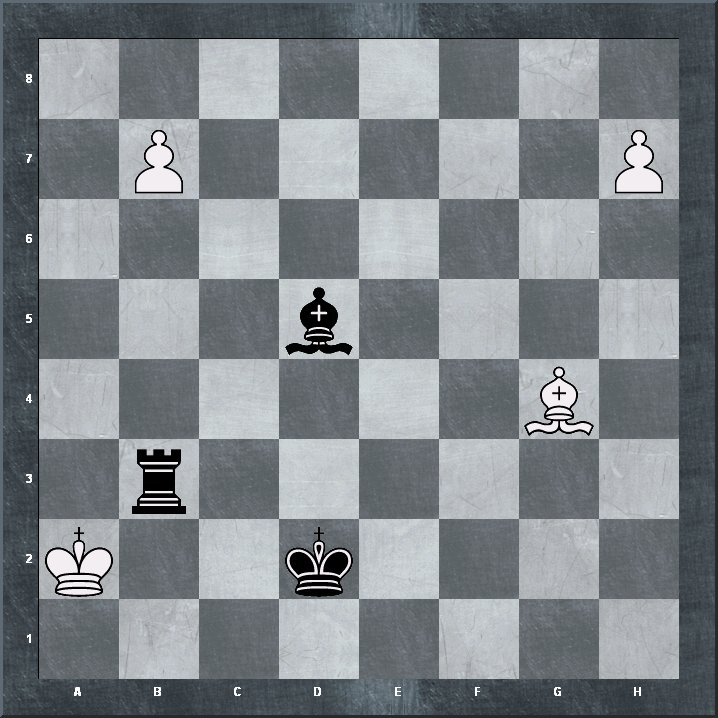
      V. & M. Platov 1911, presented by Andreas

      White to move. How should White proceed?

      8/1P5P/8/3b4/6B1/1r6/K2k4/8 w – – 0 4

      Posted by Picasa
      Chess Daily News from Susan Polgar
      Previous Article What are their secrets?
      Next Article Goa’s first Woman Grandmaster

      About Author

      Susan Polgar

      Related Posts

      • More Special Endgame!

        January 3, 2021
      • Precision Chess Tactic

        December 27, 2020
      • Daily dose of tactic!

        December 21, 2020

      10 Comments

      1. Fabrice Reply
        September 14, 2012 at 6:59 am

        1.h8:Q Rh3+
        2.Ka1 Rxh8
        3.b8:Q Rxb8 is Stalemate without the White Bishop

        Then 1.Be6 seems the solution because K+R vs K+B is draw

      2. Cortex Reply
        September 14, 2012 at 7:54 am

        Is it an habit or what?

        Truncated study (for tactical purposes, I guess), wrong and incomplete source…

        So I must restablish the whole picture:

        Platov & Platov, Shakmatnoye Obozrenye, 1910, third prize

        FEN: 8/7b/1P5P/8/6B1/3r4/KP1k4/8 w – – 0 1
        ASCII: wKa2,Bg4,Pb2,b6,h6/bKd2,Bh7,Rd3

        draw

        The solution runs like this

        1.b7 Bg8+! (the only way to draw. Otherwise, Black loses, even after the cunning 1…Rd4 2.Ka3!! (2.b8Q?? run into Black’s trap 2…Ra4+ 3.Kb3 Bc2#)) 2…Bc2 3.b3 and Black has no way to avoid promotion.)
        2.b3 (else 2…Rb3 wins) 2…Rxb3! 3.h7 Bd5!

        –And now, Mr.Bond? would say Blöfeld…

        That is the very question.

      3. pht Reply
        September 14, 2012 at 8:04 am

        Obviously bad moves are:
        1. h8=Q?? Rh3+ 2. … Rxh8
        1. b8=Q?? Rxb8+
        A bishop move can also be excluded, the very best you could get from it was:
        1. Bf3? Rxb7+!
        2. Bxd5 Rxh7.
        with R vs. B endgame, favour black.

        So it definitely has to be:

        1. Ka1!

        Black has nothing but grabbing b-pawn, h-pawn queens, and white is clearly better, though it is still a way to go here.

        The move 1. Ka1 could hardly be called difficult to find, I guess, it rather seems all enforced…

      4. CraigB Reply
        September 14, 2012 at 12:36 pm

        Nice tactical shot for you from a game on FICS. Black was a computer, white a human.

        r4rk1,pp2b1pp,2n1q3,2ppp3,8.3P2Bb,PP2B2R,RN1QN1K1

        The solution is, of course, 1…Qg4 with annihilation to follow.

      5. Yancey Ward Reply
        September 14, 2012 at 2:58 pm

        I remember this one well. The discovered check threat means white can’t queen either pawn. For example:

        1. h8(Q) Rh3
        2. Ka1 Rh3 wins for black.

        There is also a mate threat if white moves the king on move 1:

        1. Ka1? Kc1! with mate by Ra3 to follow in another 1 or 2 moves.

        On any bishop move, but one, black captures at b7 with check and then plays Rb8 to win.

        However, white can parry these various threats with Be6:

        1. Be6 Rb7 (Be6 is below)
        2. Bd5 Rh7 (Ra7 is no better)

        This R vs B ending is drawn. A more interesting line is:

        1. Be6 Be6
        2. h8(Q)Rh3
        3. Ka1! Rh8
        4. b8(Q)Rb8 stalemates.

        My notes include this reference to the full problem (probably thanks to Cortex) which is much more interesting than this truncated study:

        Platov, V & Platov, M; Shakhmatnoye Obozrenye, 1910, third prize
        FEN: 8/7b/1P5P/8/6B1/3r4/KP1k4/8 w – – 0 1

      6. Lucymarie Reply
        September 14, 2012 at 3:26 pm

        Sometimes the first crazy move one tries just happens to work out.

        1. Be6 Bxe6 2. h8=Q Rh3+ 3. Ka1 Rxh8 4. b8=Q Rxb8 stalemate.

      7. Ravi Reply
        September 14, 2012 at 5:32 pm

        I accidentally tried Be6 and it causes a king – rook & king – bishop ending which can be drawn or otherwise it is a stalemate

        1.Be6 Rxb7+
        (1…Bxe6 2.h8=Q Rh3+ 3.Ka1 Rxh8 4.b8=Q Rxb8)
        2.Bxd5 Rxh7

      8. techron Reply
        September 14, 2012 at 6:11 pm

        1. Ka1 Kc1 (avoiding Kc2 (threatening Ra3#) 2. Bc1+! Kxc1 3. h8=Q) and white is lost due to Ra3# threat. So 1. h8=Q Rh3+ 2. Kb2 Rb3+ perpetual check to avoid b pawn becoming Q.

      9. pht Reply
        September 17, 2012 at 9:37 am

        It’s a shame that i didn’t see:
        1. Ka1?? Kc1!
        and of course white looses this.

        Since pawn moves are out of question, it has to be attacking B with B going for a draw.
        1. Be6 looks nice.

        I mentioned
        1. Bf3
        as a drawish line. I don’t think black can afford to take on f3 with either piece, and in that case it should be R vs B endgame after black 1. … Rxb7 etc.

      10. pht Reply
        September 17, 2012 at 9:45 am

        Sorry about all this nonsence.
        1. Bf3?? Rxf3+
        2. Kb2 Rb3+
        3. Ka1 Kc1
        4. h8=Q Ra3#

        This leaves the brilliant stalemate idea Be6 to be only possibility.

      Leave a Reply

      Cancel reply

      Improvement

      • Important Scholastic Coaching Tips
      • My Chess Quotes Over The Years
      • My kids know chess rules. What’s next?
      • Chess Parenting

      Events

      • My Top 10 Most Memorable Moments in Chess (Part 3) May 13, 2021
      • My Top 10 Most Memorable Moments in Chess (Part 2) May 12, 2021
      • My Top 10 Most Memorable Moments in Chess (Part 1) May 10, 2021
      • About Susan Polgar April 9, 2021
      • About Us
      • Contact Us
      • Daily News
      • My Account
      • Terms & Conditions
      • Privacy Policy

      Anand Armenia Breaking News Chess Club and Scholastic Center of St Louis Chess interview Chess Olympiad Chess tactic Chess tournament chess trivia China FIDE Grand Prix Holland India Khanty-Mansiysk LIVE games Lubbock Magnus Carlsen Moscow National Championship Norway OnlineChessLessons Philippines Puzzle Solving Russia Scholastic chess Spain SPF SPICE SPICE Cup St Louis Susan Polgar Tata Steel Chess Texas Tech Tromsø TTU Turkey Webster University Wesley So Wijk aan Zee Women's Chess Women's Grand Prix Women's World Championship World Championship World Cup

      April 2026
      M T W T F S S
       12345
      6789101112
      13141516171819
      20212223242526
      27282930  
      « Sep