Hmm a tough one. I am guessing black plays 1…b2 being fully aware that after 2.Kc2 his king cannot approach and help the b-pawn further. So I thought that 2…g6! might be an interesting winning attempt. The idea is simply to make another passed pawn. Now if 3.Bxg6 the king approaches with 3…Ka2 and either a new queen will be made or white has to give up the bishop. Thus 3.hxg6. Now to continue the plan 3…f5!. (maybe 3…h5 but it seems unneccessary and to dangerous as I don’t see WRP being a problem (WRP=wrong rook pawn)) 4.gxf5 h5. Now the only way for the bishop to stop the pawn and not allow …Ka2 is to go Kb1. However then black walks his king to b3, then c3 and finally over to the kingside and wins the bishop. After that the win should be trivial. Meanwhile the black bishop has no problem stopping both pawns and keeping an eye on the b2 pawn since the are all on the same diagonal.
Concur with your suggestion. Initially, I had a slightly differenty move order but it really does not matter. The black bishop will hold the white pawns on the kingside whereas white can only stop one of the black pawns. Very nice.
The best defence for white seems to be (after Kb1) to sacrifice the pawns back, move the bishop to the b1-h7 diagonal and then walk his king over to the king side to help with stopping the h-pawn.
Without a second passed pawn black cannot win. There are several ways to create one, including perhaps starting with f5. However the method of ingvar seems more forced.
f5 is draw. White moves his king to b1. If black attacks the white f5 pawn with his king, white moves his bishop to g6 (defending both paws) and moves his king between b1 and c2.
No way that black can create a second passed pawn.
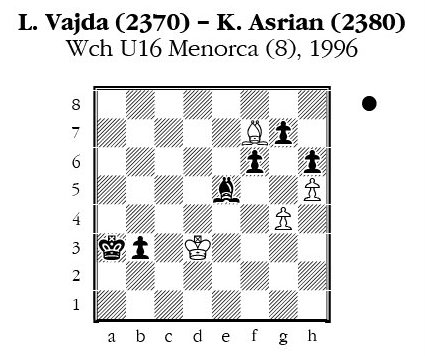


Hmm a tough one. I am guessing black plays 1…b2 being fully aware that after 2.Kc2 his king cannot approach and help the b-pawn further. So I thought that 2…g6! might be an interesting winning attempt. The idea is simply to make another passed pawn. Now if 3.Bxg6 the king approaches with 3…Ka2 and either a new queen will be made or white has to give up the bishop. Thus 3.hxg6. Now to continue the plan 3…f5!. (maybe 3…h5 but it seems unneccessary and to dangerous as I don’t see WRP being a problem (WRP=wrong rook pawn))
4.gxf5 h5. Now the only way for the bishop to stop the pawn and not allow …Ka2 is to go Kb1. However then black walks his king to b3, then c3 and finally over to the kingside and wins the bishop. After that the win should be trivial. Meanwhile the black bishop has no problem stopping both pawns and keeping an eye on the b2 pawn since the are all on the same diagonal.
Concur with your suggestion. Initially, I had a slightly differenty move order but it really does not matter. The black bishop will hold the white pawns on the kingside whereas white can only stop one of the black pawns. Very nice.
The best defence for white seems to be (after Kb1) to sacrifice the pawns back, move the bishop to the b1-h7 diagonal and then walk his king over to the king side to help with stopping the h-pawn.
I fear white is too late though.
Yep. White is definitely too late…
f5 wins immediately
How does f5 win “immediately”? I don’t see it.
Without a second passed pawn black cannot win. There are several ways to create one,
including perhaps starting with f5. However the method of ingvar seems more forced.
f5 is draw. White moves
his king to b1. If black attacks the
white f5 pawn with his king, white moves
his bishop to g6 (defending both paws) and
moves his king between b1 and c2.
No way that black can create a second passed pawn.