Menu   ≡ ╳
  • News
    • Major Tournaments
    • General News
    • USA Chess
  • Puzzles
  • Improvement
  • Event
  • College
  • Scholastic
  • Women
  • Search

        More results...

        Or you can try to:
        Search in Shop
        Exact matches only
        Search in title
        Search in content
        Search in comments
        Search in excerpt
        Search for News
        Search in pages
        Search in groups
        Search in users
        Search in forums
        Filter by Categories

        Try these: Sicilian Defense, Empire Chess, USA Chess

    • SPICE
    • Videos
    • Susan’s Blog
    • About Us
    • Contact Us
    • SPICE
    • Videos
    • Susan’s Blog
    • About Us
    • Contact Us
    Menu   ≡ ╳
    • News
      • Major Tournaments
      • General News
      • USA Chess
    • Puzzles
    • Improvement
    • Event
    • College
    • Scholastic
    • Women
    • Search

          More results...

          Or you can try to:
          Search in Shop
          Exact matches only
          Search in title
          Search in content
          Search in comments
          Search in excerpt
          Search for News
          Search in pages
          Search in groups
          Search in users
          Search in forums
          Filter by Categories

          Try these: Sicilian Defense, Empire Chess, USA Chess

      Home  >  Chess Improvement • Chess Puzzles • Daily News  >  Back to basic endgame (3)

      Back to basic endgame (3)

      Basic endgame, Puzzle Solving


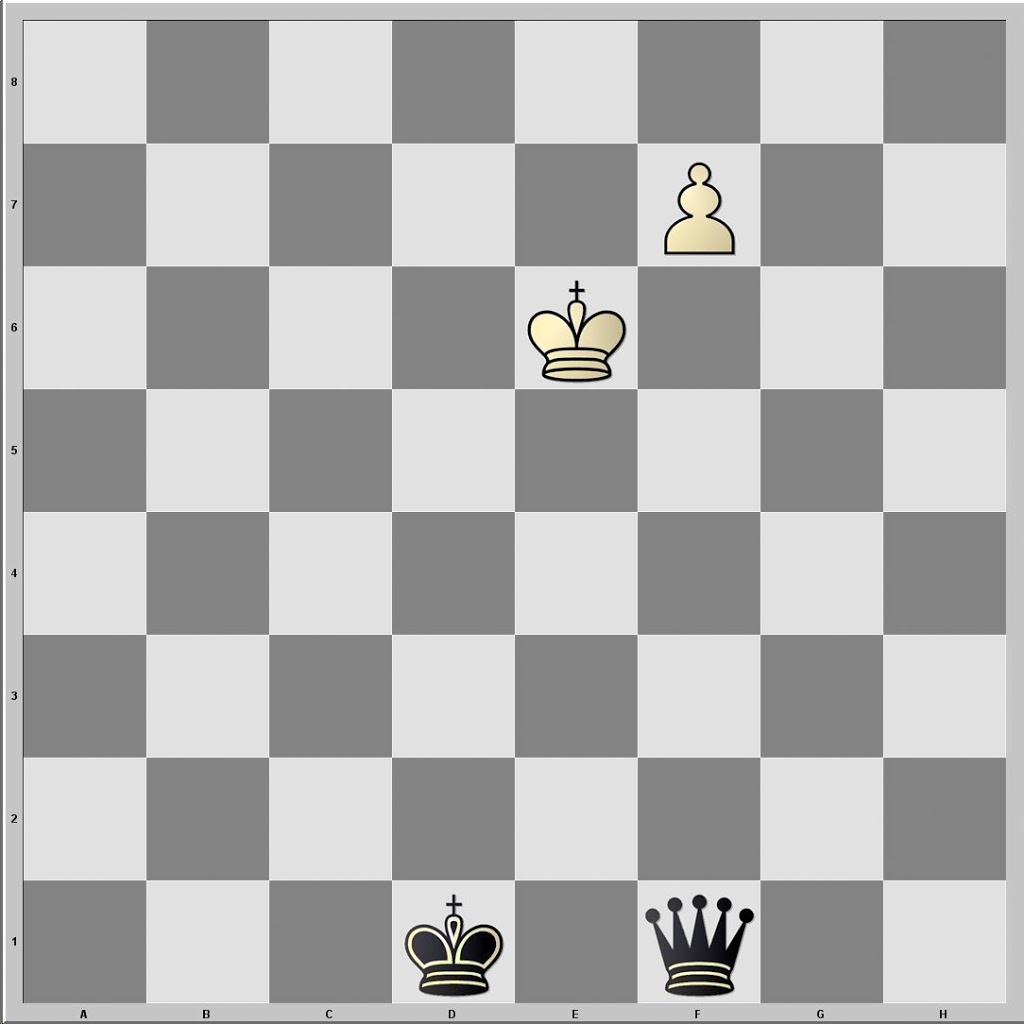
      White to move. Is this a loss or draw for White? How should White proceed?

      8/5P2/4K3/8/8/8/8/3k1q2 w – – 0 1

      Posted by Picasa
      Chess Daily News from Susan Polgar
      Previous Article Back to endgame basic (2)
      Next Article Artistic Inventor Sponsors NACA

      About Author

      Susan Polgar

      Related Posts

      • More Special Endgame!

        January 3, 2021
      • Precision Chess Tactic

        December 27, 2020
      • Daily dose of tactic!

        December 21, 2020

      6 Comments

      1. jcheyne Reply
        January 16, 2010 at 1:57 am

        A free basic endgame course online! Enjoying this.

        Draw after Ke7. No way to unhitch the king from the pawn, which will promote to a Q v. Q endgame.

      2. Garvin Reply
        January 16, 2010 at 2:54 am

        Draw, the king moves to h8.

      3. Ed Seedhouse Reply
        January 16, 2010 at 3:30 am

        This is a draw because it is one of the Bishop pawns on the seventh rank. Rook and Bishop pawns draw because of stalemate tricks. In this case white can go to h8 and if Qxc7 is stalemate, so he can always renew the threat to queen. Only if the black K was very close could black win by allowing white to Queen but mating him anyway.

      4. thanasis Reply
        January 16, 2010 at 6:16 am

        very interesting comments by ed.thx

      5. Anonymous Reply
        January 16, 2010 at 12:06 pm

        Draw. The only problem that can arrise here, as I understand, if the black king were closer, to get the white king on the corner side of the pawn, and putting the king in front of the pawn allows the other king to advance, while going behind the pawn might hazard the black queen getting control of f8. When the king gets to the other side, it is a certain draw.

      6. Ed Seedhouse Reply
        January 16, 2010 at 7:34 pm

        For a pawn on the seventh rank with it’s K supporting it, vs. Q and remotely located K, the a,c,f,and h pawns draw, whereas the b, d,e, and g pawns lose.

        There are exceptions where the stronger side’s K is close to the weaker side’s K.

        The general procedure for the stronger side is to use checks against the weaker side’s K to apprach with the Q. When close enough the Q may check in such a way that opposing the K must move in front of the pawn to preserve it.

        This allows the stronger side a move to bring the K closer to the pawn. Repeat this until the K is close enough to force the win.

        The procedure fails for the a and h pans because when the K moves in front of the pawn he will be in a stalemate position unless the stronger side moves the Q again.

        It also fails for the f and c pawns because the weaker side’s K may take refuge on the corner square (a1, a8, h1 or h8 depending), and if the pawn is captured then it is stalemate.

        The Q will then have to make a move to prevent the pawn from queening, and again the K will have no time to approach.

      Leave a Reply

      Cancel reply

      Improvement

      • Important Scholastic Coaching Tips
      • My Chess Quotes Over The Years
      • My kids know chess rules. What’s next?
      • Chess Parenting

      Events

      • My Top 10 Most Memorable Moments in Chess (Part 3) May 13, 2021
      • My Top 10 Most Memorable Moments in Chess (Part 2) May 12, 2021
      • My Top 10 Most Memorable Moments in Chess (Part 1) May 10, 2021
      • About Susan Polgar April 9, 2021
      • About Us
      • Contact Us
      • Daily News
      • My Account
      • Terms & Conditions
      • Privacy Policy

      Anand Armenia Breaking News Chess Club and Scholastic Center of St Louis Chess interview Chess Olympiad Chess tactic Chess tournament chess trivia China FIDE Grand Prix Holland India Khanty-Mansiysk LIVE games Lubbock Magnus Carlsen Moscow National Championship Norway OnlineChessLessons Philippines Puzzle Solving Russia Scholastic chess Spain SPF SPICE SPICE Cup St Louis Susan Polgar Tata Steel Chess Texas Tech Tromsø TTU Turkey Webster University Wesley So Wijk aan Zee Women's Chess Women's Grand Prix Women's World Championship World Championship World Cup

      April 2026
      M T W T F S S
       12345
      6789101112
      13141516171819
      20212223242526
      27282930  
      « Sep