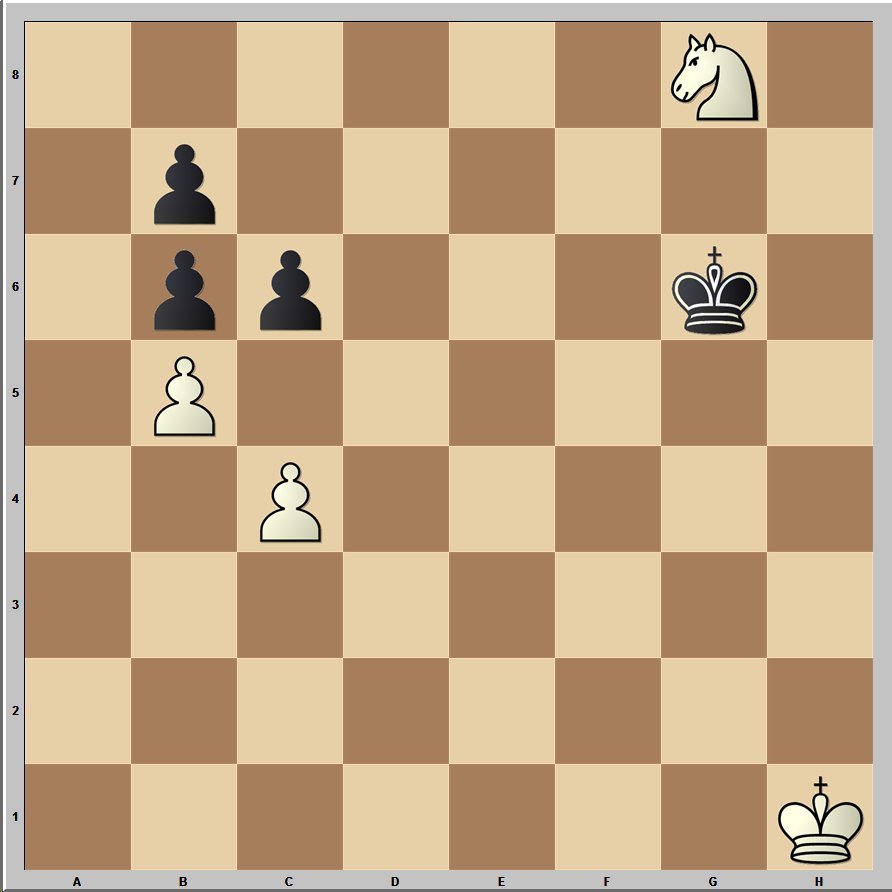
White to move. Is this a win or draw? How should White proceed?
6N1/1p6/1pp3k1/1P6/2P5/8/8/7K w – – 0 1
Afanasjev 1970

Chess Daily News from Susan Polgar

White to move. Is this a win or draw? How should White proceed?
6N1/1p6/1pp3k1/1P6/2P5/8/8/7K w – – 0 1
Afanasjev 1970
1.Ne7+ Kf6 2.Nxc6 bxc6 3.c5 wins
Am I missing something? It seems fairly simple – White wins with 1.Ne7+ K moves 2.Nxc6! bxc6 3.c5! followed by queening a pawn on b8.
Well, lets see what the obvious move brings us, shall we?
1. Ne7 Kf7 (Kf6 same, I think)
2. Nc6 bc6
3. bc6 Ke7 with a draw, I would think. However, white’s third move looks like an error to me. Better was
3. c5!! and no matter what black does, a white pawn plays to b6 and cannot be stopped by the black king.
Clearly, black’s second move above was an error. Let’s see if black has a better line at that point to hold. I see really only two likely options- Ke8 and Ke6. Taking them in order:
2. …..Ke8
3. Nb4
So the knight can threaten Nd5 and Nb6. Continuing:
3. …..Kd7 (anything better?)
4. Nd5 Kd6
5. Nb6 Kc5
6. Nc8 Kc4
7. b6
Now, this is actually the position I was aiming for since I have seen this more than once over the years in the online blitz games I have played. The black king cannot threaten both the knight and the pawn at the same time as his own pawn is a hindrance. If he plays to d7, the knight moves to a7, and from there guards c6 so black must waste two moves getting back to b5 to attack b6, but then the knight returns to c8; and in the meantime, white’s king comes into the action from any distance away. In addition, there are no stalemate themes since black cannot ever reach b8 unless white allows it (c8 guarded by the knight when he is sitting at a7).
The other alternative at move 2 for black was
2. …..Ke6
3. Nb4 Kd6
4. Nd5 Kc5 (only move)
And now white is in danger of losing both of the pawns, and I don’t see a way to win now. The difference in the two lines, of course, is that black reached c5 one move earlier than before. This might continue
5. Ne3 Kd4 and white’s king cannot help. Or
5. Kg2 Kc4
6. Nc7 Kc5
7. Kf3 Kd6
8. Na8 Kc5 (8.Ne8 Kc5 is equal too).
In this previous line, white goes wrong, I think, with the hasty 4.Nd5. Better is to cut black’s king from the fifth rank, and the way to do that is to play
4. Nd3! and white’s king will eventually enter through Kg2, Kf3, Ke4, and black cannot stop this as white always has a waiting move like Nb2 to force black out of the way while simulaneously protecting c4 from behind. If black retreats to a8/a7, the stalemate attempt will fail as white’s king reaches c7, and simply waits until black is forced back to a8.
So, 1.Ne7 followed by 2.Nc6 looks to win in all lines.
Draw. King is too far to protect the pawns.
1 Ne7+ Kf7
2 Nxc6 bxc6
counting on answering 3 bxc6 with Ke6
but 3 c5 ! obtains an unstoppable pawn on the b file
IT IS A WIN FOR WHITE!
I will let Black decide which of my pawns is going to become
a queen.
1. Ne7+ Kf7
2. Nxc6 bxc6
3. c5
then if 3… cxb5
4. cxb6 and the former c-pawn will queen
or if 3…. bxc5
4. b6 and the b-pawn will queen
Where it gets tough is when Black decides NOT to take
the knight on the 2nd move:
1. Ne7+ Kf6
2. Nxc6 Kf5 (going after the c-pawn)
and here 3. Na5 doesn’t quite work: 3. Na5 bxa5 4. c5 Ke5
5. c6 Kd6 6. cxb7 Kc7 is just fine for Black, so White
has to find something better on the 3rd move here.
White can afford to place the knight on a7 (3. Na7)
(where it is inaccessible to the Black king, and protects the
b-pawn) and forget about the c-pawn, allowing the White king
time to come up and control things. But this is pretty ugly and
time consuming. This wins, but there should be something better.
But I’ll have to look for that later. Have a meeting to go
to now. Bye.
white wins!
1. Ne7+ Kf6 2.Nxc6
and now 2.. bxc6 3.c5!
or 2.. Ke6 3. Nd8+ Kd6 4.Nxb7 Kc7 5.Nc5 bxc5 and Black can’t keep the white king at bay
white wins.
1. Ne7 K moves 2. Nxc6. If the knight is captured, white has a standard pawn breakthrough: 2…bxc6 3. c5. A passed pawn is created, with decisive effect.
This motif is worth remembering. Magnus Carlsen used it in a more complex setting against Wang Yue at the recent King’s Tourney.
1.Ne7+ Kf6 2.Nxc6! bxc6 3.c5! bxc5 4.b6 +- or 3…cxb5 4.cxb6+-
or 3…Ke6 4.cxb6 Kd6 5.b7! Kc7 6.bxc6 +-
Even with his poorly placed King, White wins. The line goes 1.Ne7+ Kf6 2.Nxc6! Ke6 (or 2…bxc6 3.c5! and Black must lose both pawns to stop White’s b-pawn) 3.Nb4 Ke5 4.Nd5 Kd4 5.Nxb6 Kc5, and now I believe 6.Nc8 Kxc4 7.b6 should win fairly soon since White can always shuttle the knight to a7 as needed, meanwhile his King comes up the board and eats Black’s pawn. The odd-looking 6.Na8!? Kxc4 7.b6 may also win, but White has to maneuvre a while to reach a position with Black’s king on a8 and the knight on c5. There White plays Na6! forcing bxa6, then Kc7 and queens. With Black’s king hiding behind the b6/b7 pawn structure, White must have a knight to win. A bishop would be a draw.
have racked my head for the last 30 minutes and can’t see anything better than a draw for white.
but i guess there must be win for white…’cos Susan says “calculation required :)”
anyway…i need a break.
White wins, I think…
1.Ne7+ Kf6
2.Nxc6 bc
3.c5
1. Kt-K7 ch K any
2. KtxP PxKt
3. P-B5 winning
First look, no board to analyze on.
1. Ne7+ Kf6
2. Nxc6
stands out. 2… bxc6 3. c5!! wins for white, since whatever black does next white gets a passed pawn on b6 which black is powerless to stop. So what else can black do at his second move? Bring the king closer?
2… Ke6
3. Nb4 Kd6
4. Nd3 and black cannot ever get to c5. White will bring over his king at leisure and win the game presumably.
If black tries an alternate route at his third move,
3… Ke5
4. Nd5 Kd4
5. Nxb6 Kc5
6. Nc8! (Took me some time to work out this move. This is where I brought the board out)
Now black has hardly anything left to try. If 6… Kxc4 7. b6 and white will bring his king over. If black king tries to get chummy with the knight, the knight will move to a7.
Essentially, each time black alternates his attack between the white knight on c8 and the pawn on b6, white gains a tempo to bring his king closer (black needs to move d7-d6-c6).
1.Ne7+ K moves 2.Nxc6! bxc6 3.b5! followed by queening on b8 looks like a win.
Hello, again. Now that I have the time to look at the variations
where Black does not take the knight on the 2nd move, I see
that there is something quicker and more elegant than the
solution I gave before.
When the Black king goes after the c-pawn, this is what White
can play:
1. Ne7+ Kf6
2. Nxc6 Kf5
3. Nd8 Ke4
4. Nxb7 Kd5
5. c5! bxc5
6. b6 Kd5
7. Nxc5! Kc6
8. b7 and only now does the White king have to
march out from the corner to support the
White pawn.
When the Black king goes after the knight, something oddly
similar happens:
1. Ne7+ Kf6
2. Nxc6 Ke6
3. Nd8+ Kd7
4. Nxb7 Kc7
5. Nc5! (this time it is the knight that gets sacrificed
on c5, not the c-pawn as before)
If Black plays 5…. bxc5 here, then the resulting king and
pawn ending is an elementary win for White. If Black doesn’t
take the knight, then the Knight just moves to safety (Na4),
and it is pretty much all over.
This problem turned out to be much more interesting than I
orginally thought it was going to be!
1 Ne7+ Ke6. 2 Nxc6 bxc6. and here comes the important move:
3 c5
On the next move white ends up with a pawn on b6, no matter what black does.
From Spain…
1)Ne7+,Kf6
2)Nc6,bc6
3)c5,bc5
4)b6,c4
5)b7,c3
6)b8=Q,c2
7)Qb2 +-
1)Ne7+,Kf6
2)Nc6,bc6
3)c5,Ke6
4)cb6,Kd6
5)b7,Kc7
6)bc6 +-
Greetings from Spain
its pretty simple:
1.Ne7 Kf6 2. Nc6 Ke6 (2…bc6, 3.c5)3.Nd4 Ke5, 4.Nb3 Ke4, 5.Kg2 Kd3, 6.Na5 Kc3, 7.Kf3 Kb4, 8.Nc6 Kc4, 9.Na7 Kc5, 10.Ke4 Kd6, 11.Kd4 Kc7, 12.Kd5 Kb8, 13.Nc6 winning.
I dont mean to boast, but this is all blindfold analysis 😛
Nq7+, K moves, Nxp, pxn c5…. perhaps
Ne7 and then Nc6!! win for white
1. Ne7 Kf6
2. Nxc6 bxc6
3. c5!!
well I can tell you this,
blacks pawn at c6 is toast.
1 Ne7+ Kf7 or whatever
2 Nxc6 .. if bxc6
3 c5! and the pawn with queen on b file before the black king can reach.
This took a lot of time to figure, but I’m glad to develop my thinking skills. In this case, I think imagination is required much more than calculation. White has no real losing chances, so let’s see if white can win.
You need to discover that white can always use a black pawn (eg. b7)to shield his knight (eg.Na8) while the defending the pawn(eg.b6), and if the king attacks the knight, white moves the knight (eg. Nc7) into the pawn’s defense. This defensive fortress that buys white time to bring his king into the picture.
We don’t want the c6 pawn because no fortress is possible there.
In a game situation, the above is all you need to figure in advance.
So we start by capturing the b6 pawn, (Ne7, Nc8, Nxb6) and then see if we can set up a fortress. Black has three possible plans.
a) Black plays c5. In this case the fortress is already established. Bring a knight to b6
b) Black trades early on b5. Then 5.Na8 and 6.b6 create a fortress before the king arrives. If 5…b6 then Nc7/Na6 form the fortress. (Nxb6 also wins)
c) Black approaches with his king. It turns out white cannot create a fortress with her c pawn, so she sacrifices it with Na8! followed by b6!
Black trading on b5 loses as above, so the only other try is to promote the pawn. White will try to stop with the king, so black must escort the pawn This buys black time to bring the knight out in defense. 1. Na8 Kc5 2 b6 Kxc4 3 Kg1 c5 4Kf1
i) 4..Kb3 5 Ke2 Kb2 6 Nc7! c4 7 Nd5 winning.
ii) 4..Kd3 Ke1 5.Kc2 Nc7 also wins.
Nicely done, Lucy! I had missed that roundabout attack on the c-pawn. Your solution is elegant.
The line I gave was complex, and completely different from everyone else, but I think correct. I had tried Nxc6 but missed c5!! Yet this line is also complex, and only Yancey has made an attempt to thoroughly analyze variations. I see one variation he missed, but same result:
1.Ne7 Kf6 2.Nc6 Ke6 3.Nb4 Ke5 4.Nd5 Kd4 5.Nxb6 Kc5 6.Na8 (or Nc8, same thing) 7.Kc5 b6 with the fortress.
We both neglected to explain how to break black’s fortress if he brings a K to g8. It’s interesting as you can’t chase the K out, white’s king can’t approach because of stalemate, and Nxb7 Kxb7 is a draw regardless of white’s king position. The answer is to arrange for white king to d7-d8, black king shuffles a8-b8, then when the black king reaches a8:
1.Na6! bxa6 (forced) 2.Kc7 a5 3.b7+ Ka7 4.b8Q+ Ka6 5.Qb6++
Last word on my line: The pawn-race variation was not calculated correctly. In particular, I neglected to consider that black can double back after pushing the c-pawn and go after white’s b pawn. White can’t stop the pawn and simultaneously guard b6.
So long story short: Ne7-c8-b6 is drawn with best play. And my calculation skill needs further development.
1.Ne7+ kf6 2.Nxc6 Kf5(only move) 3.Nd8 Ke4 4.Nxb7 Kd4 5.c5 bxc5 6.Nd6