Nice problem, not so difficult. Is’s about the unprotected white queen, combined with a mate threat.
1. …, e5 ! (Black threatens to take white bishop with a check.) 2. Qe4 (2. dxe5 loses the queen, 2. …, Bxe5. 3. Bxe5, Rxe5+. 4. Nxe5, Qxb7) 2. …, Nd7; 3. Qe3 (gets the queen out of the pin) 3. …, Bd8 ! (prepares for a lethal attack on the white king!) 4. Rc1, Bb4+ 5. Kd1, Qf1+ 6. Kc2, Rc8+ 7. Kb3, Rxc1 8. Qxc1, Qxf3+ 9. Kxb4, Qb7+ ! 10. Kc3 and now black can takes the white bishop and wins.
e5 is really a crushing move in this position. for example 1. … e5 2. dxe5 Bxe5 3. Bxe5 Rxe5+ 4. Nxe5 Qxb7 so maybe 2. Rd2 exf4+ 3. Kd1 Qf1+ 4. Kc2 fxg3 good night, white pride. greets, jan
As black, I would definitely be looking to finish opening the e-file. But for one detail, it might appear that the d-pawn, the bishop, and the knight give white three-fold control vs two-fold attack on e5 if black pushes the pawn. That one detail makes the difference- the knight is pinned to the queen at b7:
1. …..e5
And I don’t see a good defense for white now. All captures at e5 look the same to me- for example
2. de5 Be5 3. Be5 Re5 with a decisive edge. Or
2. Be5 Be5 3. de5 Re5
Trying a move like 2.Rd2 is going to fail because black takes with check at f4:
2. Rd2 ef4 3. Kd1 Qf1 4. Kc2 fg3 (Qc4 worth look, too) 5. Ne5 Be5 6. de5 Qc4 and this is likely going to cost white his rook, too, or get mated with the king out in the open.
Of all the possible moves white might make at move 2, only one doesn’t immediately drop a piece or worse:
2. Qe4
The knight is still pinned, but so is black’s e-pawn, but it is only a matter of time before the pressure becomes overwhelming:
2. …..Nd7
Protecting e5 and threatening Nf6 followed by ef4. Continuing:
3. Qe3
Nothing seems any better to me with the coming discovered check. White still can’t take at e5 due to the pinned knight. Moving the bishop to g5 just loses it after Qg3+, while moving it to d2 or c1 just loses to Nf6 followed by ed4 opening the rook up on the king/queen combo. 3.Rd2 is met by Qh1- for example (3.Rd2 Qh1 4.Kf2 Nf6 and a piece is still going to be lost). 3.Qe3 at least unpins the hapless knight and takes a good part of the sting out of Nf6 since white could then take at e5, though black will then take at h3 and still be up a pawn with the initiative.
The real question that is hard to answer here is, what is best for black now? Black still can’t open up the e-file because the pawn is pinned. Black could take at a2 or h3:
3. …..Qa2 4. de5 Ne5 (Be5 ok, too, I think) 5. Ne5 Be5 6. Be5 Qa5 (better than Qe6) 7. Kf2 Re5 with a two pawn advantage, but white can still put up some resistance. Or
3. …..Qh3 4. de5 Ne5 5. Ne5 Be5 6. Be5 Qe6 (Qf5 7.Rd5 ok or not?) 7. Rd2 Qe5 8. Qe5 Re5 and black is again up two pawns, but now in a rook endgame. I think black’s edge is decisive here, but I am not 100% sure. At move 3, black could try the pawn push:
3. …..e4
Now, at least, the hard question is back on white- what to do with the knight? The options are Ne5, Ng5, Ng1, and Nd2:
4. Ng1
Protects h3. I have a hard time seeing anything here for black other than the obvious take at a2:
4. …..Qa2
The position is complicated. I could spend a lot of time looking at the various lines here, but the fact is that black is up two clean pawns and still has the initiative. Is this a position better than the ones in which more material was liquidated? I simply can’t tell. Or, at move 4
4. Ne5 Ne5 5. de5 Be5 (Qh3 better?Don’t know) 6. Be5 Re5 7. Rd8 Kg7 8. Qc3 Qg1 9. Ke2 Qc5 10.Qc5 Rc5 with a two pawn advantage in a rook endgame for black. Or, at move 4
4. Nd2 Nf6 (threatening Nd5) 5. Qe2 Qh3 and this is quite complicated, too, but the advantage looks better for black to me due to the increased pressure of the black knight.
All in all, I like the positions that arise for black when he plays 1. ….e5. At worst, he seems to end up in a rook endgame up two clean pawns, or up two clean pawns in a major piece middle game. For this continuation, the key unknown to me is black’s move at move 3. Right now I don’t see better than the pawn push or the two takes at h3 and a2.
Black attacks White’s Bishop and threatens to open the file for her Rook.
2 Qe4
White must do something about the lethal threat of exf4 or exd4. With the given move, White prevents the pawn from capturing anything and adds another piece to attack it.
2 … Nd7
Black supports the e-pawn so that White can’t safely capture it.
3 Qe3 Bf8
Threatening … Bb4+
4 a3 Bxa3!
Better than 4 … Exf4, 5 Qxe8 Qxf3, which wins two pieces for a pawn but ends Black’s attack.
5 Rb1
White stops the threat of Bb5+
5 … Qh1+ 6 Ng1 Be7!
This peculiar looking move protects the Rook from harm so that exf4 is again threatened. On e7, the Bishop also threatens two deadly attacks if White should capture the pawn with either pawm or Bishop.
7 Kf1
Of course 7 dxe5 is met by Bb4. 7 Bxe5 Bg5!, 8 Qf2 Nxe5, 9 dxe5 Rxe5+, 10 Kf1 Be3, and White is in more trouble that he can handle.
7 … exf4
The point of 6 … Be7. Black can now take the Bishop, as the Rook is shielded from the Queen by the Bishop.
An instructive position. A rook pin on the e file, a diagonal pin on h1-a8 and an unprotected queen combine. 1.… e5! 2. d*e5 (cannot take with B because of f6) B*e5! (the justification of 1. …e5) 3.B*e5 R*e5+ wins with 4. N*e5 Q*b7 wins easily not only because of the material but because the queen dances around picking up pawns e.g. 5. Ng4 Qh1+ 6.Ke2 Qg2+ 7. Nf2 Q*g3.
Because of this, white can decline taking at 2. d*e5 e.g. strongest is 2. Qe4, Rd8! 3. Be3 (If now 3.d*e5, Qh1+ wins the rook)and now 3. …e*d4 is good but simply 3. …Q*g3+ is better. e.g. 4. Bf2 Q*h3 ( if then 5. N*e5 Re8, e.g. 6 Qd5 B*e5 7.d*e5 N-d7 wins another pawn e.g. 8 Qc6, R*e5+) so 5. d*e5, Qh1+ 6. Bg1 R*d1+ 7. K*d1 B*e5! 8. Q*e5 Q*f3+ (it’s this check that makes the game won).
Ah, 3. ….Bf8 suggested by Tom Barrister. I never once considered bringing the bishop in at b4. I was definitely too focused on protecting the e5 pawn as long as possible. A much stronger move, I think, than the ones I offered.
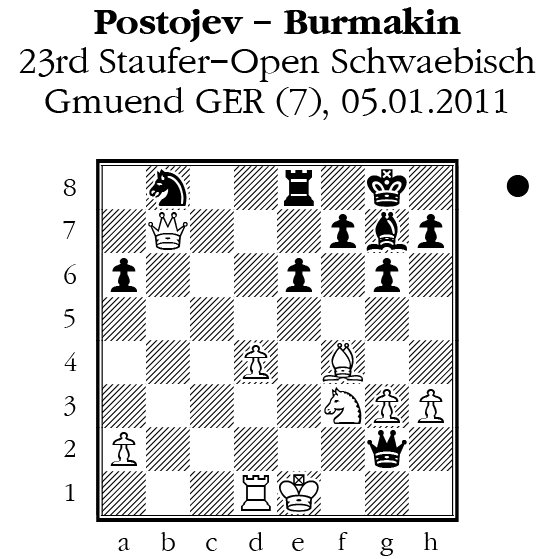


Nice problem, not so difficult.
Is’s about the unprotected white queen, combined with a mate threat.
1. …, e5 ! (Black threatens to take white bishop with a check.)
2. Qe4 (2. dxe5 loses the queen, 2. …, Bxe5. 3. Bxe5, Rxe5+. 4. Nxe5, Qxb7)
2. …, Nd7; 3. Qe3 (gets the queen out of the pin)
3. …, Bd8 ! (prepares for a lethal attack on the white king!)
4. Rc1, Bb4+
5. Kd1, Qf1+
6. Kc2, Rc8+
7. Kb3, Rxc1
8. Qxc1, Qxf3+
9. Kxb4, Qb7+ !
10. Kc3 and now black can takes the white bishop and wins.
Erik Fokke
Amsterdam, Netherlands
10.
1. e5 …
White’s knight is pinned, so it doesn’t count as a defender of e5.
1. … de
2. Be5 Be5
3. Re5+ Ne5
4. Qb7
e5 is really a crushing move in this position. for example
1. … e5
2. dxe5 Bxe5
3. Bxe5 Rxe5+
4. Nxe5 Qxb7
so maybe
2. Rd2 exf4+
3. Kd1 Qf1+
4. Kc2 fxg3
good night, white pride.
greets, jan
e5 without thinking. The e-file must to be opened.
Then I wondered whether Bxd4 might to be even better. But after Rd2 white, though worse, still has chance.
1.e5 dxe5
what else? white cannot allow opening e-file with check.
2.Bxe5 Resign
If Be3, Bxg3
If Bxe5, Rxe5
The only possible move to obtain anything, in this position, is e5.
As black, I would definitely be looking to finish opening the e-file. But for one detail, it might appear that the d-pawn, the bishop, and the knight give white three-fold control vs two-fold attack on e5 if black pushes the pawn. That one detail makes the difference- the knight is pinned to the queen at b7:
1. …..e5
And I don’t see a good defense for white now. All captures at e5 look the same to me- for example
2. de5 Be5
3. Be5 Re5 with a decisive edge. Or
2. Be5 Be5
3. de5 Re5
Trying a move like 2.Rd2 is going to fail because black takes with check at f4:
2. Rd2 ef4
3. Kd1 Qf1
4. Kc2 fg3 (Qc4 worth look, too)
5. Ne5 Be5
6. de5 Qc4 and this is likely going to cost white his rook, too, or get mated with the king out in the open.
Of all the possible moves white might make at move 2, only one doesn’t immediately drop a piece or worse:
2. Qe4
The knight is still pinned, but so is black’s e-pawn, but it is only a matter of time before the pressure becomes overwhelming:
2. …..Nd7
Protecting e5 and threatening Nf6 followed by ef4. Continuing:
3. Qe3
Nothing seems any better to me with the coming discovered check. White still can’t take at e5 due to the pinned knight. Moving the bishop to g5 just loses it after Qg3+, while moving it to d2 or c1 just loses to Nf6 followed by ed4 opening the rook up on the king/queen combo. 3.Rd2 is met by Qh1- for example (3.Rd2 Qh1 4.Kf2 Nf6 and a piece is still going to be lost). 3.Qe3 at least unpins the hapless knight and takes a good part of the sting out of Nf6 since white could then take at e5, though black will then take at h3 and still be up a pawn with the initiative.
The real question that is hard to answer here is, what is best for black now? Black still can’t open up the e-file because the pawn is pinned. Black could take at a2 or h3:
3. …..Qa2
4. de5 Ne5 (Be5 ok, too, I think)
5. Ne5 Be5
6. Be5 Qa5 (better than Qe6)
7. Kf2 Re5 with a two pawn advantage, but white can still put up some resistance. Or
3. …..Qh3
4. de5 Ne5
5. Ne5 Be5
6. Be5 Qe6 (Qf5 7.Rd5 ok or not?)
7. Rd2 Qe5
8. Qe5 Re5 and black is again up two pawns, but now in a rook endgame. I think black’s edge is decisive here, but I am not 100% sure. At move 3, black could try the pawn push:
3. …..e4
Now, at least, the hard question is back on white- what to do with the knight? The options are Ne5, Ng5, Ng1, and Nd2:
4. Ng1
Protects h3. I have a hard time seeing anything here for black other than the obvious take at a2:
4. …..Qa2
The position is complicated. I could spend a lot of time looking at the various lines here, but the fact is that black is up two clean pawns and still has the initiative. Is this a position better than the ones in which more material was liquidated? I simply can’t tell. Or, at move 4
4. Ne5 Ne5
5. de5 Be5 (Qh3 better?Don’t know)
6. Be5 Re5
7. Rd8 Kg7
8. Qc3 Qg1
9. Ke2 Qc5
10.Qc5 Rc5 with a two pawn advantage in a rook endgame for black. Or, at move 4
4. Nd2 Nf6 (threatening Nd5)
5. Qe2 Qh3 and this is quite complicated, too, but the advantage looks better for black to me due to the increased pressure of the black knight.
All in all, I like the positions that arise for black when he plays 1. ….e5. At worst, he seems to end up in a rook endgame up two clean pawns, or up two clean pawns in a major piece middle game. For this continuation, the key unknown to me is black’s move at move 3. Right now I don’t see better than the pawn push or the two takes at h3 and a2.
1 ,,, e5!
Black attacks White’s Bishop and threatens to open the file for her Rook.
2 Qe4
White must do something about the lethal threat of exf4 or exd4. With the given move, White prevents the pawn from capturing anything and adds another piece to attack it.
2 … Nd7
Black supports the e-pawn so that White can’t safely capture it.
3 Qe3 Bf8
Threatening … Bb4+
4 a3 Bxa3!
Better than 4 … Exf4, 5 Qxe8 Qxf3, which wins two pieces for a pawn but ends Black’s attack.
5 Rb1
White stops the threat of Bb5+
5 … Qh1+
6 Ng1 Be7!
This peculiar looking move protects the Rook from harm so that exf4 is again threatened. On e7, the Bishop also threatens two deadly attacks if White should capture the pawn with either pawm or Bishop.
7 Kf1
Of course 7 dxe5 is met by Bb4. 7 Bxe5 Bg5!, 8 Qf2 Nxe5, 9 dxe5 Rxe5+, 10 Kf1 Be3, and White is in more trouble that he can handle.
7 … exf4
The point of 6 … Be7. Black can now take the Bishop, as the Rook is shielded from the Queen by the Bishop.
8 Qxf4 Qd5
Black is a piece and a pawn ahead.
1…e5!
Kamalakanta
An instructive position. A rook pin on the e file, a diagonal pin on h1-a8 and an unprotected queen combine.
1.… e5! 2. d*e5 (cannot take with B because of f6) B*e5! (the justification of 1. …e5) 3.B*e5 R*e5+ wins with 4. N*e5 Q*b7 wins easily not only because of the material but because the queen dances around picking up pawns e.g. 5. Ng4 Qh1+ 6.Ke2 Qg2+ 7. Nf2 Q*g3.
Because of this, white can decline taking at 2. d*e5 e.g. strongest is 2. Qe4, Rd8! 3. Be3 (If now 3.d*e5, Qh1+ wins the rook)and now 3. …e*d4 is good but simply 3. …Q*g3+ is better. e.g. 4. Bf2 Q*h3 ( if then 5. N*e5 Re8, e.g. 6 Qd5 B*e5 7.d*e5 N-d7 wins another pawn e.g. 8 Qc6, R*e5+) so 5. d*e5, Qh1+ 6. Bg1 R*d1+ 7. K*d1 B*e5! 8. Q*e5 Q*f3+ (it’s this check that makes the game won).
Psyche/Anonymous
1.e5 de 2.Bxe5 Bxe5 3.Rxe5 Nxe5 4.Qxb7
Ah, 3. ….Bf8 suggested by Tom Barrister. I never once considered bringing the bishop in at b4. I was definitely too focused on protecting the e5 pawn as long as possible. A much stronger move, I think, than the ones I offered.