

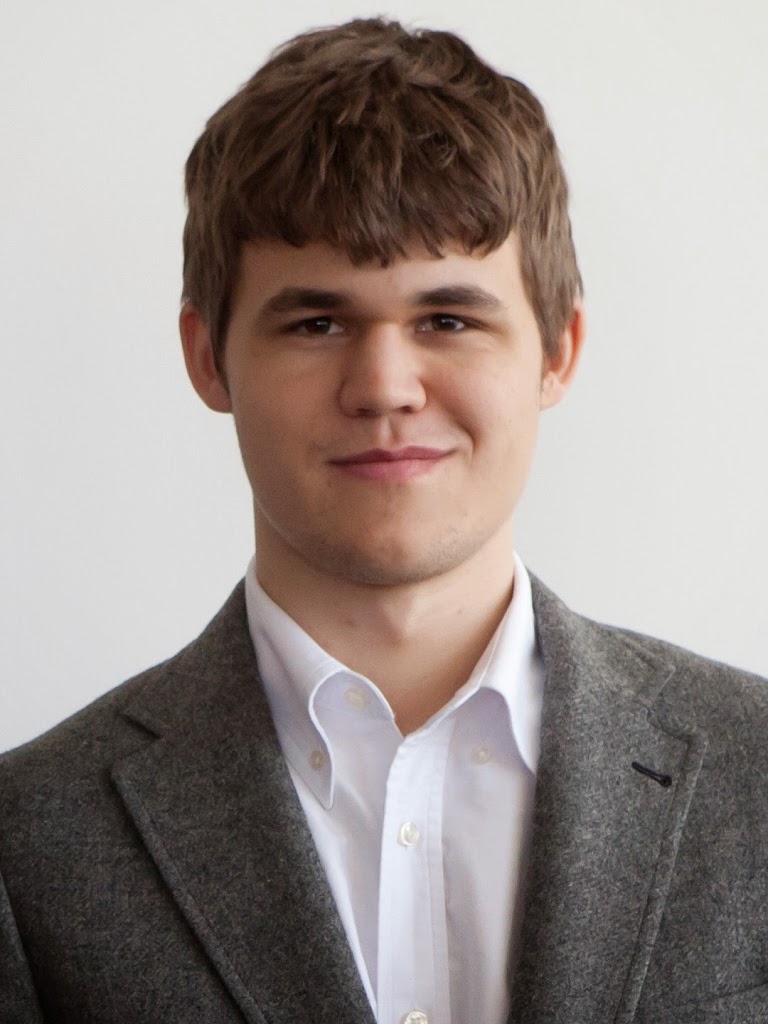
OSLO — It’s a rainy day in Norway‘s capital, and a fire is burning in the luxurious building of investment bank Arctic Securities. Next to the hearth, a chessboard reminds us that the organization is a proud sponsor of new world chess champion Magnus Carlsen. Lounging on a couch, with part of his shirt untucked from his trousers, the 23-year-old is nibbling on peanuts.
The last time we met was in 2008. He was just a teenager back then but already one of the games’ top prospects, “the Mozart of chess,” in the words of The Washington Post. At the time, we retraced the conventional steps of a child prodigy gifted with an exceptional memory. He had just won one of the world’s most difficult tournaments, in the Dutch city of Wijk-aan-Zee, at just 17.
“I think the question is not whether Carlsen will become world champion, but rather when,” former Russian world champion Vladimir Kramnik predicted at the time.
Kramnik’s prophecy came true five years later when Carlsen defeated Indian Viswanathan Anand on Nov. 22, 2013. As if it was always meant to be. And yet, reaching the top was no easy task. During the second half of 2008, Carlsen’s results receded. But one year later, everything was strangely back to normal.
In the meantime, the Norwegian played his trump card: Garry Kasparov. Carlsen established contact with the greatest chess player of the 20th century — world champion between 1985 and 2000 — at the end of 2008 via Frederic Friedel, director of ChessBase, a German company specializing in chess computer software.
“[Friedel] had been trying to talk Garry into coaching me for a long time, but he wasn’t convinced by the idea,” Carlsen explains. Kasparov had struggled to accept that his best days were behind him. On the other hand, if he accepted the offer, he could be the one to introduce the world to his successor. That and a big check finally convinced him.
Carlsen’s agent Espen Agdestein went looking for sponsors to bankroll the six training sessions that would take place during 2009. The collaboration between Carlsen and Kasparov remained secret for months, but the news broke in September. During those sessions, Carlsen worked on something he had never really studied in depth before — openings. But most of all, his Russian mentor offered him an analytical glimpse of the psychology of other great chess masters.
“I was sometimes surprised to see how well he knew his opponents,” Carlsen says during our talk in Oslo. “Even with players famous for their unpredictability, like the Russian Morozevich or the Ukrainian Ivanchuk, he managed to find patterns in their game. And with first-rate champions such as Kramnik or Anand, he knew what position they liked to play in and those in which they felt uncomfortable.”
Finding the crack
In an era when computer software is ubiquitous, champions have changed methods. It is not so much about overwhelming the opponent with rehearsed moves anymore as it is about forcing him into an uncomfortable position, where he will commit the one tiny mistake that will cost him the win.
This method suits Carlsen’s style. According to the top French player Maxime Vachier-Lagrave, “He is very patient. He’s a universal player who can adapt to anybody. He creates a problem on the right-hand side, then one on the left to cause you to make a mistake and to crack under the pressure. On top of that, he makes very few mistakes. In fact, I don’t believe we’ve ever seen a player make so few mistakes.”
Carlsen agrees and sums up his strategy this way: “I try to play 40 or 50 good moves, and I challenge my opponents to do the same. Even when the position is simple, or seems simple, I try to remain focused and creative to find the hidden possibilities. I do just like everybody else, but a bit better.”
French master Laurent Fressinet, who helped Carlsen prepare for the 2013 world championship, says Carlsen isn’t arrogant, just unwaveringly confident. “On top of his extraordinary talent to feel where the pieces must be placed, what sets him apart is his exceptional mindset,” Fressinet says. “If he thinks he can win, he’ll have no mercy for his opponent.”
In 2009, Kasparov thus put Carlsen back on the right track, and he has not budged since. On Jan. 1, 2010, he became No. 1 in the rankings measured by points. All that was left to do was win the ultimate title from Anand, who was born in 1969 and is old enough to be his father. This was almost a formality. Although the game was played in Anand’s hometown of Chennai, in southeastern India, Anand played with fear. He lost before he even started.
Infamous and notorious
That is also why the Norwegian is now considered such an exceptional player. When playing against him, some seem to start with a handicap. Just as Bobby Fischer and Garry Kasparov used to crush their opponents just with their presence on the other side of the board, Carlsen too holds his reputation up his sleeve. As Dutch Grandmaster Anish Giri explains, “You first play for your name, then your name plays for you.”
At only 23, Magnus Carlsen is already a dread-inspiring legend. So much so that American Grandmaster Hikaru Nakamura nicknamed him Sauron, the evil character in J.R.R. Tolkien’s The Lord Of the Rings, represented in Peter Jackson’s film adaptation by a great lidless eye in the sky that sees everything. At a February competition in Zurich, Switzerland, Nakamura had the opportunity to defeat his nemesis. Carlsen, who had taken too many risks, was facing a devastating attack. Like a groggy boxer, he tried to take one more blow, and another one, not wanting to throw in the towel before his defeat was inevitable. The American knew he had him.
But the clock kept ticking, and though Carlsen was on the ropes, he kept laying traps. The mistake was lurking there, always tempting, waiting to be committed, and it finally forced itself on Nakamura. The American had barely opened the door when Carlsen rushed in with a devastating counterattack. The fight was nearly lost, but in the end Carlsen won it. What makes great players is precisely their ability to create their own luck, or at least to squeeze out the very best from every opportunity.
Just a regular guy
When we ask Carlsen to assess himself, he says he sees himself as a “normal man.” He left his parents’ home in September. His father, Henrik, left his job in the oil industry years ago to oversee Magnus Chess, the company that manages his son’s career and revenue. “He spends time with his friends, does a lot of sports,” Henrik says of his son. “He doesn’t need to work on his chess too much. He always has it in a corner of his mind, and he mulls over his ideas without really thinking about them.”
After winning the title, Carlsen became an internationally known figure. He is now a model for a clothing brand. He has performed the kickoff for the Real Madrid soccer game in Spain, given a chess lesson to Facebook CEO Mark Zuckerberg, and delivered a chess beating to Bill Gates. Microsoft’s founder was humiliated on a television program, mated in just nine moves and 79 seconds.
But although Carlsen knows that the media can make his sport more popular, he is not looking for fame. Instead, he is fully focused on his next challenge: Defending his world champion title. After all, being king of the game of kings is all this normal man knows. In November, he will once again face Viswanathan Anand, whose victory in the Candidates tournament in March was a rebirth for the Indian player.
As our interview draws to an end, Carlsen is watching a sports program on his computer. His agent shows us a smartphone app that allows players to compete against Carlsen at different ages. Without taking his eyes off his screen, the world champion says, “8-year-old me is easy to defeat.” I try it, and indeed, the game doesn’t last long. “Magnus, I’m afraid I beat you.” He doesn’t reply.
Yes Magnus, I defeated you, and it feels great.
Read the full article: Magnus Carlsen, A Chess Child Prodigy Grows Up
Worldcrunch – top stories from the world’s best news sources
This boy is no match to Nakamura.