

Chess-Championship Results Show Powerful Role of Computers
The digital revolution has pushed human abilities to new heights
By Christopher Chabris and David Goodman
Nov. 22, 2013 11:21 a.m. ET
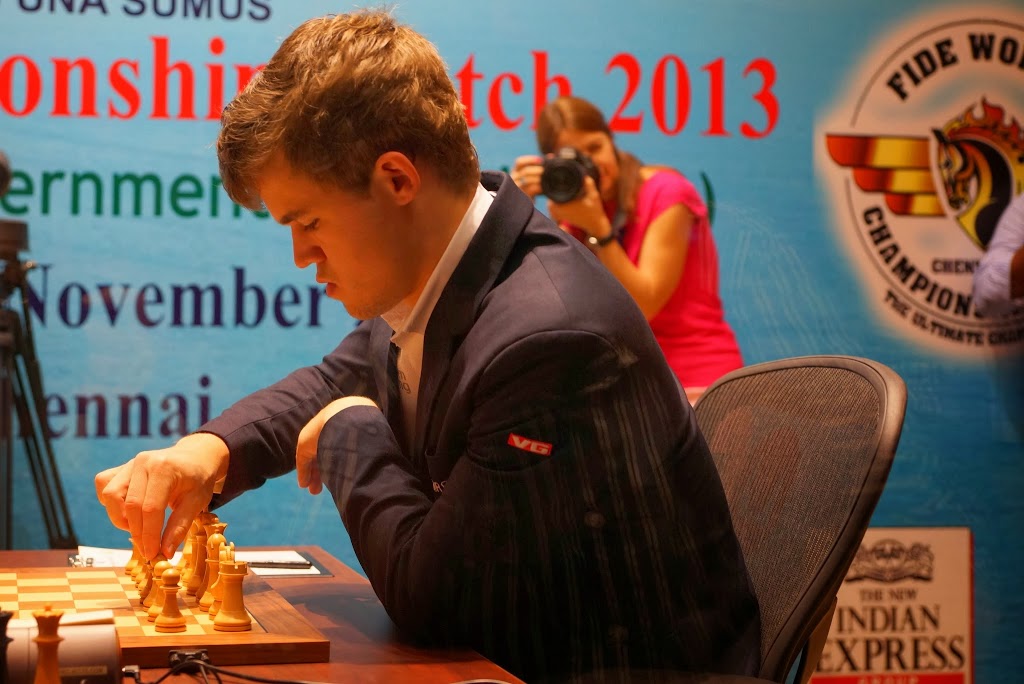
In the world chess championship match that ended Friday in India, Norway’s Magnus Carlsen, the cool, charismatic 22-year-old challenger and the highest-rated player in chess history, defeated local hero Viswanathan Anand, the 43-year-old champion. Mr. Carlsen’s winning score of three wins and seven draws will cement his place among the game’s all-time greats. But his success also illustrates a paradoxical development: Chess-playing computers, far from revealing the limits of human ability, have actually pushed it to new heights.
The last chess match to get as much publicity as Mr. Carlsen’s triumph was the 1997 contest between then-champion Garry Kasparov and International Business Machines Corp.’s Deep Blue computer in New York City. Some observers saw that battle as a historic test for human intelligence. The outcome could be seen as an “early indication of how well our species might maintain its identity, let alone its superiority, in the years and centuries to come,” wrote Steven Levy in a Newsweek cover story titled “The Brain’s Last Stand.”
But after Mr. Kasparov lost to Deep Blue in dramatic fashion, a funny thing happened: nothing. Amateurs didn’t throw away their sets, and professionals didn’t switch careers. In fact, just about the only people who quit chess after the match were the IBM IBM -1.54% IBM in Your Value Your Change Short position computer scientists, who moved on to other challenges. Chess went back to the way it was before—with one big difference.
Before the Deep Blue match, top players were using databases of games to prepare for tournaments. Computers could display games at high speed while the players searched for the patterns and weaknesses of their opponents. The programs could spot blunders, but they didn’t understand chess well enough to offer much more than that.
Once laptops could routinely dispatch grandmasters, however, it became possible to integrate their analysis fully into other aspects of the game. Commentators at major tournaments now consult computers to check their judgment. Online, fans get excited when their own “engines” discover moves the players miss. And elite grandmasters use computers to test their opening plans and generate new ideas.
This wouldn’t be very interesting if computers, with their ability to calculate millions of moves per second, were just correcting human blunders. But they are doing much more than that. When engines suggest surprising moves, or arrangements of pieces that look “ugly” to human sensibilities, they are often seeing more deeply into the game than their users. They are not perfect; sometimes long-term strategy still eludes them. But players have learned from computers that some kinds of chess positions are playable, or even advantageous, even though they might violate general principles. Having seen how machines go about attacking and especially defending, humans have become emboldened to try the same ideas.
Computers have gone so far that the top human players are now those who most often play the moves that would be chosen by the best engines (which sport names like Houdini, HIARCS and Rybka). Magnus Carlsen’s biographers dub him the “hero of the computer era.” Indeed, a study published on ChessBase.com earlier this year showed that in the tournament Mr. Carlsen won to qualify for the world championship match, he played more like a computer than any of his opponents.
Full article here.
Can they use computers during the game?
It is so sad to see the Vishvanath lost it. Hey seriously computers allowed in between the game.