Menu   ≡ ╳
  • News
    • Major Tournaments
    • General News
    • USA Chess
  • Puzzles
  • Improvement
  • Event
  • College
  • Scholastic
  • Women
  • Search

        More results...

        Or you can try to:
        Search in Shop
        Exact matches only
        Search in title
        Search in content
        Search in comments
        Search in excerpt
        Search for News
        Search in pages
        Search in groups
        Search in users
        Search in forums
        Filter by Categories

        Try these: Sicilian Defense, Empire Chess, USA Chess

    • SPICE
    • Videos
    • Susan’s Blog
    • About Us
    • Contact Us
    • SPICE
    • Videos
    • Susan’s Blog
    • About Us
    • Contact Us
    Menu   ≡ ╳
    • News
      • Major Tournaments
      • General News
      • USA Chess
    • Puzzles
    • Improvement
    • Event
    • College
    • Scholastic
    • Women
    • Search

          More results...

          Or you can try to:
          Search in Shop
          Exact matches only
          Search in title
          Search in content
          Search in comments
          Search in excerpt
          Search for News
          Search in pages
          Search in groups
          Search in users
          Search in forums
          Filter by Categories

          Try these: Sicilian Defense, Empire Chess, USA Chess

      Home  >  Chess Improvement • Chess Puzzles  >  Chess Study of the Year!

      Chess Study of the Year!

      Chess tactic, Puzzle Solving


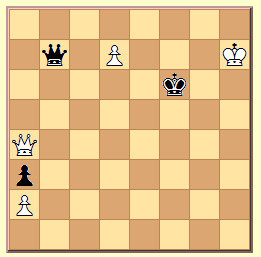
      In the Congress of Chess Composition, the above puzzle was chosen as the ‘Study of the Year 2008’.

      It is White to move. Can you find the winning continuation for White?

      Special thanks to Boris Tummes for sharing this one with us. Puzzle by
      Velimir Kalandadze (GEO).

      Posted by Picasa
      Chess Daily News from Susan Polgar
      Previous Article London possible WC 2012
      Next Article Carlsbad Caverns Blitz Chess Video

      About Author

      Susan Polgar

      Related Posts

      • More Special Endgame!

        January 3, 2021
      • Precision Chess Tactic

        December 27, 2020
      • Daily dose of tactic!

        December 21, 2020

      22 Comments

      1. jcheyne Reply
        October 21, 2009 at 2:09 am

        We could try something like Qf4+ followed by Qf7+, and on Black’s capture, promote to a knight for a fork. I think White then has a known win in the endgame, but I’m playing through some variations to see.

      2. Anonymous Reply
        October 21, 2009 at 3:28 am

        ‘Can you find the winning continuation for White?’

        The real question is: Can YOU find the winning continuation for White?

      3. Anonymous Reply
        October 21, 2009 at 4:43 am

        Found it eventually, but this is a tough one! I won’t spoil the enjoyment by revealing the solution yet. It deserves the accolade.

      4. Anonymous Reply
        October 21, 2009 at 5:06 am

        searching for a winning fork with an underpromotion… maybe:

        1.Qf4+ Ke6
        2.Qf7+ Kxf7
        3.d8N

      5. Umesh::ഉമേഷ് Reply
        October 21, 2009 at 5:11 am

        1. Qf4+ Ke6/e7 2. Qf7+ Kxf7 3. d8=Q+ wins.

        If this is the solution, I have no idea why this is called the study of the year. What is so great in this ordinary puzzle?

      6. Umesh::ഉമേഷ് Reply
        October 21, 2009 at 5:21 am

        An improvement to my last comment.

        1. Qf4+, and now:

        A) 1…Ke7 2. Qf7+ Kd8 (2… Kxf7 3. d8N+; 2… Kd6 3. d8Q+) 3. Qe8+ Kc7 4. d8Q#.

        B) 1…Ke6 2. Qf7+ Ke5 (otherwise 3. d8Q+) 3. Qg7+ Kf4 4. d8Q wins.

      7. Anonymous Reply
        October 21, 2009 at 7:24 am

        What is ‘on’:

        Qf4+ Ke6/Ke7
        d8=N wins if there’s a Q/K fork
        …
        1.Qf4+ Ke6/Ke7
        2.Qf7+!! and then
        2….Kd6 3.d8=Q+ wins
        2…Ke5 3.Qe7+ K? 4.d8=Q wins
        2…Kd8 3.Qe8+ Kc7 4.d8=Q#
        so 2…Kxf7
        but this is a tablebase loss …
        3.d8=N!! K? 4.Nxb7

      8. Jagdish Dube. Reply
        October 21, 2009 at 7:24 am

        Since there was no restriction I referred “Shredder” & got the answer but will refrain from posting it now.I
        will consider later if Susan replies to this post.

      9. aam Reply
        October 21, 2009 at 7:47 am

        1. Qf4+

        if 1… Ke6
        2. Qf7+ Kd6
        3. d8(N) QxQ
        4. NxQ
        now, need to make sure that this still wins for white. I’m assuming it does.

        if 2… KxQ
        3. d8(N) + and 4. Nxb7
        hopefully, here too, the N is able to take black’s a-pawn and protect white’s own a-pawn.

        if 1… Ke7
        2. Qf7+ Kd8
        (2… KxQ transposes to the line above)
        3. Qe8+ Kc7
        4. d8(Q) wins.

        The main issue is can the N win the game for white — i.e., can it at least defend the white a-pawn?

      10. Rainer Reply
        October 21, 2009 at 8:25 am

        I guess
        1. Qf4+ Ke7(e6)
        2. Qf7+ Kxf7
        3. d8=N+ Kf6
        4. Nxb7
        Than I thought Na5-c4-a3-c1 would be win but Black is to fast.

        Therefore
        4. … Ke5
        5. Kg6 Kd4
        6. Kf5 Kc3
        7. Ke4 Kb2
        8. Kd3 Kxa2 (… Ka1, Kc3)
        9. Kc2 Ka1
        10. Nc5 Ka2
        11. Nd3 Ka1
        12. Nc1 a2
        13. Nb3#

      11. Anonymous Reply
        October 21, 2009 at 8:40 am

        Qf4 Ke6
        Qf7 KxQ
        d8=N K any
        NxQ White wins

        Arctic Knight in 5 secs. (which means it might be wrong)

      12. Yuly Reply
        October 21, 2009 at 12:42 pm

        May be???
        1. Qf4+ Ke6 [or 1…Ke7]
        2. Qf7+ Kxf7
        3. d8=N+

      13. Cortex Reply
        October 21, 2009 at 12:48 pm

        I strongly suspect a pawn underpromotion for a knight while the black king is in f7, forking King and Queen.

        The challenge after is either taking the a3 pawn without losing the white remaining pawn, or losing elegantly the pawn a2 without apparent compensation… to transpose in a classic checkmate demonstrated by Saint Nicholai 8 centuries ago !

        Now, the hard part : calculation !

      14. Max Reply
        October 21, 2009 at 12:57 pm

        1. Qf4 Ke6
        2. Qf7+ Ke5
        3. d8=N and white should be on the way to winning?

      15. Max Reply
        October 21, 2009 at 1:01 pm

        1. Qf4+ Ke6
        2. Qf7+!!Ke5
        3. Kg8 and white promotes the pawn i think is a better solution …

      16. Anonymous Reply
        October 21, 2009 at 3:02 pm

        At least Rainer showed the line that leads to the smothered mate! lol

      17. dezi Reply
        October 21, 2009 at 4:09 pm

        o.k. i think i got this one… i’m new to this so…
        i’m thinking first qf4 which brings ke6 THEN qf7 when the queen is taken….then d8 knight then whatever then take d7. now i’m thinking the black king goes after the pawn so the black king e5 then you kg6 black will go d4 kf5 so on until black takes the pawn, the the knight comes down and the check should be obvious from there!
        correct me if i’m wrong in there

      18. frenez Reply
        October 21, 2009 at 6:50 pm

        thanks rainer for showing us how hard it was, especially the kn moves to hit b3# just right

      19. Cortex Reply
        October 22, 2009 at 4:27 am

        Best Study of 2008?

        I have a deep doubt about it. The position is very natural, game-like, few pieces and all, and this is uncommon about modern studies IMHO. But…

        An under-promotion in knight, following by a classic checkmate manoeuvre was already realized by the strong player and study composer Jan Timman in Vrij Nederland, 1992. Win

        Here is the FEN (so you can paste it in your favorite chess GUI, engine, or database) and solution to Timman’s Study :

        FEN : 2q3B1/R1P1k3/1P3bK1/2Rp4/8/p1P5/P6B/8 w – – 0 1

        Solution :
        1. Bd6+! Kxd6
        2. Rxd5+ Ke7
        3. Be6 Kxe6
        4. Td8! (third sacrifice)Bxd8
        5. Ta8 (fourth one) Qxa8
        6. b7

        (A known trapezoidal configuration of white and black pieces which occurred for the first time in a study of Nadareishvili, Vecherni Leningrad, 1965, first prize ex-aequo, draw
        FEN : K2b3q/3kP3/5P2/8/2Pp4/6R1/4P3/7B w – – 0 1)

        6… Qxb7
        7. cxd8N+ (here is our under-promotion)
        7… Kd5
        8. Nxb7 Kc4
        9. Kf5 Kxc3

        and now you know the finish, because the position is the very same as in the Gurgenidze study composed 27 years later…

        Originality? Perhaps the seemingly dead draw Queen ending (because the d pawn is pinned). But is this enough for such an award?

        This is not the place for such debates. But I feel obliged to mention the much superior Timman’s Study.

        Thank you Susan and bravo Rainer to bring us the precise and complete solution.

      20. Anonymous Reply
        October 22, 2009 at 8:32 am

        Umesh::ഉമേഷ് said…
        1. Qf4+ Ke6/e7 2. Qf7+ Kxf7 3. d8=Q+ wins.

        wins so much that 3. …;Qh1! is checkmate

      21. Cortex Reply
        October 22, 2009 at 9:31 am

        Errata
        ——-

        I’ve done a slight mistake due to my French mother-tongue and the hour of my intervention, early in the morning.
        Please read, instead of

        4. Td8! Bxd8
        5. Ta8

        naturally

        4. Rxd8! Bxd8
        5. Ra8

        My apologize

      22. Anonymous Reply
        October 23, 2009 at 6:48 pm

        I can’t see a straightforward white win here. Say:

        1. Qf4+ K~
        2. Qf7+ Kxf7
        3. d8N+ Kf6
        4. Nxb7

        Why is this a certain win for white? The black king can reach b2 easily, and white’s only way of protecting its a2 pawn is by putting his knight on b4. Then all I see is a draw by Nb4 Kc3 Na6 Kb2 Nb4… What am I missing here?

      Leave a Reply

      Cancel reply

      Improvement

      • Important Scholastic Coaching Tips
      • My Chess Quotes Over The Years
      • My kids know chess rules. What’s next?
      • Chess Parenting

      Events

      • My Top 10 Most Memorable Moments in Chess (Part 3) May 13, 2021
      • My Top 10 Most Memorable Moments in Chess (Part 2) May 12, 2021
      • My Top 10 Most Memorable Moments in Chess (Part 1) May 10, 2021
      • About Susan Polgar April 9, 2021
      • About Us
      • Contact Us
      • Daily News
      • My Account
      • Terms & Conditions
      • Privacy Policy

      Anand Armenia Breaking News Chess Club and Scholastic Center of St Louis Chess interview Chess Olympiad Chess tactic Chess tournament chess trivia China FIDE Grand Prix Holland India Khanty-Mansiysk LIVE games Lubbock Magnus Carlsen Moscow National Championship Norway OnlineChessLessons Philippines Puzzle Solving Russia Scholastic chess Spain SPF SPICE SPICE Cup St Louis Susan Polgar Tata Steel Chess Texas Tech Tromsø TTU Turkey Webster University Wesley So Wijk aan Zee Women's Chess Women's Grand Prix Women's World Championship World Championship World Cup

      April 2026
      M T W T F S S
       12345
      6789101112
      13141516171819
      20212223242526
      27282930  
      « Sep