Though, I will point out, in your line, you miss a path to win the black rook starting at move 5. One can maneuver the black king by playing 5.Qg5+ and eventually playing Kf5- basically, you give black a choice- either allow Qxgpawn with check, or allow Qd3/c4 with check to win the rook on f1. It might be worth your time to figure this out.
In your 2. ….Kh5 line, though not the best defense for black, you missed setting up this kind of position: 8/4k3/8/5K2/3Q2p1/8/5p2/5r2 with black to move. Black can’t prevent white from setting this up, either. Now black has only really bad choices, and won’t reach Q vs R ending, because the rook and king can’t be reconnected by Re1 followed by Re6.
What I am trying to get across here, if badly, is that you should always be looking for ways to win the rook when the king and rook are disconnected from each other. This is why 2. ….Kh5 is so weak for black and why 2. …Kh3 is so much more tenacious a defense.
Why is this puzzle difficult? Because it is a bishop’s pawn on f2. It isn’t so easy to win this pawn in the end, and especially so if the g-pawn has already been captured. You may, with this clue, already have an idea of what I am talking about here.
1. Nf1 Rxf1
2. h7 Kh3 (it’s a tough puzzle with the move Kh3)
3. h8+Q+ Kg2
4. Qa8+ Kh2
5. Qa7 Kg2
6. Qb7+ Kh2
7. Qh7+ Kg2
8. Qe4+ Kh2
9. Qe2 Rg1
10. Qf2+ I’m stuck here.
I don’t fully understand this type of ending because I haven’t studied it at all. That’s why I sometimes make bad moves for black.
All of this is correct. The maneuver via a8, a7, b7, h7, e4, and e2 was to be able to either capture g4 with check, or to capture f2 with check– or, of course, simply win the rook.
What black would have loved would have been for white to hastily play 4.Kxg4 without check leading to a technical draw -black always has the resource of 4. ….Rh1 (or any square on the 1st rank but g1) 5.Qa8 Kg1 6.Kg3 Rh3= because once free, the rook can harass the king endlessly because as long as the white king is a move away from the f2 pawn, black has a draw upon capture of the rook because black can always retreat to h1 allowing the white queen to capture at f2 for a stalemate. The only alternatives for white is to allow f1Q.
So, after your 10th move, you can’t see where to go. Black loses quickly here with 10. …..Kh1 and 10. ….Kh3 because the first allows white to win at g4 with check and the other leads to a quick mate, so black blocks:
10. …………..Rg2
Now, what should white do? The first thing is to get the queen off of the second rank but on the move- I would check from h4 and then again from e1…..
11. Qh4 Kg1
12. Qe1 Kh2
I could show you how to win this, but I would rather tell you what you need to try to do here and let you discover it yourself. To protect the g-pawn from the white king, black will always have to keep the rook on the g-file in front of the pawn- eventually black will put the pawn on g3 and white will then maneuver the white king to h3 taking away h2 from the black king- a position like this one: 8/8/8/4Q3/8/6pK/6r1/6k1 b – – 0 1 In this position, black is in zugzwang- it the rook moves off of g2, white simply wins the pawn by taking it with the king, but if the rook stays on g2 under attack by the white king, white simply needs to maneuver a double attack on g2 winning the rook.
Waiting on black. 15. …Rh3 will lose the pawn to 16.Qb2+ followed by 17.Kg4. If black plays 15. ….Kf2 he will lose the rook to 16.Qb2+. Rook moves to a3, b3, and d3 will almost surely lose the rook more quickly to a double attack. This leaves…..
15. …………..Rf3
16. Kg4 Rg3
17. Kf4 Rf3
18. Ke4 and the rest will be a mate with the Q vs R. So my anticipation was a bit wrong- I had thought yesterday black resists longer by advancing the pawn at some point, but I can now see from your line that isn’t the case.
What I try to do, sometimes unsuccessfully, when trying to solve a problem like this is to try to figure out what a clearly winning position would look like, then I try to see if I can find a forced path to that position, or a similar one.
I will pick out another problem later this afternoon and put it in the puzzle after this one from Susan.
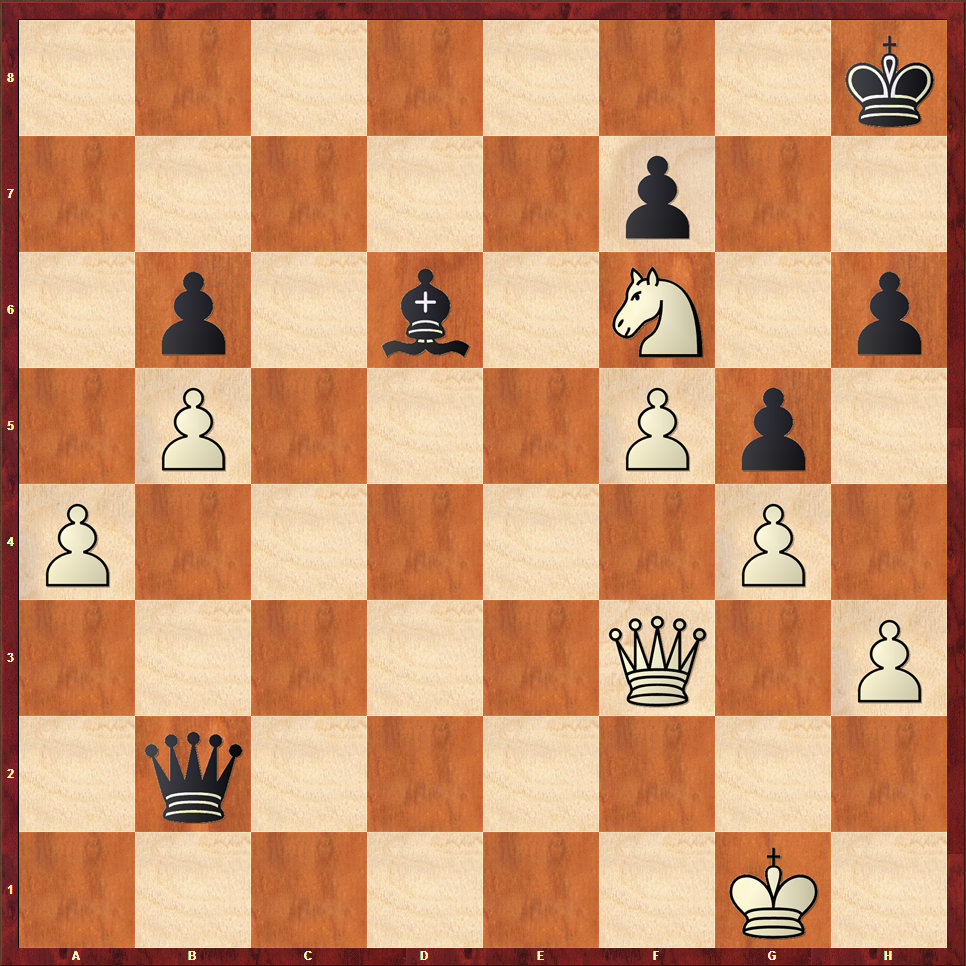


1.Qa8+ Kb7
2.Qb8+ Kxn(Kxf6)
3.Qh8+ wins the black queen
1. Qa8+ Kg7 2. Qg8+ Kxf6 3. Qh8+ Ke7 4. Qxb2
Another problem for Alena:
8/8/7P/8/5Kpk/4N3/5p2/6r1 w – – 0 1
Ponziani 1792
And this is a tough puzzle after the first few moves.
But it is enough if you reduce it down to a queen vs rook ending- you don’t have to show how to win that.
It was easy for me. I saw the first move at once. I solved it quickly.
1. Nf1 Rxf1
2. h7 Kh5
3. h8=Q+ Kg6
4. Qg8+ Kf6
5. Qxg4 Rc1
6. Qh4+ Ke6
7. Qxf2
Black’s best defense is 2. …..Kh3. This puzzle isn’t easy, and certainly not as easy as you thought.
Though, I will point out, in your line, you miss a path to win the black rook starting at move 5. One can maneuver the black king by playing 5.Qg5+ and eventually playing Kf5- basically, you give black a choice- either allow Qxgpawn with check, or allow Qd3/c4 with check to win the rook on f1. It might be worth your time to figure this out.
In your 2. ….Kh5 line, though not the best defense for black, you missed setting up this kind of position: 8/4k3/8/5K2/3Q2p1/8/5p2/5r2 with black to move. Black can’t prevent white from setting this up, either. Now black has only really bad choices, and won’t reach Q vs R ending, because the rook and king can’t be reconnected by Re1 followed by Re6.
What I am trying to get across here, if badly, is that you should always be looking for ways to win the rook when the king and rook are disconnected from each other. This is why 2. ….Kh5 is so weak for black and why 2. …Kh3 is so much more tenacious a defense.
Why is this puzzle difficult? Because it is a bishop’s pawn on f2. It isn’t so easy to win this pawn in the end, and especially so if the g-pawn has already been captured. You may, with this clue, already have an idea of what I am talking about here.
1. Nf1 Rxf1
2. h7 Kh3 (it’s a tough puzzle with the move Kh3)
3. h8+Q+ Kg2
4. Qa8+ Kh2
5. Qa7 Kg2
6. Qb7+ Kh2
7. Qh7+ Kg2
8. Qe4+ Kh2
9. Qe2 Rg1
10. Qf2+ I’m stuck here.
I don’t fully understand this type of ending because I haven’t studied it at all. That’s why I sometimes make bad moves for black.
Alena, lets take your line up to move 10
1. Nf1! Rxf1
2. h7 Kh3
3. h8+Q+ Kg2
4. Qa8+! Kh2
5. Qa7 Kg2
6. Qb7+ Kh2
7. Qh7+ Kg2
8. Qe4+! Kh2
9. Qe2 Rg1
10.Qxf2!
All of this is correct. The maneuver via a8, a7, b7, h7, e4, and e2 was to be able to either capture g4 with check, or to capture f2 with check– or, of course, simply win the rook.
What black would have loved would have been for white to hastily play 4.Kxg4 without check leading to a technical draw -black always has the resource of 4. ….Rh1 (or any square on the 1st rank but g1) 5.Qa8 Kg1 6.Kg3 Rh3= because once free, the rook can harass the king endlessly because as long as the white king is a move away from the f2 pawn, black has a draw upon capture of the rook because black can always retreat to h1 allowing the white queen to capture at f2 for a stalemate. The only alternatives for white is to allow f1Q.
So, after your 10th move, you can’t see where to go. Black loses quickly here with 10. …..Kh1 and 10. ….Kh3 because the first allows white to win at g4 with check and the other leads to a quick mate, so black blocks:
10. …………..Rg2
Now, what should white do? The first thing is to get the queen off of the second rank but on the move- I would check from h4 and then again from e1…..
11. Qh4 Kg1
12. Qe1 Kh2
I could show you how to win this, but I would rather tell you what you need to try to do here and let you discover it yourself. To protect the g-pawn from the white king, black will always have to keep the rook on the g-file in front of the pawn- eventually black will put the pawn on g3 and white will then maneuver the white king to h3 taking away h2 from the black king- a position like this one: 8/8/8/4Q3/8/6pK/6r1/6k1 b – – 0 1 In this position, black is in zugzwang- it the rook moves off of g2, white simply wins the pawn by taking it with the king, but if the rook stays on g2 under attack by the white king, white simply needs to maneuver a double attack on g2 winning the rook.
13. Qa1 g3
14. Qh8+ Kg1
15. Kf3 Rd2
16. Kxg3
I have won the important pawn and then I need to fork the rook and king to win the game.
The most resistant line would probably be……
13. …………..Rg3
14. Qh8 Kg2 (Rh3 15.Qb2 Kh1/g1 16.Kg4+-)
15. Qh7
Waiting on black. 15. …Rh3 will lose the pawn to 16.Qb2+ followed by 17.Kg4. If black plays 15. ….Kf2 he will lose the rook to 16.Qb2+. Rook moves to a3, b3, and d3 will almost surely lose the rook more quickly to a double attack. This leaves…..
15. …………..Rf3
16. Kg4 Rg3
17. Kf4 Rf3
18. Ke4 and the rest will be a mate with the Q vs R. So my anticipation was a bit wrong- I had thought yesterday black resists longer by advancing the pawn at some point, but I can now see from your line that isn’t the case.
What I try to do, sometimes unsuccessfully, when trying to solve a problem like this is to try to figure out what a clearly winning position would look like, then I try to see if I can find a forced path to that position, or a similar one.
I will pick out another problem later this afternoon and put it in the puzzle after this one from Susan.