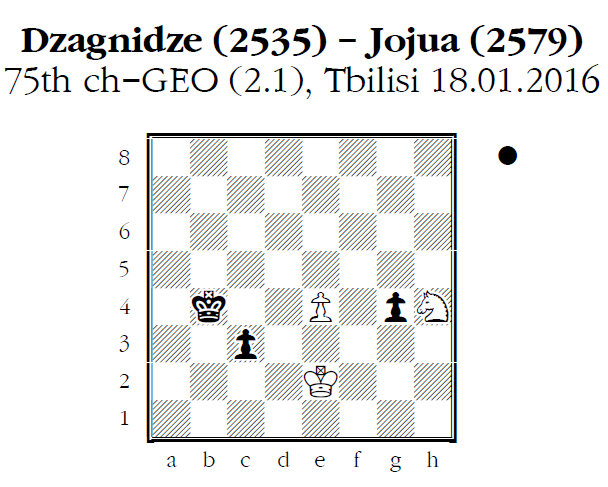
Impressive that Jojua found the only winning move over the board. I had to look at this a long time late last night and again this morning before I realized that Susan wasn’t just wrong that there was a “winning tactic”.
Getting the draw isn’t difficult for black here- he can advance either pawn. I got badly narrow-focused on those two moves and the losing move of Kb3. Let’s first discuss the draws.
1. …………c2
2. Kd2
This is obviously the only move for white to stop black from queening. Continuing:
2. …………g3 (I will return to the alternative Kb3 in a moment, but g3 is the only draw now for black)
3. Kc2
There are several moves here for white that should hold, but taking the unprotected c-pawn is the obvious one. Sure, white can play e5 here, but the black king can still catch the pawn with either Kb5 or Kc5 before or after queening at c1, and variations on those lines where white can both protect the e-pawn and hold up the g-pawn with just the knight don’t exist on just a cursory look. Continuing:
3. …………Kc4
I think g2 here should draw, too, since, if white takes at g2, Kc4 still wins the pawn since the knight can’t protect it at either e4 or e5 in time, and if white instead tries 4.Nf3 followed by 5.e5, black forces the knight away by playing g1Q. In any case, 3. ….Kc4 is just that much clearer a draw:
4. Nf3
There is really nothing else here. The only other move that looks promising for white to win is Nf5 cutting off d4 from a different square, but black just plays the same reply anyway to force the knight away (white would then have to fork from e3 to stop the g-pawn, but then the e-pawn is toast, too). Continuing:
4. …………g2 (only move)
5. e5 Kd5
Here, Kc5 is ok, too, but why play it? Clearly, black can win the e-pawn by queening his own g-pawn sacrificially. So, let’s back up to move 2 where black can lose in this line by trying to protect the c-pawn on c2:
1. …………c2
2. Kd2 Kb3??
3. Kc1!
So, nothing has changed in regards to black’s chances of queening the c-pawn, even though it is still on the board- it can’t move. White’s king is still just as out of play as previously, but there is now a critical difference in black’s defense. White is now threatening to run the e-pawn away on the next move, and black’s king must retreat to either b4 or c4 to stay within range:
3. …………Kc4
4. Nf5!
The key point here is that black has no way to get next to the e-pawn other than to go through c5 and d6, or to sacrifice the g-pawn on g3, but in that latter case, the knight protects the e-pawn from behind- exactly the set up a player wants in a N+P ending most of the time- the enemy king can’t take the knight without allowing the pawn to get away. Finally, if black does try Kc5-Kd6 etc., white just gobbles up the c-pawn, and the white king enters the fray decisively.
The lines where black plays 1. ….g3 are somewhat similar to what is above, but with moves transposed. So, I will move on the 1. ….Kb3??:
1. …………Kb3??
This move cost me a lot of time- it looks for all the world like the winning move for black- white can’t push the e-pawn in a race because black queens two moves more quickly, however, black now it loses!
2. Nf5!!
This move wasn’t hard for me to find for white since there really is no way to stop the c-pawn with a move like 2.Kc1, for example, or with 2.e5 since black just wins the race. In addition, the other plausible knight move, 2.Ng2, also fails since black just pushes c2 to win with the c-pawn. Only 2.Nf5 was left, but it contains a big poison stinger:
2. …………Kc4
Here, black cannot play 2. …..c2 since white forks the king and pawn with 3.Nd4 and sacrifices the knight for the c-pawn since the recapture on c2 allows the white e-pawn to run away from the black king while the white king still has the g-pawn under observation. Indeed, no other move can save black either- if he tries 2. …Kb2, white just puts the knight on either e3 or d4 to stop the c-pawn while the white king again controls, still, the g-pawn- in which case the e-pawn is free to start its march forward. Finally, if black tries 2. …g3, white can just take the pawn with the knight since white has time to clear the e2 square for the knight by either playing Kd2 in reply to c2 or playing Kd3 in reply to Kb2. With 2. ….Kc4, black is conceding that it can’t be won, and retreats to guard against the e-pawn, but that is now hopeless due to the loss of time. Continuing from 2. …Kc4 above:
3. Ke3
Here, 3.Kd1 should win, too, since black has the same problems either way- no way to use the g-pawn to win the e-pawn, and still eventually having to give up the c-pawn to the encroaching white king. The only thing white need avoid here is playing a hasty fork from e3 with the knight- black draws with Kd4 since white can’t now protect his last pawn. Continuing:
3. …………c2 (if Kb3, then 4.e5 c2 5.Nd4+)
4. Kd2 and this is just as lost as it was before.
I spent more time than I would like to admit with this line trying to find a win. I did finally realize that the black king doesn’t have to be on b3 in order to threaten a winning Kb2-c2-c1Q: that blindness was the hole in my thinking. The move 1. …Ka3 prevents white from the killing fork from d4 in the key line above, while preserving the threat from the c-pawn:
1. …………Ka3!!
Deserves double exclamation point. A very non-obvious move. However, the main threat for black now was the same as before- advancing the c-pawn. White still can’t win the race with e5 here- it takes him 4 or 5 moves to queen while it takes black 2 or 3 moves to do so (the number depending on whether white tries Kc2 at some point). The key behind this move is that white no longer has the time to play 2.Nf5, nor does he now have the time to play Nf5-Ng3-Ne2. There is no way to stop black from queening the c-pawn first and decisively.


1 ka3 win
The only move to win.
Impressive that Jojua found the only winning move over the board. I had to look at this a long time late last night and again this morning before I realized that Susan wasn’t just wrong that there was a “winning tactic”.
Getting the draw isn’t difficult for black here- he can advance either pawn. I got badly narrow-focused on those two moves and the losing move of Kb3. Let’s first discuss the draws.
1. …………c2
2. Kd2
This is obviously the only move for white to stop black from queening. Continuing:
2. …………g3 (I will return to the alternative Kb3 in a moment, but g3 is the only draw now for black)
3. Kc2
There are several moves here for white that should hold, but taking the unprotected c-pawn is the obvious one. Sure, white can play e5 here, but the black king can still catch the pawn with either Kb5 or Kc5 before or after queening at c1, and variations on those lines where white can both protect the e-pawn and hold up the g-pawn with just the knight don’t exist on just a cursory look. Continuing:
3. …………Kc4
I think g2 here should draw, too, since, if white takes at g2, Kc4 still wins the pawn since the knight can’t protect it at either e4 or e5 in time, and if white instead tries 4.Nf3 followed by 5.e5, black forces the knight away by playing g1Q. In any case, 3. ….Kc4 is just that much clearer a draw:
4. Nf3
There is really nothing else here. The only other move that looks promising for white to win is Nf5 cutting off d4 from a different square, but black just plays the same reply anyway to force the knight away (white would then have to fork from e3 to stop the g-pawn, but then the e-pawn is toast, too). Continuing:
4. …………g2 (only move)
5. e5 Kd5
Here, Kc5 is ok, too, but why play it? Clearly, black can win the e-pawn by queening his own g-pawn sacrificially. So, let’s back up to move 2 where black can lose in this line by trying to protect the c-pawn on c2:
1. …………c2
2. Kd2 Kb3??
3. Kc1!
So, nothing has changed in regards to black’s chances of queening the c-pawn, even though it is still on the board- it can’t move. White’s king is still just as out of play as previously, but there is now a critical difference in black’s defense. White is now threatening to run the e-pawn away on the next move, and black’s king must retreat to either b4 or c4 to stay within range:
3. …………Kc4
4. Nf5!
The key point here is that black has no way to get next to the e-pawn other than to go through c5 and d6, or to sacrifice the g-pawn on g3, but in that latter case, the knight protects the e-pawn from behind- exactly the set up a player wants in a N+P ending most of the time- the enemy king can’t take the knight without allowing the pawn to get away. Finally, if black does try Kc5-Kd6 etc., white just gobbles up the c-pawn, and the white king enters the fray decisively.
The lines where black plays 1. ….g3 are somewhat similar to what is above, but with moves transposed. So, I will move on the 1. ….Kb3??:
1. …………Kb3??
This move cost me a lot of time- it looks for all the world like the winning move for black- white can’t push the e-pawn in a race because black queens two moves more quickly, however, black now it loses!
2. Nf5!!
This move wasn’t hard for me to find for white since there really is no way to stop the c-pawn with a move like 2.Kc1, for example, or with 2.e5 since black just wins the race. In addition, the other plausible knight move, 2.Ng2, also fails since black just pushes c2 to win with the c-pawn. Only 2.Nf5 was left, but it contains a big poison stinger:
2. …………Kc4
Here, black cannot play 2. …..c2 since white forks the king and pawn with 3.Nd4 and sacrifices the knight for the c-pawn since the recapture on c2 allows the white e-pawn to run away from the black king while the white king still has the g-pawn under observation. Indeed, no other move can save black either- if he tries 2. …Kb2, white just puts the knight on either e3 or d4 to stop the c-pawn while the white king again controls, still, the g-pawn- in which case the e-pawn is free to start its march forward. Finally, if black tries 2. …g3, white can just take the pawn with the knight since white has time to clear the e2 square for the knight by either playing Kd2 in reply to c2 or playing Kd3 in reply to Kb2. With 2. ….Kc4, black is conceding that it can’t be won, and retreats to guard against the e-pawn, but that is now hopeless due to the loss of time. Continuing from 2. …Kc4 above:
3. Ke3
Here, 3.Kd1 should win, too, since black has the same problems either way- no way to use the g-pawn to win the e-pawn, and still eventually having to give up the c-pawn to the encroaching white king. The only thing white need avoid here is playing a hasty fork from e3 with the knight- black draws with Kd4 since white can’t now protect his last pawn. Continuing:
3. …………c2 (if Kb3, then 4.e5 c2 5.Nd4+)
4. Kd2 and this is just as lost as it was before.
I spent more time than I would like to admit with this line trying to find a win. I did finally realize that the black king doesn’t have to be on b3 in order to threaten a winning Kb2-c2-c1Q: that blindness was the hole in my thinking. The move 1. …Ka3 prevents white from the killing fork from d4 in the key line above, while preserving the threat from the c-pawn:
1. …………Ka3!!
Deserves double exclamation point. A very non-obvious move. However, the main threat for black now was the same as before- advancing the c-pawn. White still can’t win the race with e5 here- it takes him 4 or 5 moves to queen while it takes black 2 or 3 moves to do so (the number depending on whether white tries Kc2 at some point). The key behind this move is that white no longer has the time to play 2.Nf5, nor does he now have the time to play Nf5-Ng3-Ne2. There is no way to stop black from queening the c-pawn first and decisively.