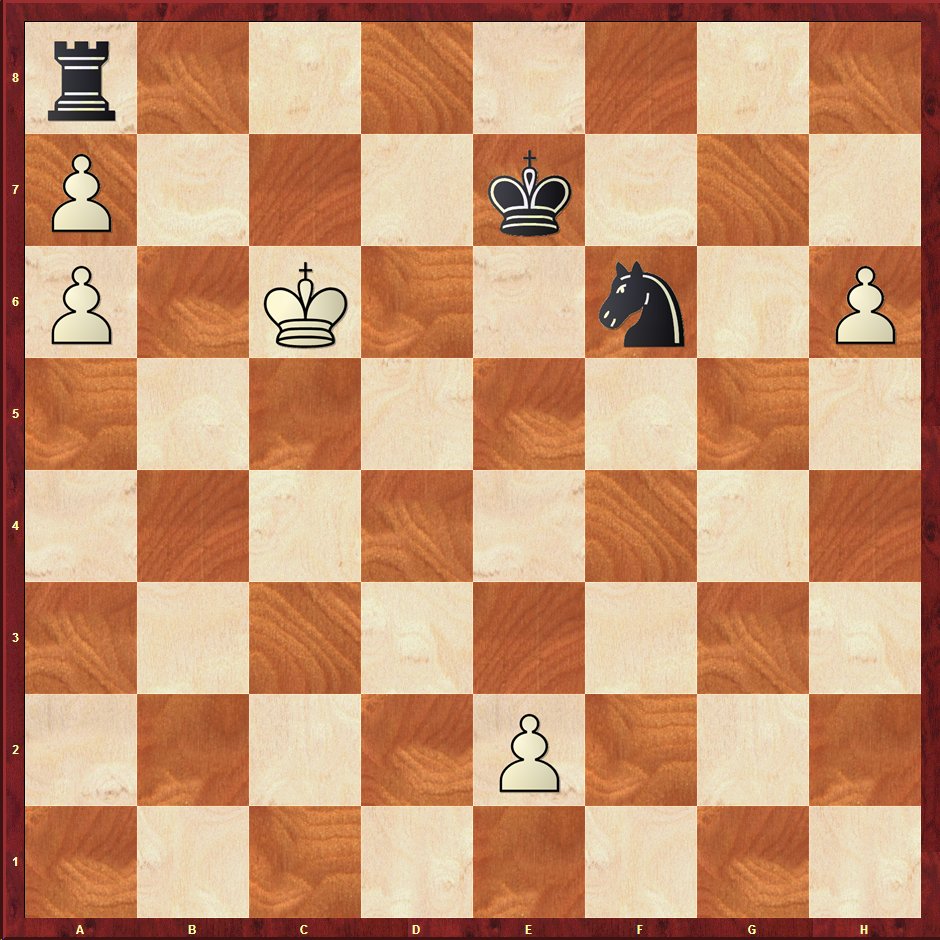
My first thought has a problem: 1.Kb7 Kd7, 2.Ka8 Kc7, then Knight mates from b6 square. Is there a way to deflect the knight so that it takes one more tempo?
1.Kb7! Kd7 2.e4 Ne8?? 3.h7 and White may even be winning.
Kb7 has to be first, I don’t think we can recommend that White allow Black to take the a7 pawn and Kb7 also immobilizes the Black Rook. Then White just has to figure out when he can take the rook safely. I think 2.e4 seems like a good way to start. Basically White can just leave the king on b7 until either he runs out of pawns (which would leave him stalemated) or he can queen before the knight gets to b6 and then he would win.
So based on this logic, I think that Black has to play the 2…Nh7 after e4 in order to try to immobilize the h pawn temporarily. Then after
3.Ka8 Kc8!? (Kc7 is analyzed above) 4.e5 Nf8 5.h7 Nh7 (5.e6 would be met by Ne6 and mate on c7) 6.e6 (only move) Nf6 7.e7 Ne8 stalemate
The immediate Kb7 fails due to Kd7, and if White takes the rook, Kc7 traps the king until the knight can maneuver to deliver checkmate. Therefore the knight must be restricted first, then the king can move towards the rook.


Tickly –
My first thought has a problem:
1.Kb7 Kd7, 2.Ka8 Kc7, then Knight mates from b6 square.
Is there a way to deflect the knight so that it takes one more tempo?
Tickly-
Following my first thought:
Does 1.e4 2.e5 do the job?
I’m in without a chessboard right now, so maybe it’s all wrong, but my guess is: yes, anon, 1.e4, Rxa7; 2.Kb6, Rd7; 3.e5, Nh7; 4.a7
Rail
1.e4, Rxa7; 2.Kb6, Rd7; 3.e5, Nh7; 4.a7
The right idea, but slightly mis-timed:
3.e5? Nd5+
4.Kc6 Ke6
5.Kb5 Kxe5
6.Kc5 Rh7
… wins for Black.
1. Kb7 Kd7
2. Ka8? Kc7 and Nd7/Nb6#
So 2. e4!!´
2. .. R any 3. a8Q
2. .. Nh7 3. Kxa8 Kc7 4. e5! (prevents Nf6) Nf8 5. e6! (prevents Nd7) +-
2. .. N any 3. Kxa8 Kc7 4. h7 +-
Greetings from Germany
1. Kb7 Kd7
2. Ka8? Kc7 and Nd7/Nb6#
So 2. e4!!´
2. .. R any 3. a8Q
2. .. Nh7 3. Kxa8 Kc7 4. e5! (prevents Nf6) Nf8 5. e6! (prevents Nd7) +-
2. .. N any 3. Kxa8 Kc7 4. h7 +-
2. .. Kd6 3. e5+!
Greetings from Germany
1. Kb7 Kd7
2. Ka8? Kc7 and Nd7/Nb6#
So 2. e4!!´
2. .. R any 3. a8Q
2. .. Nh7 3. Kxa8 Kc7 4. e5! (prevents Nf6) Nf8 5. e6! (prevents Nd7) +-
2. .. N any 3. Kxa8 Kc7 4. h7 +-
2. .. Kd6 3. e5+!
1.Kb7? Kd7
2.e4 Ne8
3.Kxa8? Kc8
… and 4…Nc7#
1.Kb7. Im on my way to lunch, bye!
WCM Claudia Munoz
4th grade
womancandidatemaster.blogspot.com
1.Kb7? loses to 1…Kd7.
1.Kb7? Kd7
2.e4 Ne8
3.Kxa8? Kc8
1.Kb7! Kd7
2.e4 Ne8??
3.h7 and White may even be winning.
Kb7 has to be first, I don’t think we can recommend that White allow Black to take the a7 pawn and Kb7 also immobilizes the Black Rook. Then White just has to figure out when he can take the rook safely. I think 2.e4 seems like a good way to start. Basically White can just leave the king on b7 until either he runs out of pawns (which would leave him stalemated) or he can queen before the knight gets to b6 and then he would win.
So based on this logic, I think that Black has to play the 2…Nh7 after e4 in order to try to immobilize the h pawn temporarily. Then after
3.Ka8 Kc8!? (Kc7 is analyzed above)
4.e5 Nf8
5.h7 Nh7 (5.e6 would be met by Ne6 and mate on c7)
6.e6 (only move) Nf6
7.e7 Ne8 stalemate
1.Kb7? Kd7
2.e4 Ne8
3.Kxa8? Kc8
1.Kb7! Kd7
2.e4 Ne8??
3.h7 and White may even be winning.
1.Kb7? Kd7
2.e4 Ne8!
3.h7? Nc7
… wins easily for Black.
The immediate Kb7 fails due to Kd7, and if White takes the rook, Kc7 traps the king until the knight can maneuver to deliver checkmate. Therefore the knight must be restricted first, then the king can move towards the rook.
Stripes,James – Hiarcs 10
27.02.2008
384MB, Fritz9.ctg, 1.e4 Rxa7 2.Kb6 Rd7 3.a7 Rd8 4.Kb7 Nxe4 5.a8Q Rxa8 6.Kxa8 Ng5 7.Kb7 Nh7 8.Kc6 Ke6 9.Kc5 Ke5 10.Kc6 Ke4 11.Kd6 Kf3 12.Ke6 Ke4 13.Kf7 Kd3 14.Kg7 Ng5 15.h7 Nxh7 ½–½
1. e4, Ne8 2. e5, Rxa7 3. Kb6, Ra8 4. h7, Ng7 or any other Knight move (must prevent queening of pawn). 5. Kb7, Rd8 6. a7, Rd7+, Kb8 7. Kb7….perpetual check. Hence, 1/2-1/2
some puzzles at
http://chesspuzzles4u.blogspot.com/