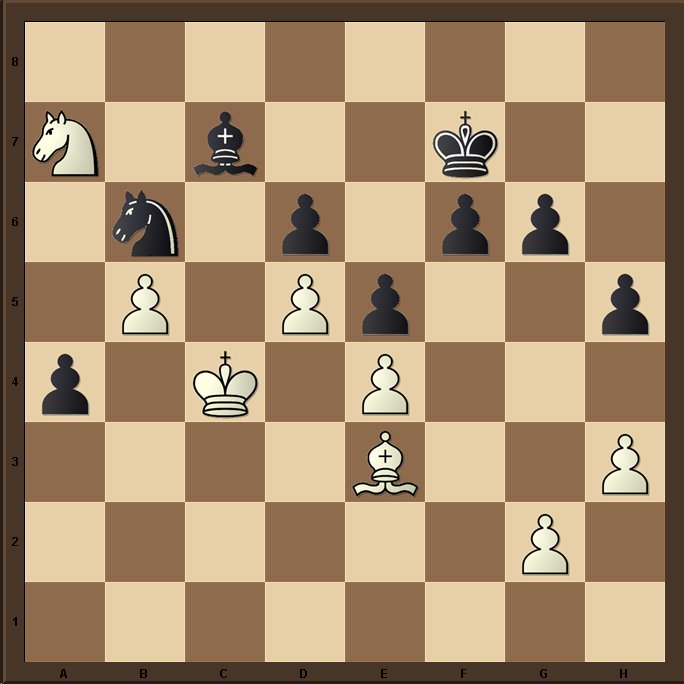
White to move. Which side has a better position? How would you continue? No computer help please, just calculate everything out 🙂

Chess Daily News from Susan Polgar

White to move. Which side has a better position? How would you continue? No computer help please, just calculate everything out 🙂
I say King goes to B4 with the Bishop taking the Knight on the next move winning the pawn!
I think that might lose to pawn forward with threat of fork if K takes.
What of BxN BxB, Nc8 Bc7, b6…then go for a pawn
Banjanx
Hello anonym poster,
if you think that Kb4 is winning you should think of what’s happening about after winning the pawn (of course you have to rescue your knight after 2. Bxb6, Bxb6 first before capturing a4) because if you count the material it’s just even after white’s win of that pawn. So it’s not an easily won endgame.
My first proposal (it’s not thought to end at all!) is starting directly with 1. Bxb6, Bxb6 and then try to win black’s bishop: 2. Nc8 and now there are some variants:
Two of them are 2.-, Bc5 and Bc7 to defend the pawn.
Let’s short look at black moves not defending d6: I think only Bd8 and Ba5 should be regarded because other moves (esxect the moves that sacrifice the bishop at once) get to the line after Bc5 (with 3. b6).
So what happens after Bc5?
3. b6 wins the bishop immediately because black mustn’t allow white to play 4. b7.
So we just have to be careful of black pawns breaking through on the king side but I think that’s harmless (?) because whites knight is over there very quick.
So what about Bc7?
3. b6 looks good to me because black mustn’t play Bb8 because of 4. Na7 5. Nc6 with win.
So 3.-, Bd8 has to be played.
Now the question is: is it good for white having played b6 already (in the variation after 2.-, Bc7) or not (after the variation 2.-, Bd8 immediately)?
I think in both variations 2. -, Bd8/Ba5 white should capture the d6 pawn.
Probably it’s better not having played b6 because the white pawn on b5 is much safer, then blacks defense 2.-, Bc7! 3. b6, Bd8 would be best for black.
I’d like to read other comments before rethinking the problem, maybe I’m totally wrong now. I didn’t use a chess board so perhaps I oversaw really easy things….. I hope not. 😉
Greetings,
Jochen
Isn’t the King in check from the Knight ??? And it has to move first?
This comment has been removed by the author.
Bxb6!
… Bxb6 Nc8 Bc7 (Bc5 b6 -+) b6 Bb8 Na7! Ke8 Nc6 -+
No, I didn’t use a computer (so I might be wrong!).
-Andrew
bxn bxb
nc8 bc7
b6 bb8
na7 f5
nc6 bc7
b8 bb8
nb8 fe
nc6 e3
nb4 e2
nc2 kf6
kb4 kf5
ka4 kf4
kb3 ke3
kc2 kf2
kd2 e4
nc2 e3
kd3 and i don’t know
in any event, not so easy
White probably can capture black bishop, but black also have strong move f5.
pretty even I think.
Somewhat confusing.
1.Kb4 a3 looked nice at first (pawn gets closer to promotion and if Kxa3 Nc4+ winning the bishop), what’s more, after 2.Kb3 Nc4 (white can’t take the knight, a2 and queens)… But then just 3. Bc1 and the pawn drops off. So it does not seem terribly bad for white, and I have not decided if white has more than a draw or not….
But my problem with Kb4 is twofold:
1) after 1.Kb4 a3 2.Kb3 black can just play Ke8! (to get to the queenside on time if white takes on b6).
2) after 1. Kb4, black can just ignore the a pawn and activate his kingside majority immediately with f5. And since black’s king always gets to the queenside on time to stop the white b pawn, this is not to my liking. I think white is just praying he can survive such an ending (Actually, that’s something I’d be very interested in. CAN white survive THIS ending in this variation?).
So Kb4 doesn’t look so good to me. So, what about 1. Bxb6 Bxb6 2.Nc8 ???
Then there is the annoying 2…Ba5 which blocks the white king’s entrance to help his pawn (as well as indirectly and neatly protecting black’s a pawn). and if white plays b6 then whenever he plays b7 Bc7 by black … black can play on the kingside in the meantime with f5, and white’s king is a bit preoccupied temporarily by the black a pawn.
I like it better than Kb4, but I have no idea if this is a win or a draw (yet).
I’ve analyzed a bit, so I’ll add my analysis of the Bxb6 variation to complement my previous comment:
1.Bxb6 Bxb6
2.Nc8 Ba5
3.Nxd6+ Ke7
and white cannot enter with his king because black’s a pawn queens.
how to penetrate the black king + bishop defense? if anyone think this is doable, please show how.
Another try for white:
1.Bxb6 Bxb6
2.Nc8 Ba5
3.b6 immediately. Ke8
4. Nb6 (since knight is immune… lets get rid of the pesky a pawn)
4… a3! (just driving the white king back temporarily)
5. Kb3 Bb8
with …kc7 next and black can even begin play on the kingside with …f5, giving the white king something to think about.
Also, all of the white’s king infiltration squares are taken.
Don’t think this can be won (by either side).
Damn that’s an interesting endgame.
i love endgames! thus, i tried to move the pieces around in my head, then on a board – and indeed, i found a win for white. but i’m a weak player – so my question was – did i always find the best continuations for black?
1.Bxb6… the only convincing continuation.
(1.Kb4?! f5 2.Bxb6 Bxb6 3.Nc8 Bc5+ 4.Kxa4 Ke8 5.exf5 gxf5 6.b6 Kd7 7.b7 Kc7 8.Ne7 f4+/- so far so good)
but after
1…Bxb6
2.Nc8 Ba5 is a very sophisticated move, and by the way the only move, which does not lose at once…
see a) 2…f5 3.Nxb6 fxe4 4.Nxa4+-;
see b) 2…Bd4 3.b6 a3 4.Kb3 Bxb6 5.Nxb6+-;
see c) 2…Bc7 3.b6 Bb8 4.Na7 f5 5.exf5 gxf5 6.Nc6 e4 7.Nxb8 a3 8.Kb3 e3 9.b7 e2 10.Nc6 e1Q 11.b8Q Qg3+ 12.Kc4+-;
see d) 2…Bc5 3.b6+-
and now
3.b6… looked very tempting
(i had excluded 3.Nxd6+ Ke7 4.Nc8+ ( 4.Nb7? Bb6 5.Kb4 f5 6.exf5 gxf5 7.Kxa4 e4-+) 4…Kd7 5.Na7 Bb6 6.Nc6 h4 +/= because it felt very drawish.)
3…Ke8 was not hard to find at all, once sacrified, always sacrified – black does not need it’s d6 pawn… 🙂 of course i’m joking.
4.b7 the main idea to force the bishop back to c7. but what about taking this dammned pawn? with check! a temptation – too much temptation – i let the seven o’tail cat in …
[ 4.Nxd6+ Kd7 5.b7 Bc7 ( 5…Kc7?? 6.Kb5+-) 6.Nb5 f5 7.exf5 gxf5 8.Kb4 ( 8.d6 Bb8 9.Kb4 e4 10.Kxa4 f4 11.Nc3 e3 12.Kb5 Kxd6 13.Ne2 Kd5 14.h4=) 8…e4 9.Kxa4 e3 10.Nd4 Bb8 11.Kb5 ( 11.Kb3? f4 12.Kc2 Kc7 13.Kd3 Kxb7 14.Nf5) 11…Kc7 12.Ka6 h4 13.d6+ ( 13.Nb5+ Kd7=) 13…Kd7 14.Kb6 f4 15.Ka6 Ke8! 16.Ne2 Bxd6 17.Ka7 Ke7 18.b8Q Bxb8+ 19.Kxb8 Ke6! 20.Nxf4+ ( 20.Nd4+ Ke5 21.Nf3+ Ke4 22.Kc7 e2 ( 22…Kd3? 23.Kd6 e2 24.Ke5 Ke3 25.Kf5+-) 23.Kd6 Ke3 24.Ke5 Kf2 25.Kxf4 Kxg2 26.Kg4 Kf2 27.Ne5 Ke3 28.Nf3=; 20…Kf5 21.Ne2 Ke4 22.Kc7 Kd3 23.Ng1 e2 24.Nxe2 Kxe2= ok! drawish lines! the cat went out!]
4…Bc7
5.Na7 f5
6.exf5 gxf5
7.Kb4 e4
8.Kxa4 one main enemy lost his life… but there is an other one on e4 – again the cat went in – and i decided to play it out otb…
8…e3
[ 8…f4 was my first suggestion and i forced fritz to play it, but after 9.Nb5 Bb8 10.Nd4 Kd7 11.Ka5 Bc7+ 12.Ka6 Bb8 13.h4 e3 14.Kb6 Ke8 15.Ne2 Kd8 16.Nxf4 Kd7 17.g3 Kd8 18.Kc6 Ke7 19.Kb5 Kd7 20.Kc4 Ba7 21.Kd3 white is clearly winning]
9.Nb5 Kd7
10.Nd4 Bb8
11.Kb3! Kc7
12.Kc2 Kxb7
13.Nxf5 e2
14.Kd2 Kb6
15.Kxe2 Kc5
16.Ne3 Kd4
17.Kf3 Bc7
( 17…Ke5 18.g3 Ba7 19.Ng2! Kxd5 20.Nf4+ Ke5 21.Nxh5 Bb6 22.h4+-)
18.h4! Ba5
19.Nf5+ Kxd5
20.Ng7 Bd8
21.g3 Ke5
22.Nxh5+- white is winning now.
the game against fritz 7.0 went on with 22…d5 23.Nf4 Bf6 24.Kg4 d4 [ i thought the cat blundered here and 24…Bd8 should be stronger, but after 25.h5 d4 26.h6 Bf6 27.Kh5 Ke4 28.Kg6 Be5 29.h7 Bh8 30.Kf7 Kf3 31.Kg8 fritz resigned] 25.Kf3 Bd8 26.g4 Ba5 27.Nd3+ Kf6 28.Ke4 Bc3 29.Ne5 Be1 30.g5+ Kg7 31.h5 Bd2 32.h6+ Kh7 33.Kf5 d3 34.Nxd3 Bc3 35.Ne5 and fritz resigned.
greetings
Vohaul, there is one very big mistake near the end of your analysis I believe:
18…Ba5? (What the hell???)
Instead, black goes Bd8 next I play Bf6, and you never get to attack that black h pawn. Looks drawn to me.
But you know, the whole line looks a lot better than my Nb6 line for white. I think there are 2 places to look for an improvement:
Near the end, I think 18. h4?! may be a more correct mark. Instead I’d take a look at
18. g3 first. but then
18…Bd8 again 19. Ng2 And the annoying thing is that even 19…Kxd5 20.Nf4+ Kc4 may be drawn.
21.Nxh5 d5
22. Nf4 (or ke2 first, really matter, except that this move gives white the g4 option next move as well). 22…d4
and now either:
23.Ke2 Bc7
24.h4 d3+
25.Nxd3
(25.Kd1 Bd8 26.h5 Bg5 again drawn because of effective blockade. If you try 26. Nh3 in this line 26…Bf6 27.Ng5 27…Kd5 and drawn)
25…Bxg3
26.h5 Bh4
followed by Bf6, AND the black king is closer, so no chance to block with Ng7. Draw.
The other option at move 23:
23. g4 d3
24. Nxd3
(24.ke3?? Bg5 and black wins! Hows that for a turnaround?
24. Kf2 Bh4+ and again, effective blockade coupled with cutting of the white king. Draw)
24…Kxd3
25.Kf4 (if the black king cannot get close, white will win when the bishop has to sac itself for one of them…Alas, it is not to be…)
25…Bf6 and whatever happens, black either stops both pawns on a blockade, or reach a drawn position.
I still believe there are unexplored options.
For example, the Nxd6 option was not fully explored by you. I’ll test it.
This comment has been removed by the author.
i don’t think, that 18…Ba5 is a blunder …
if you are still interested in this endgame, i did some refined analysis of the move 18…Bd8
have fun
18…Bd8
19.g3 Ke5
20.Ng2 Kxd5
21.Nf4+ Ke5
22.Nxh5 d5
a) 22…Be7 23.Nf4 Bf6 (23…d5 24.Ng6+) 24.Kg4 Ke4 25.h5 Be5 26.h6 Bf6 27.h7 d5 28.Kh5 Bh8 29.Kg6 d4 30.Kf7 d3 31.Nxd3 Kxd3 32.g4+-
b) 22…Bb6 23.Kg4 Be3
[23…Bd8 24.Nf4 d5
b1) 24…Bf6 25.h5 d5 26.Nd3+ Ke4 27.Nc5+ Kd4 28.Nd7 Bh8 29.Kf5 Kc3 30.g4 d4 31.g5 Kc4
( 31…d3 32.Nc5 d2 33.Ne4++-) 32.Ke4 Bg7 33.h6 Bh8 34.g6 d3 35.g7 d2 36.g8Q++-
b2) 24…Kf6 25.Kh5 Kf5 26.Ne2 Ke4 27.g4 Ke3 28.Nc3 Kd4 29.Nd1 Ke5 30.g5 Kf5 31.g6 Bf6 32.Kh6 Kg4 33.h5 Kh4 34.Ne3 Bg5+ 35.Kh7+-
25.h5 Bf6 26.h6 d4 27.Nd3+ Ke4 28.Nb4 d3 29.Nxd3 Kxd3 30.Kf5 Bd4 31.g4 Be3 32.h7 Bd4 33.g5 Ke3 34.g6 Bg7 35.Ke6 Bh8 36.Kf7+-]
24.Nf4 Bd2 25.Kg5 d5 26.h5 Ke4 27.h6 Bc3 28.Kg6 Bh8 29.Kf7 d4 30.h7 d3 31.Nxd3 Kxd3 32.g4+-
c) 22…Ba5 and again it is most probably the best choice 23.Kg4 Be1 24.Nf4 Kf6 25.Kf3 Bd2 26.Nd3 Ke6 27.Ke4 d5+ 28.Kf3 Ba5 29.Nf4+ Ke5 30.h5 d4 31.h6 Kf6 32.Ke4 Kf7 33.g4 Kg8 34.g5 Kh7 35.Nd3 Bd8 36.Kf5 Be7 37.Kg4 Bf8 38.Kh5+-
23.Nf4 Bc7
a) 23…Bf6 24.Kg4 d4 25.Kf3 Bd8 26.g4 Bxh4 27.Ng6+ Kd5 28.Nxh4 d3 29.Ke3+-
b) 23…Ba5 the mysterious bishop move again… 24.Kg4 d4 25.Kf3! Bc7
(25…Bd8 26.g4 Ba5
b1) 26…Bxh4 27.Ng6+ Kd5 28.Nxh4
b2) 26…Bf6 27.g5 Bd8 28.g6 Kf6 29.h5 d3 ( 29…Be7 30.Nd5+) 30.Nxd3 Be7 31.Ne5! Bd6 ( 31…Bf8 32.Nd7+) 32.Ng4+ Kg7+-
27.Nd3+ Kf6 28.Ke4 Kg7 29.Kxd4 Bd8 30.h5+-)
26.g4 Bd8 27.Nd3+ Ke6 28.h5+-
c) 23…Bb6 24.Kg4 d4 25.h5 Bd8 26.h6 Bf6
c1) 26…Kf6 27.h7 Kg7 28.Ne6++-
c2) 26…Ke4 27.Nd3! Bf6 (27…Kxd3 28.Kf5+-) 28.Nb4 Bh8 (28…d3 29.Nxd3 Kxd3 30.Kf5+-) 29.Kg5 Ke5 30.Kg6 Ke4 31.g4+-
27.Nd3+ Ke4 28.Nb4 Bh8 29.Kg5 d3 30.Nxd3 Kxd3 31.Kf5+-
24.h5 Bd6
( 24…Bd8 25.Kg4 d4 26.h6 Bf6 27.Kh5 Kf5 28.Nd3 29.Ke4 Nb4 +-)
25.Kg4 Ke4
26.h6 d4
27.Kg5 d3
28.Nxd3 Kxd3
29.Kf5+-
greetings
You’ve read only my moves and not my annotations.
The reason for Bd8 is …Bf6 next,
and you blundered again for black right on the next move.
Bd8 g3 Ke5?
…Bf6 IMMEDIATELY. Time IS important here. I said that was my idea yet you did not play it for many moves later.
Also, you seem to take pawns on the very first move you can do so… Sometimes waiting is the best policy.
In this case, there is the tactical point that after… 19.g3 Bf6 20.Ng2 Be5! (That’s the difference between the variations)
I dare you to try to win from here.
21. Nf4 Bxf4 seems to be a draw no matter what captures back,
and going back to Ne3 and Bf6 is…well, nothing special.
Trying 21.g4 hxg4+
22.Kxg4 Kxd5
So, I hold to my opinion, Ba5 is a blunder, and Bd8 draws. Youre more than welcome to try and break the analysis.
Being addicted has its uses. I’ve analyzed this for a while, refusing to believe that black can survive this thing. I believe I’ve finally found it:
After
1.Bxb6 Bxb6
2.Nc8 Ba5
3.b6 Ke8
4.Nxd6 Kd7
5.b7 Bc7
6.Nb5 f5
And it is here, I believe, that the win lay hidden all this time.
7.d6! and if
7…Bb8 Kd5 and it’s just a slaughter… black has to give up his lovely kingside play, and the rest is easy.
But what else? lets see… After
7.d6:
diverting the king with 7…a3
loses to 8.dxc7
7…Bxd6
8.Nxd6 winning.
So, 7…Bb8 8.Kd5 remains to be checked.
8…a3
9.Nxa3 Bxd6
10.Nc4 Bb8
11.Nxe5 With a winning position.
or 8…fxe4 (Get that king outa there, even just for a couple of moves).
9.Kxe4 and the final two attempts:
9…a3
10. Nxa3 Kxd6 (Bxd6 Nc4 Bb8 Nxe5 +-)
11.Nc4 and if either Kc6 or Kc7
12.Nxe5 with an easy win again.
9…Kc6
10.Kxe5! Key move. Now the knight is immune.
10…a3 (10…Kxb5 11.Ke6 a3 12. d7 and the bishop can only stop one of the pawns)
11.Nxa3 Bxd6+ (Kb7 Nc4 needs no explanation I believe)
12.Kf6 and the black kingside pawns fall.