

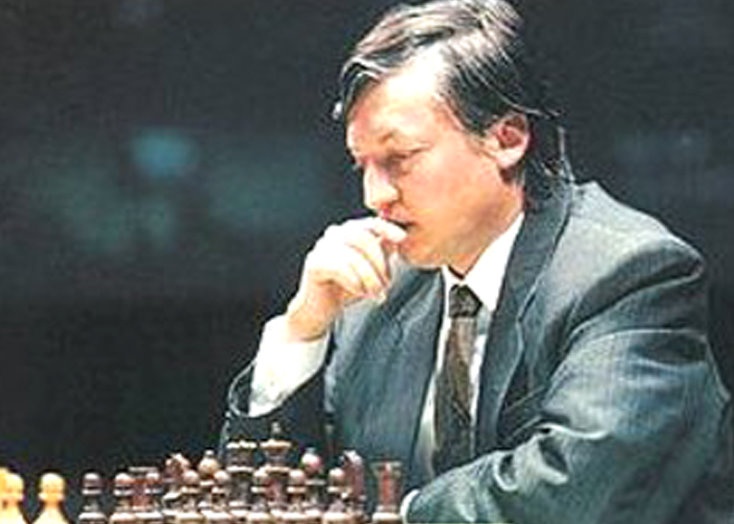
Yasser Annotates for www.ChessCafe.com
http://www.chesscafe.com/yaz/yaz.htm and http://shop.chesscafe.com
Karpov–Kamsky, FIDE-Wch Elista 1996
Karpov,Anatoly (2770) – Kamsky,Gata (2735)
FIDE-Wch Elista (1), June 6, 1996
Grünfeld [D98]
1.d4 Nf6
Karpov, as expected, opened with his d-pawn.
2.c4 g6 3.Nc3 d5
I expected Kamsky to answer with the King’s Indian Defense. Instead he chose the Grünfeld, a very dangerous opening. Kasparov himself has gotten clobbered by Karpov in this line.
4.Nf3 Bg7 5.Qb3
This was a surprising choice. Karpov has preferred both the Exchange Variation and, more recently, Fianchetto lines. In the period 1991 through 1993 he employed 5.cxd5 in nine of the thirteen Grünfelds he played, scoring eight wins and one loss, to Kamsky!
5.Qb3 has been a favorite line of GM Jeroen Piket. He used it to defeat Garry Kasparov at the 1995 VSB tournament. Karpov last played the line in 1986 and 1987, chiefly in his Seville and Leningrad World Championship matches against Kasparov.
5…dxc4 6.Qxc4 O‑O 7.e4 Nc6
Also a surprise, though Gata has faced 5.Qb3 only a few times in his career, managing but one draw in four games! The text is an old favorite of Smyslov. The modern choice is to play 7…Nb8-a6 followed by 8…c7-c5.
8.Be2 Bg4 9.Be3 Bxf3 10.Bxf3
The move 10.Bxf3 is considered inferior to 10.gxf3. The idea is prevent Black from gaining control over the d4-square.
10…e5
This line is considered innocuous for Black.
11.d5 Nd4
This is Black’s point, i.e., 12.Bxd4?? exd4 13.Qxd4? Nxe4! leads to an advantage for Black.
12.Bd1
With this passive move, the theoreticians consider Black’s chances equal. After all, the d1-bishop isn’t any great shakes. But Karpov is very good at probing weak places.
12…b5
This appears to be a mistaken novelty. Black is asking far too much of his position. He wants to take over the initiative without the necessary preparations. I doubt that Kamsky could’ve anticipated this line. Black should play 12…Rc8! in order to play …c7-c5, reinforcing the d4-knight. After the text, Black’s queenside is very weak.
13.Nxb5 Nxe4 14.O‑O
Scurrying to the kingside. 14.Nxd4 is dangerous because of 14…exd4 15.Bxd4 Qg5!? and …Qg5-d2+ or …Qg5xg2. And 15…Qg5 isn’t the only problem!
14…a6 15.Nc3
On 15.Nxd4 Black gets enough compensation for the pawn with 15…exd4 16.Bxd4 Nd2 17.Qc3 Bxd4 18.Qxd2 Qf6. Now Kamsky has a problem. He can’t capture on c3, as 15…Nxc3 16.bxc3 boots the d4-knight. He has to retreat.
15…Nd6 16.Qd3 Qh4
This is Black’s problem. His bad structure forces him to chase the initiative. If Black waits, White will develop and redeploy the d1-Bishop with advantage. I think Kamsky avoided 16…Rb8 17.Qxa6 Rxb2 out of fear of White’s passed a-pawn. And 16…f5 weakens the e6-square badly. After 17.Bxd4 exd4 18.Ne2, the threats of Ne2xd4 and Ne2-f4-e6 are good for White.
17.g3 Qh3 18.Bxd4 exd4
Now Black faces a similar problem: How to defend the d4-pawn?
19.Ne2 Qf5
Again White is poised for improving his pieces, which will give him the initiative.
20.Nf4
Karpov makes a nice redeployment of the knight to the blockading d3-square.
20…Rfb8
Sensible. Black wants play along the b-file. However, perhaps better is 20…Bg7-h6, even if it means sacrificing the d4-pawn. Once White plays Rc1, the c7-pawn will be tender. This is all a result of 12…b7-b5.
21.Qxf5 Nxf5 22.Nd3 Bh6
Looks forced. The trick 22…Rb5?? 23.Ba4 Rxd5 24.Bc6 of course favors White.
23.Re1 a5 24.Bg4 Nd6 25.Re2
White prepares Re2-c2.
25…a4
This is exceptionally risky! Black puts a pawn on the light squares. Now a line involving Bg4-d7-c6 will leave Black in trouble.
26.a3 Ra5 27.Rc2 Rxd5 28.Rxc7
Both players are now happy, having gotten rid of weak pawns. But Black still has two pawn weaknesses remaining! Most important, the d4-pawn actually hurts Black. In addition, the h6- bishop is ineffective. White threatens to produce an unpleasant pin by Rc7-d7.
28…Ra5 29.Bf3 Bg5 30.Rd1
This move appears a bit inaccurate. I would’ve played 30.h4! The idea is to see if Black is willing to give up control over the c1-square. Note how White’s pieces are doing things, while Black’s are defending.
30…Rc8
A good move, it gets rid of an active piece.
31.Rxc8+ Nxc8 32.h4 Bf6 33.Rc1 Nd6 34.Kf1
Excellent! Remember Fischer–Petrosian, Buenos Aires 1970? The passed d-pawn in the center was a key liability that got gobbled by the white king.
34…Be7 35.Ke2 Kf8 36.Rc7 Bf6 37.Kd2 h5 38.Ke2
This smacks of time trouble. Karpov moves quickly, just wanting to make the time control without spoiling anything.
38…Nf5 39.Rc4 Nd6 40.Rb4
Excellent play by White. Now the threat of Bf3-c6 is rather serious.
40…Ra6
This is a time trouble mistake. Kamsky wants to stop Bc6, which will grab the a4-pawn, but the cure is worse than the disease.
41.Nc5 Ra7 42.Kd3 Rc7 43.Nxa4
Very nice! White’s army coordinates well. Gobbling a pawn. Essentially, it’s game over now.
43…Rc1 44.Nb6 Bg7 45.a4
This is too enthusiastic. Yes, White is winning, but it was simpler to play 45.Nd5!, preparing 46.Rb6, and then to push the b-pawn. Now it is a little harder for White to push his passed queenside pawns through.
45…Ra1 46.Nd7+ Ke8 47.Nc5 Ke7 48.Kc2 Rf1 49.Nd3
Despite my earlier quibbling, White has achieved the ideal: his pieces are invulnerable! Now he is ready to rock and roll on the queenside.
49…Ra1
Black has to go back so as not to release the b4-rook from defensive duties. He hopes to play …Nd6-e4 at some point.
50.Kb3 f5
Essentially, there is nothing for Black to do. The text, however, weakens the g6-pawn.
51.Rb6 Bh6 52.Bd5 g5 53.Ra6
A surprising move. Normally, one would just play 53.hxg5 Bxg5 54.Ra6 and not allow a weak h4-pawn to appear.
53…gxh4 54.gxh4 Rd1 55.Bc4 Rh1 56.a5 Rxh4
Here the game was adjourned. Karpov should win easily after 57.Ra7+. What can Black do? It seems that 57…Kd8 or 57…Ke8 are the only moves. If 57…Kf8 or 57…Kf6, then 58.Rd7 with the idea of pushing the a-pawn home. The rook gets off the a-file with tempo. After 57…Kd8, Karpov plays 58.Be6, threatening Rd7+. The idea is to play Ne5-c6 and Rd7-d8 mate. Black is quite lost.
57.Bd5 1‑0
Karpov’s sealed move prevents Black from bringing his rook to h1 and, by extension, the a1-square. While not as convincing as 57.Ra7+, it is hard to argue with a move that forces resignation! Kamsky resigned without resuming the adjourned position.
Great game by Karpov.