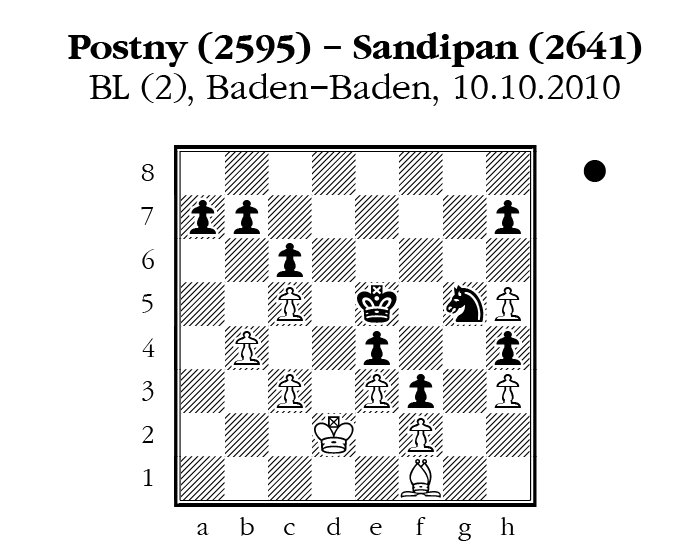
Black to move. Can you formulate the correct winning plan for Black? This is a very good endgame to learn from.
Source: ChessToday.net (The best daily chess newspaper!)

Chess Daily News from Susan Polgar

Black to move. Can you formulate the correct winning plan for Black? This is a very good endgame to learn from.
Source: ChessToday.net (The best daily chess newspaper!)
Does it involve something along the lines of Kd5 and then N to f7, e5 followed by a5 and then rounding up the pawns on the Queenside?
The one pawn that sticks out to me as a weakness is the f2 pawn which can only be protected by the king, but the bishop controls the d3 square the knight would have to sit on to attack it, so I doubt that plan has any real usefulness.
The other thing that black might do is to undermine the c5 pawn with a move like a5. The bishop is rather useless in this line due to the fact that it is tied down to the defense of h3. Let’s take a look at this line and see if we get anywhere:
1. …..a5
Now, here, white has limited options. Like I wrote above, the bishop is tied down to f1. A king move like Ke1 might well lose to a4- the white king can get back to a1 in time to stop the pawn, but doing so might allow black to play Kd5/Nf7/Ne5/Nd3 in which black will create a second passed pawn on d3, and the king can’t stop both in time if I am counting correctly without allowing the black king to penetrate and win all three queenside white pawns. As I see it, white either takes at a5 or plays a king move like Kc1, Kd1, or Kc2. Again, just counting moves leads me to believe that any king move is going to lose to the black plan I outlined above, so lets look at ba5 first:
2. ba5 Kd5
Ok, here the c5 pawn is toast, but the combination of the c3 and a5 pawns with the bishop will keep the black king out of the queenside for the moment. Continuing:
3. Kc1
White could play a number of moves here, but I don’t think any of them are particularly different overall- black has the initiative, and I see no way for white to affect this with a different king move. Continuing:
3. …..Kc5
4. Kc2 h6
Here, I would just take away a potential waiting move from white while taking the backward h-pawn off of the white square. Also, having reached this position, I can now see that the white king cannot stray too far away from the king side for another reason- black might eventually be able to bring the knight to g3 and then e2 as white cannot take at g3 without allowing the resulting connected black pawns from pushing the bishop off the board. Continuing:
5. Kd2
I will deal with a6 later. Continuing:
5. …..Nf7
This has to be played eventually in order to make progress, and I see no reason not to play it now. Continuing:
6. a6
This is going to be forced eventually as the knight is coming to c4 via e5 to win a5. Continuing:
6. …..Kb6 (ba6 looks same to me)
7. ab7 Kb7
Now, it is getting complicated. My natural desire as white would be to play the bishop to c4. Of course, white could play a king move instead, but, as above, all the initiative is on black’s side, and I am having a hard time seeing a white move that interrupts this:
8. Bc4 Ne5
Here, if the bishop leaves the a6/f1 diagonal with a move like Be6, the knight takes d3, and the f2 pawn falls as the king is cut off from e1. Bf1 seems forced:
9. Bf1 c5 (threatening c4 and Nd3)
10.Bb5 Kb6
11.Bf1 c4 (boa constrictor style?)
12.Kc2 Kb5 (threatening Ka4/Ka3)
13.Kb2
Here, I had planned to play Nd3 forcing white to exchange the pieces, then penetrate with the black king and win c3, but I overlooked the fact that white need not play his king to d2 at all, but maintain the king at c1 and b2. So, I needed another plan. In this position, it isn’t hard to find one as white is completed tied up in knots and the knight play where he wants at will:
13. …..Nd7
14. Ka3 Nf6
15. Kb2 Nh5
16. Kc2
And, now, I can implement the plan I noticed halfway through this analysis- penetrate with the knight at g3:
16. …..Ng3
And this is clearly lost as the bishop has nowhere to go and fg3 loses quickly:
17. fg3 hg3
18. Kd2 g2
19. Ke1 g1(Q) and it is over.
Now, this analysis is far from exhaustive, especially at the beginning, but I had a hard time finding appropriate defenses for white the entire time. I think 1.a5 does win convincingly.
I like 1…a7-a5, to break up white’s pawn structure. But I’m not clear about the follow-up, except that if white takes the pawn at a5, then black’s king can get in with Kd5, take the pawn at c5. Maybe there is a knight for the h-pawn to distract the bishop so the king can get in on the queenside. I’m not exactly clear on how and when to do it.
I couldn’t help noticing a helpmate in 3:
1. Kd5 Bd3 2. b5 Bb1 3. Kc4 Ba2#
Well, as my comment appeared so quickly, there must be a more convincing win than the one I outlined. When I started the previous analysis, I hadn’t noticed the power of an eventual Ng3, so, I wonder if this isn’t the most direct plan right from the start.
1. …..Nf7
With the idea of Nh6/Nf5/Ng3. Now, can white generate any counter play whatsoever? About the only thing I can see is to threaten the h7 pawn with the bishop at some point, so
2. Bc4 Nh6
3. Ke1 Nf5 (Ng4 possible, too)
4. Bg8 h6
And, now, with the bishop out of the way, Ng3 is not winning any longer. So, lets go back to black’s third move and look at Ng4:
3. …..Ng4
4. Bb3
Obviously, hg4 loses instantly to h3 as the king will be cut off from h1 after black plays h2:
4. …..b6
I am having a difficult time finding any other move that makes progress for black:
5. cb6 ab6
6. Ba4 Kd5
7. Bb3 Kd6
8. Kf1 Nf6 (best I think)
I have no clue if white has a really good move here. It might look that h6 is rather meaningless, but playing it does matter now that white has control of the a2/g7 diagonal- it keeps the knight at bay.
9. h6 c5
As before, it is hard to find a plan for black without this.
10.bc5 bc5
11.Bc4
I just don’t like this line nearly as much as the line starting with 1. ….a5. I will consider some of the other possible first moves in my next comment.
In my previous comment, I tried to find a direct way to implement my plan of playing the knight to g3, but the line I chose allowed white some counter play that simply mucked it all up. Let’s take a look at black playing an immediate h6 to prevent this potential white counter play:
1. …..h6
So, now, as black, I need never worry about white playing a future Bc4/Bg8/Bxh7. Now white has a choice of king moves (Ke1, Kd1, Kc2, Kc1) and two pawn moves (c4 and b5). Let’s look at the two pawn moves first. I don’t think either is effective defense, but I want to clear them out of the way before continuing:
2. c4 Nh7 (idea is Nf6/Nh5/Ng3)
The real tragedy of 2.c4 is that it takes the only available square away from the bishop, who must move out of the way and make way for the king since only the king can answer the knight threat from g3. Continuing:
3. Kd1
What else? 3.b5 seems hopeless to me, and any other king move seems no different than Kd1. Continuing:
3. …..Nf6
4. Ke1 Nh5
5. Kd2 Ng3
6. Ke1 Kf5 And it is over, white is in zugzwang and must eventually lose the bishop, or give black a passed pawn on the queenside.
Back at move 2, the other pawn move also loses:
2. b5 cb5
And, from here, there are two basic lines, 3.Bb5 and 3.K anywhere:
3. Bb5 Nh3
4. Ke1 Ng1!
5. Kf1 Ne2!
6. Bd7
Of course, Be2 loses to fe2 and the white king can’t stop all three passed black pawns. Continuing:
6. ……a5
And, now, the white bishop can’t stop the two passed black pawns. Back at move 3 in this line, if white plays a king move (any), black wins much like we showed previously:
3. Ke1 a6
4. c4
Otherwise, black will play Nh7/Nf6/Nh5/Ng3 as we saw before- the bishop needs access to c4 otherwise he is trapped once the knight reaches g3. Continuing:
4. ……b4 (bc4 playable, too)
5. Kd2 Nh7
6. c6
What else? This position is clearly lost for white, so lets stop analyzing it right here, shall we?
So, after 1. …..h6, we have dispensed with both of the possible white pawn moves, so we only need to consider the king moves. From the top:
1. ……h6
2. Ke1 Nh7
3. Bc4
So, now, can black continue with the plan of Nf6/h5/g3? I have trouble with Bf7 in that case. I can’t quite find the right plan. Let’s look at one of the moves I considered for black optional to Nf6:
3. ……Kf6 (taking f7 from B)
4. Bf1 Ke7
5. Bc4 Nf6
6. Bf1 Nh5
7. Bc4 Nf6 (Ng3 no good now)
Again, I am having trouble finding the clear winning line for black. Having the bishop come to c4 is a disrupting defensive move. This gives me the idea of trying to take this square away from the bishop with the second move. I will continue in my next comment.
In my previous comment, I tried to find a direct way to implement my plan of playing the knight to g3, but the line I chose allowed white some counter play that simply mucked it all up. Let’s take a look at black playing an immediate h6 to prevent this potential white counter play:
1. …..h6
So, now, as black, I need never worry about white playing a future Bc4/Bg8/Bxh7. Now white has a choice of king moves (Ke1, Kd1, Kc2, Kc1) and two pawn moves (c4 and b5). Let’s look at the two pawn moves first. I don’t think either is effective defense, but I want to clear them out of the way before continuing:
2. c4 Nh7 (idea is Nf6/Nh5/Ng3)
The real tragedy of 2.c4 is that it takes the only available square away from the bishop, who must move out of the way and make way for the king since only the king can answer the knight threat from g3. Continuing:
3. Kd1
What else? 3.b5 seems hopeless to me, and any other king move seems no different than Kd1. Continuing:
3. …..Nf6
4. Ke1 Nh5
5. Kd2 Ng3
6. Ke1 Kf5 And it is over, white is in zugzwang and must eventually lose the bishop, or give black a passed pawn on the queenside.
Back at move 2, the other pawn move also loses:
2. b5 cb5
And, from here, there are two basic lines, 3.Bb5 and 3.K anywhere:
3. Bb5 Nh3
4. Ke1 Ng1!
5. Kf1 Ne2!
6. Bd7
Of course, Be2 loses to fe2 and the white king can’t stop all three passed black pawns. Continuing:
6. ……a5
And, now, the white bishop can’t stop the two passed black pawns. Back at move 3 in this line, if white plays a king move (any), black wins much like we showed previously:
3. Ke1 a6
4. c4
Otherwise, black will play Nh7/Nf6/Nh5/Ng3 as we saw before- the bishop needs access to c4 otherwise he is trapped once the knight reaches g3. Continuing:
4. ……b4 (bc4 playable, too)
5. Kd2 Nh7
6. c6
What else? This position is clearly lost for white, so lets stop analyzing it right here, shall we?
So, after 1. …..h6, we have dispensed with both of the possible white pawn moves, so we only need to consider the king moves. From the top:
1. ……h6
2. Ke1 Nh7
3. Bc4
So, now, can black continue with the plan of Nf6/h5/g3? I have trouble with Bf7 in that case. I can’t quite find the right plan. Let’s look at one of the moves I considered for black optional to Nf6:
3. ……Kf6 (taking f7 from B)
4. Bf1 Ke7
5. Bc4 Nf6
6. Bf1 Nh5
7. Bc4 Nf6 (Ng3 no good now)
Again, I am having trouble finding the clear winning line for black. Having the bishop come to c4 is a disrupting defensive move. This gives me the idea of trying to take this square away from the bishop with the second move. I will continue in my next comment.
In my previous comment (maybe the previous 2 or 3- I have software hiccups posting comments these days), I had outlined the plan of playing h6 and then planning to bring the knight to g3, but I need to take c4 away from white’s bishop to make this plan a clear win. So, from the top:
1. ……h6
2. Ke1 b5
And white can take en passant, or not. I will consider both cases:
3. cb6 ab6
Here, white has king moves and pawn moves only as the bishop is still tied to protecting h3:
4. b5 c5 (best I think)
5. Kd2
What else? 5. c4 just accomplishes the black plan of denying c4 to the bishop. Continuing:
5. ……Kd5 (threatens c4)
6. Kd1 c4
And I think it is clear that white’s position is hopeless- the bishop has no safe squares. Continuing:
7. Ke1 Nh7
8. Kd1 Nf6
9. Ke1 Nh5
10.Kd1 Ng3
11.Bc4
Here, fg3 is hopeless, too. Continuing:
11. ……Kc4 and black wins easily. At move 4 in this line, white does no better with
4. c4 c5
5. b5 Nh7
6. Kd1 Nf6
7. Ke1 Nh5
8. Kd1 Ng3
9. Ke1 Kf5
10.fg3 hg3
11.Be2 g2
12.Kf2 fe2 and one of the pawns must queen. So, at move 4, white has only king moves:
4. Kd2 c5
And white has the same problem we have already seen, there is no way to prevent black from closing up the c4 square- 5. b5 is answered by Kd5 and c4 (by either side). This just loses for white like the lines above. Finally, at move 3 above, white did not have to take en passant, but this still loses:
3. Kd2 a6
4. Ke1
Here, c4 is no good as black just proceeds with the plan outlined above. Continuing:
4. ……Nh7
5. Kd2 Nf6
6. Ke1 Nh5
7. Kd2 Ng3
8. Ke1 Nf1 (wins anyway, now)
9. Kf1 Kd5
10.Ke1 Kc4
11.Kc2 Kb3 and all the white queen side pawns fall.
So, the plan of 1. …..h6 and 2. ….b5 works, and I find no defense for white.
Getting the Knight to g3 would be it, so first close of the queenside for the bishop with b6, going for either a white pawn on c4, og a black protected one on b5…. then Ne6-g7-f5, and then wait for whites king to not be in a position to go to e1, either by being in e1 or to far away from it, the zugswang will take care of that, and then play Ng3.
Yancey Ward, jdalberg:
What is white mobilizes his king?
On b6 white exchanges on b6, then the king runs d2-c2-b3-a4, and counters the c5 move by Kb5, preventing c4.
And if Black tries for a c6-b5 pawn formation, then white plays c4 and Kc3.
h6 31.Kc2 Nh7 32.Kd2 Nf6 33.Bc4 Nxh5 34.Bf7 Nf6 35.Bc4 Nh7 36.Kd1 Ng5 37.Bf1 Kd5 38.Kd2 Nf7 39.c4+ Ke5 40.Kc3 h5 41.Kd2 Nh6 42.Ke1 Ng4 0-1
One possible plan might be the
following plan
Capture the h5 pawn
Play h5
Move the night to g4
This ties the white king to e1. Meanwhile
the black king can create havoc
on the other side.
I haven’t done any analysis on it, but it occurred to me last night while I was going to sleep, that black might more effectively shut the bishop out of c4 by playing Kd5 immediately. If I have time later today, I may work on this. I was hoping that maybe LucyMarie might have taken a look at this by now, but I am guessing she was busy with other things.
SBruno,
Without looking at it in detail, I don’t think the white king can venture far from f2 and d3 without the knight planting itself on d3- so I don’t think white can hold the position by threatening the king march you are describing. However, I will take a look at it later today.
Well, I got really lazy and went to the actual game. Sandipan won with h6, he then won the advanced white h-pawn at h5, advanced his own pawn to h5, then eventually maneuvered the knight to g4, which left white in zugzwang. One commenter did suggest this plan, but he anonymous. I am still not sure Sandipan’s was the most proficient way to win, but I could find a good white defense either, but that was the case for the plans I offered, too.
Any way, very fascinating position. Was a lot of fun working on.
Yancey, you looked up the actual game – where?
Without the game, I am still not convinced. If black plays the Knight to g4, then the white King defends the f2 pawn from e1, and the Bishop is free to move. Where is the zugzwang?
This is another example of many, when an interesting puzzle on this site disappears out of sight without a satisfactory solution. Dear Susan, please give us the solution.
SBruno,
You can find the game here
http://bundesliga.liveschach.net/index.php
It is in round 2 on October 10, but the player listing is backwards.
In the final position, white had to either create a passed pawn for black on the queenside and also lose the advanced c-pawn to the king, or take the knight at g4 creating an unstoppable passed h-pawn, or move the king away from f2 losing that pawn- there were no squares for the bishop not covered by black pawns.
The final position includes all the themes discussed by the various commenters, Sandipan simply brought them all together in about 11 moves. I find no defense for white in the entire line of the game.