
Original article on Chess Interview with Dragan Solak is on William’s site and includes PGN and more.
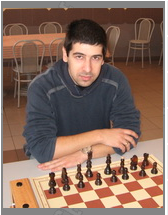
Dragan Solak is a strong Serbian GM with a FIDE rating over 2620. He was kind enough to do an interview with me a few months ago and what he had to say was absolutely fascinating. He’s the first person I met who says he was competing in tournaments by the time he was 3 years old. In it he says you should FORGET about opening preparation until you are at least 2200+ and he is sure that at least 2-3 GMs in the Top 100 level are probably getting away with cheating!
Watch the game of GM Dragan Solak vs. GM Gabriel Sargissian
The Interview with Dragan Solak
When did you learn chess and who taught you?
I was too young to remember. Before I was 4 I definitively new the rules and even started playing some tournaments. My father taught me how to play. He was very patient and invested a lot of time and energy, although he had a very serious job. I wasn’t much different from other kids of my age, but he was really persistent in trying to teach me some patience, thinking and so on. Chess was just a tool for this and now I think the time he was spending with me trying to teach me these basic things really mattered.
When did you begin playing tournaments and how did you do?
I have a material proof that I took part in some tournament before I was four. Tournaments with adults were difficult for me, but I started to beat most other kids rather quickly.
Can you recall a specific turning point? (a game, event, working with a chess coach, etc..)
One interesting moment was when I won the 14 player round-robin U20 championship of my country when I was 15 and rated around 2200 when some much older and much better players were taking part. I was really lucky during that tournament, once my opponent lost on time in equal position and in another game a very strong opponent, Ivanisevic, blundered a rook. I did play some good games, but luck was decisive. Before that I was playing and sometimes studying with FM Notaros, although I was successful it wasn’t really serious. After that everyone around me started acting differently and I got some support.
What are your top book recommendations for beginner to intermediate players?
No openings! The important thing is to improve the thinking process, so books with positions that you can look at and solve are best. There are many such books, but some of them have mistakes in the solutions section, which is really bad.
What are your top book recommendations for advanced players?
Until around 2300 I recommend no serious involvement in opening theory, even until 2400, unless the student has really really great potential (aiming for 2700+ lets say) when under very good guidance he/she could start learning openings almost right from the start. So I recommend the same kind of books, only that the examples are a bit more difficult, meaning that sometimes no forced mate will be required, but maybe only a nuance in evaluation of position. I’ve seen many such examples in Dvoretsky books, plus they have really good solutions as they were checked and rechecked by many of his students. There must be many other similar books out there. Endings can be used to train the thinking process and can be very useful since they are often easier to grasp as there are fewer pieces on the board. I don’t think that knowing by heart many endgame positions is a key to success. It will earn some points, yes, but for progress the most important thing is to constantly improve the quality and speed of the thinking process. I think it is still the most important thing even for me at the 2600 level.
How did you become a GM? (What tournaments, did you have a chess coach, etc..)
I lived in a communist society so even strong GMs were not expecting money for teaching, they would just gladly show me things for free. By the time I was 7 or 8 years old I was working regularly with FM Notaros, who only wanted to help me and didn’t ask anything in return. There were many strong tournaments around and I would take part in them. So when I was 16 my rating jumped to around 2450, and I already started beating some GMs. It was only a matter of time when I would get norms.
What was your exact study regiment when you were working towards GM?
I didnt do anything special. Just played a lot, sometimes analyzing my games. My openings were ridiculously weak. I did have some training sessions, once with GM Nevednichy and one very, very short one with GM Petar Popovic. Together not more than 50 hours of serious work and I don’t think they were very important although I did learn some things from them.
What is your study routine now? (how is it different?)
Now I devote more time to openings than I used to. Maybe even around 30%. The rest is the same – I am trying to improve my thinking process.
Nature or Nurture: Do you think top chess players are born with a natural ability/gift or do they become so talented through hard work and the right environment?
There might be some natural limits, but I think we are far from them. Some things are much more difficult to change, but they can still be changed! I think what some people call IQ can be changed drastically, easier at a younger age, but also at any other age. Memory can also be improved very much by working hard on it. Of course, there are also inborn differences in people and with the same training one will get better than the other, but as we are very far from the limitations – hard work and proper training matter a lot. I am pretty sure that an average (even below average) 5 year old kid can became a 2600 player before the age of 18 with proper training and support. Also, when I look some years back into the past, I think I see people who became smarter by working and trying hard.
How do you feel about cheating in chess? (specific deterrents/punishments?)
This is a very serious problem. Let me put it this way: if I would want to cheat, I am 99.9% sure that I could get to 2700 in 3 years time without anyone suspecting anything and with absolutely no chance of being discovered. This would at least double my income, possibly triple it. Now tell me, why wouldn’t some other guys with different moral standards take a shot? My guess is that there are at least a few players in the top 100 regularly cheating. Officials must first accept that there is a problem, then I am sure they can come up with appropriate deterrents and punishments. If there is a solid proof of cheating for a long period of time then a lifetime ban is clearly insufficient punishment if you ask me. With solid proof that someone organized receiving one or two engine moves, I wouldn’t mind a 5-year ban, plus a large financial fine depending on the scale of the tournament that would allow organizers to compensate money to all participants that took part in the event.
Original article on Chess Interview with Dragan Solak is on William’s site and includes PGN and more.
 Follow William for fresh daily updates: Follow @OnlineChessLess
William Stewart is a National Master. He specializes in Online Chess Coaching and maintains a daily updated Chess Blog
I would be led to believe that books on strategy would be good?