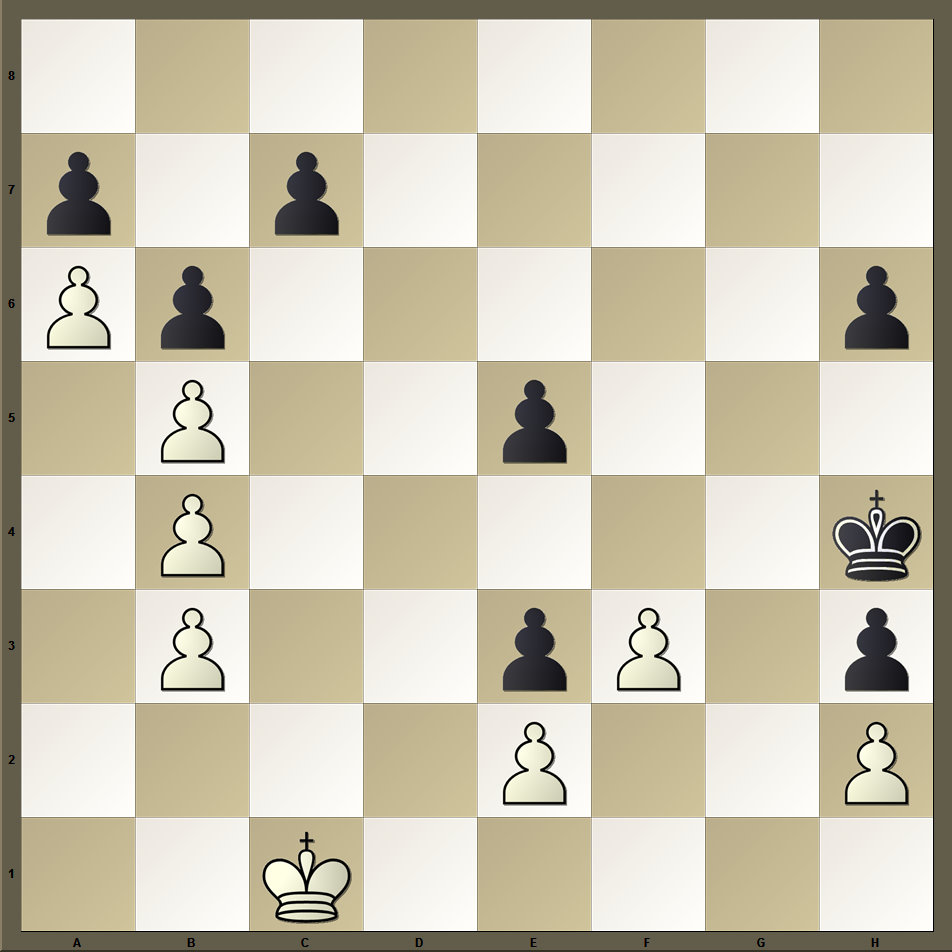
White to move. Is this a win, draw, or loss for White? How should White proceed?
8/p1p5/Pp5p/1P2p3/1P5k/1P2pP1p/4P2P/2K5 w – – 0 1
(Zinar, 1976)

Chess Daily News from Susan Polgar

White to move. Is this a win, draw, or loss for White? How should White proceed?
8/p1p5/Pp5p/1P2p3/1P5k/1P2pP1p/4P2P/2K5 w – – 0 1
(Zinar, 1976)
Can’t see even a draw for white. White cannot win when black has all the moves and e4 is coming when the black king will support it while the white is not there. And I cannot see a credible stalemate position.
Oh, well, now I see black does not really achieve that much without white cooperation. But I cannot see that white can achieve anything without black cooperation.
White doesn’t have any good pawn moves, but Black can’t break through. If White gets his king to d5, Black can’t defend both the c7 and e5 pawns.
This is going to be complicated, I think. First, white has no worries about the king side as the pawns at e2 and h2 keep the black king out of f3 and and g3. As the position stands, I think we can eliminate the only pawn move white has, f4 as this would simply give black a supported passed pawn after ef4, Kg4 and f3 in that order. This leaves the king moves Kd1, Kb1, Kb2, and Kc2. Now, obviously, white wants to attack and win the pawns on the e-file, or run up the c and d-files to win the pawns on the queenside. Lets look at the direct attacking line and see what we learn:
1. Kc2 Kg5 (will do Kh5 if needed)
2. Kd3 Kf4 (protecting e3)
3. Kc4
White has to move, so this is the active plan. Now, black has a choice- follow the white king over to the queen side with either Kf5 or Kg5, or play e4 to force open the path through e4 with eyes towards winning at e2, or trapping the white king on the a-file. I will have to consider all three, though two of them look bad on first principles to me:
3. …..Kf5
4. Kd5
Taking the opposition. This already looks bad for black as the e-pawns are terribly weak now:
4. …..h5 (Kf6 5.Ke4)
5. Kc6
And white has gained a valuable tempo by my count. Black can win the e2 pawn and queen his advanced e-pawn in 9 moves, but white wins the queenside pawns and queens the a-pawn in seven moves total (one move will be fe4), and will also queen a b-pawn in another 4 moves. So the black king must follow to the queenside to have any chance at drawing:
5. …..Ke6
Here, I made a detour through 6.Kc7, but this draws as it leaves the c7 square open to the black king himself. White must play
6. Kb7! Kd7
7. Kb8! Kd8 (h4 8.Ka7 Kc8 9.Ka8+-)
8. Ka8! Kd7 (Kc8 9.Ka7 h4 10.Ka8+-)
9. Kb7! Kd8 (else, Ka7 wins)
10.Kc6! and now black’s e-pawns will fall as the black king has been lured far enough away. Back at move 3 for black, he will still lose, I think, with
3. …..e4
4. fe4 Ke4
5. Kc3 h5
6. Kc4 h4
7. Kc3 Ke5 (Kf4 8.Kd4 Kf5 9.Ke3)
8. Kd3 Kf4
9. Kd4 and black will lose the e-pawn and the game most likely. After move 4 in this line, it doesn’t matter how black uses up his waiting moves with his h-pawn as the white king always has waiting moves himself c3, c4, and d3 and d4 in the various lines. No, at move 3, the only possible holding move is the counter intuitive Kg5:
3. …..Kg5
4. Kd5 Kf5
And, now, it is black with the opposition, and this makes all the difference in the world from the previous line:
5. Kc6 Ke6
6. Kb7 Kd7
7. Ka7 Kc8
8. Ka8 c6 (only move, I think)
9. bc6
Here, Ka7 is met by Kc7 (the open square for the black king is critical), and a7 is a stalemate after cb5 and f4 followed by ef4. Continuing:
9. …..b5 (Kc7 draws, too)
And regardless of what white does, this position is drawn (stalemate is coming on a7, Ka7, or c7), unless he plays 10.f4 in which case white actually loses.
So, I don’t think white can play 3.Kc4 and win this. I will continue the analysis in my next comment.
White wins !
The white can enter the black position, black to late whites position.
Erik Fokke
In my previous comment, I had started the analysis on the following beginning:
1. Kc2 Kg5
2. Kd3 Kf4
And, I think I had demonstrated that black can draw after 3.Kc4 by playing Kg5. So, at move 3, can white find a winning move? The alternatives were Kc3 and Kc2:
3. Kc3
Here, I think black must clearly avoid a move like e4 as this leads to a position we saw in my previous comment that I showed was a loss for black. With the white king now at c3 instead of c4, I think black can safely play Kf5 as white cannot come to d5 on the next move:
3. …..Kf5
And, now what for white? 4.Kd3 is met again by Kf4- the position after move 2. If white plays 4.Kc4, black plays the drawing move of Kg5 we saw in the previous comment. This leaves Kc2 and Kb2:
4. Kc2 Kg5
Well, this is the position after the first move! We will come back to it later. Or
4. Kb2 Kf4
And, I am damned if I see a path forward for white here that we haven’t already seen, or just gives up ground to the black king by allowing black to play e4 safely.
So, were there winning moves at move 2? The most obvious alternative was Kc3, but black just plays Kf5, a position that led to a draw. On 2.Kb2
2. Kb2 Kf4
And, if white plays Kc2, black plays Kg5, and if white plays Kc3, black plays Kf5, both draws. I think I see the solution, now, though. Will continue in my next comment.
I think white wins this easily. The main feature is the white pawns on h2 and e2 as well as the black pawns on h3 and e3 which means that the black king can not infiltrate the position to mop up the white pawns and promote. The white king on the other hand is free to move up along the c and d files to attack all of blacks loose pawns.If the black d3 pawn falls then white can use his 2 to 1 majority in the center to win the game.
In my previous two comments, I think I has shown that 1.Kc2 draws with proper play. In that line, the only way to win the game for white is divert the black king to defense of the queenside and then come back win the e3 pawn, but black can foil this plan with proper play. The way this previous line played out leads me to believe that white can keep a key waiting move in reserve by playing
1. Kb2
Now, as before, black has h5, Kh5, and Kg5 as moves:
1. …..Kg5
2. Kc2!
And we have arrived at the position reached in the previous line after black’s first move, but then, white had to move- here, black must move:
2. …..Kf5 (alternatives below)
3. Kc3
Again, we covered this position in my previous comments, but in that case white had to move, here it is black:
3. …..Kf4 (alternatives below)
4. Kd3 h5 (else, lose the e3 pawn)
5. Kc4 Kf5 (alternatives below)
6. Kd5 Kf6 (alternatives below)
7. Ke4 Ke6 (what else, now?)
8. Ke3 Kf5
9. Kf2 Kg5 (everything looks same)
10.Kg3 Kf5 (everything looks same)
11.e3 Kg5
12.Kh3 Kg6(h4 13.f4 ef4 14.ef4+-)
13.f4 ef4
14.ef4 Kf5
15.Kg3 Ke4
16.h3 Kf5 (everything loses, now)
17.Kf3 h4
18.Ke3 and it is over as the black king has to give way.
Alright, let’s work our way backwards through the alternatives.
At move 6, black loses with
6. …..h4
7. Kc6 Ke6
8. Kb7
Again, Kc7 will draw as it leaves the c7 square open at a critical point for the black king:
8. …..Kd7 (everything is losing)
9. Ka7 Kc8 (else, 10.Kb7 wins)
10.Ka8 and black must either allow 11.Kb7 winning, or give white a passed e or f-pawn after playing 10. ….e4. Or, at move 6:
6. …..Kf4
7. Kc6 e4 (what else?)
8. fe4 Ke4
9. Kb7
Again, not Kc7!
9. …..Kd5
10.Ka7 wins easily.
Back at move 5, the alternatives for black still lose:
5. …..e4
6. fe4 Ke4
7. Kc3 and we saw this in my previous comments- black cannot save the e3 pawn as he runs out of pawn moves and the king must eventually give way to white’s king. Or
5. …..h4
6. Kd3 and the e3 pawn falls. Or
5. …..Kg5
6. Kd5 Kf5 (Kf6 7.Ke4+-)
7. Kc6 Ke6
8. Kb7 Kd7
9. Kb8! and we saw this position in one of my previous comments- eventually, to keep white from winning the a-pawn and forcing the black king to give way, white will force the black king to d8 and then travel back through c6 win at e3.
Back at move 3, the alternatives still lose for black:
3. …..h5
4. Kc4 Kg5 (Kf6 or e6 loses e3)
5. Kd5 Kf5 (Kf6 6.Ke4 wins)
6. Kc6 Ke6
7. Kb7 Kd7
8. Kb8 Kd8(h4 9.Ka7 Kc8 10.Ka8+-)
9. Ka8 Kd7 (Kc8 10.Ka7 h4 11.Ka8)
10.Kb7 Kd8 (h4 11.Ka7 wins)
11.Kc6 and e3 will fall once again.
Finally, back at move 2:
2. …..Kf4
3. Kd3 h5
4. Kc4 and we have seen this position above was lost for black. Or
2. …..h5
3. Kc3!
And, on 3. ….Kf4 white will play 4.Kd3 leading to a win for white. On 3. …..Kf5 4.Kc4 wins as before, and on 3. ….Kg6 or Kf6, 4.Kd3 will win.
I think 1. Kb2 wins in all variations after black replies with 1. ….Kg5. In my next comment, I will consider black’s first move alternatives.
In my previous comment, I think (I hope), I had proven that the line
1. Kb2 Kg5
2. Kc2
was a win for white in all relevant variations. The last loose thread are the first move alternatives for black-Kh5 and h5:
1. …..Kh5
2. Kc3 Kg5 (what else)
3. Kc4 Kf4
4. Kd3 and we know from previous lines that this is lost for black. Or, at move 3 in this line:
3. …..Kf5
4. Kd5 and we saw this line in an earlier comment of mine which showed that white wins. Or
3. …..h5
4. Kd5 and we saw this line in my last comment, and it was lost for black, too. And 3. ….Kf6 or Kg6 loses to 4.Kd3.
And, at long last
1. …..h5
2. Kc3 Kg5
3. Kc4 and we have reached previously proven losing position for black.
This study is an amazing example of very subtle waiting move variations and the accompanying zugzwang positions.
easy win for wh. blk will run out of moves and lose his e3 pawn
han
And, then again, the sources:
Zinar, Shakhmaty v SSSR, 1976, twelfth issue, #46, special prize.
And then again the same complaint: why on earth don’t you mention sources?
Cortex, aka Sourceman.
PS : Yancey, nice, very nice job. But, last anonymous, this study is not an easy one, as we can expect from Zinar. He’s really amazing. Only Grigoriev understood as well the pawn endings…
Cortex, are you blind? This isn’t the first time you say this and if you read below the FEN, it clearly says the name of the author. Why do you troll?
I absolutely love M. Zinar’s studies, always very complicated!
For me it’s a draw.
1.Kb2! Kh5 3.Kc3 Kg5 4.Kc4 Kf4 5.Kd3 h5! This is the worst concession Black has to make but it’s not enough to enable White to win
6.Kc4 Kg5! 7.Kd5 Kf5 8.Kc6 Ke6 9.Kb7!? Kd7 10. Kxa7 Kc8 11.Ka8 c6!! 12.bxc6 b5!. Even if the pawn was on h4 10.Ka8!? Kd8= would draw
No i just checked and i’m completely wrong, please delete my comment or don’t take it into account !