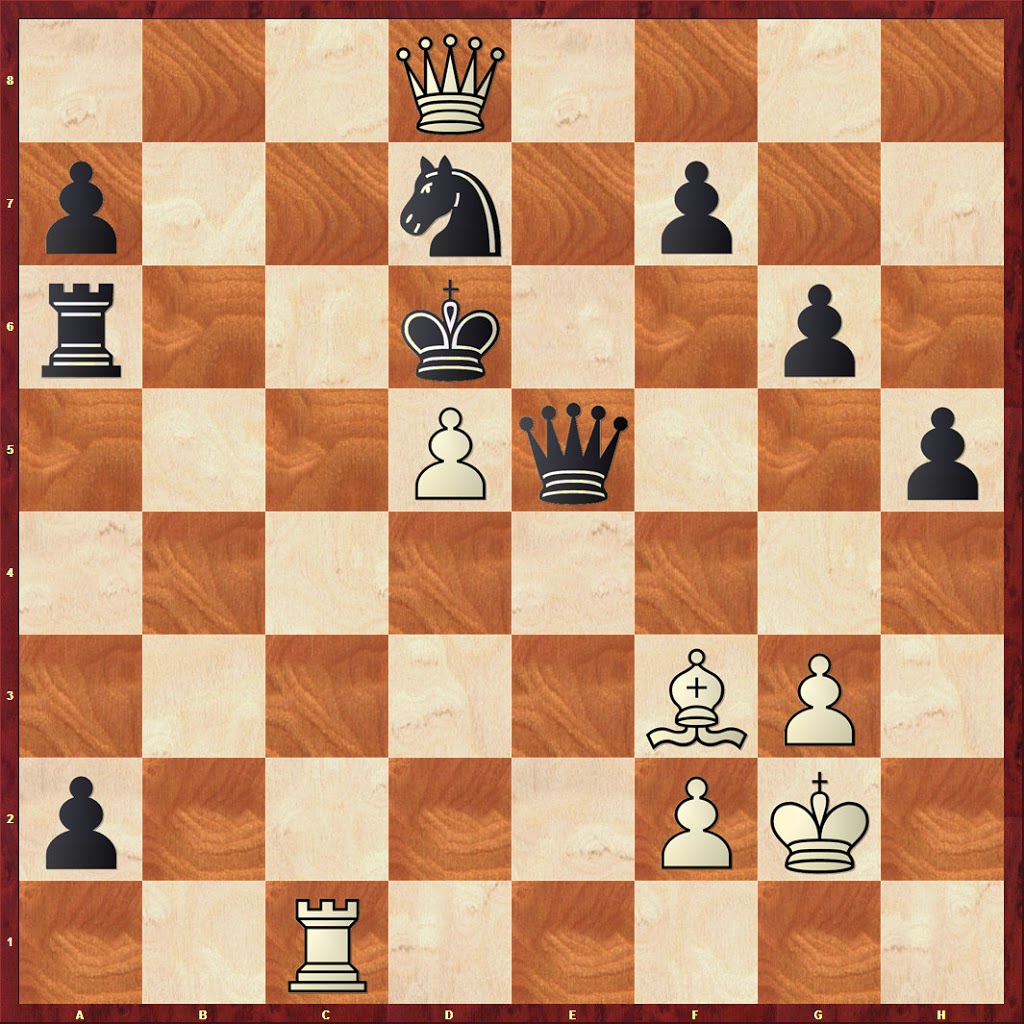
White to move. How should white proceed?
3Q4/p2n1p2/r2k2p1/3Pq2p/8/5BP1/p4PK1/2R5 w – – 0 2
Chess Daily News from Susan Polgar


White to move. How should white proceed?
3Q4/p2n1p2/r2k2p1/3Pq2p/8/5BP1/p4PK1/2R5 w – – 0 2
The first thing I would look at would definitely be the rook exchange at c6 to see if white could win or draw. I am not sure I see a win- but a draw isn’t out of the question, even with the black pawn about to queen:
1. Rc6 Rc6 (only move)
2. dc6 a1(Q) (alternatives below)
3. Qd7! Kc5 (only move)
4. c7!
And with no attack on the white king, and no way to prevent c8(Q), black is going to be down a piece for two pawns, and will have a vulnerable king to boot. So, clearly, black must find something better at move 2 than a1(Q). After white’s second move, the black is knight is pinned and double attacked, and all I can think to do in this position is to protect it with either Qe7, Qe6, or Qf5:
2. …..Qe7
3. Qa5
Here, 3.c7 doesn’t look as good: [3.c7 Qd8 4.cd8 a1Q and while the black king is more vulnerable, white is still down two pawns- I would much rather be black here]. Continuing:
3. …..Nb6 (Ne5?! 4.Qa3!)
4. Qa3! Ke6
5. Qa2 Kf6
And, I think this is about even- white has the advanced pawn, but no real way to take advantage of it, and black has the extra pawn, and no real way to take advantage of that. Back at move 2, black probably does better to play a move like Qe6 to guard the a2 pawn:
2. …..Qe6
3. c7
This or 3.Qa5: [3.Qa5 Nb6! 4.Qa3 (4.Qa7 Qc4! and it is unclear to me without a deep analysis) 4. …Ke5 5.Qc3 Kf5 6.c7 and, again, unclear to me without a deeper analysis]. Continuing:
3. …..Qc4
This is probably the only move for black: [3. …a1Q? 4.c8Q and there is no defense to the different mate threats of Qc7 or starting with Qc6]; or [3. …Qf6 4.Bc6 Qd8 5.cd8Q a1Q 6.Qd7 Kc5 7.Qd5 Kb6 8.Be8+-]. Continuing:
4. c8(N)
It really doesn’t matter what white does with this pawn- black always can take and queen the a-pawn on the next move. I would play this underpromotion simply as an attempt to lure black into a trap. Continuing:
4. …..Qc8!
This is the only reply to hold- Ke6 is mate starting with Qe7+, and Kc5 and Ke5 both lose: [4. …Kc5 5.Qe7 Kb5 (5. …Kd4 6.Qe3#) 6.Nd6+-]; or [4. …Ke5 5.Qg5! f5 (otherwise mate) 6.Qe3 Qe4 (6. …Kf6 7.Qe7#) 7.Be4 a1Q 8.Bf3 Kf6 9.Qe7#]. Continuing:
5. Qc8 a1(Q) and black is clearly better with the two pawns, but it is unclear that he can win the game. Attempts to win knight by white with a move like 6.Bc6 fail to black simply moving the knight to b6 or e5.
All in all, I don’t think 1.Rc6 leads white anywhere that he can win the game, but I have some ideas now having played this line out a bit. I will cover those ideas in my next comment.
Don’t see a clear win, but after 1.Rc6+ Rxc6 2.dxc6 Qe7 (2…a1(Q)? 3.Qxd7+ Kc5 4.c7 favors White) 3.Qa5 White has all the winning chances.
I think white should move 1.Rc7 +-
The only try is 1. Rc7 when Black has to defend the threatened mate (2. Qd7) by playing 1. … Qe7.
1. Rc7 Qe7
2. Rd7 Qd7
3. Qf6
Now, Black can either move his king or interpose with … Qe6.
Say Black plays 3. … Kc7
3. … Kc7
4. Qa6 and Black’s advanced a-pawn falls.
And if Black interposes the Queen on his 3rd move:
3. … Qe6
4. de6 a1=Q [ this move by Black stops what was White’s threat of 5. e7, and regains the material advantage]
5. Qf7
Now, if 5. … Qe5, White can play e7:
5. … Qe5
6. e7! Qe7
7. Qd7 Kc7
8. Qb7 Kd8
9. Qa6
Or Black can try 5. … Qa2, pinning the e-pawn:
5. … Qa2
6. Qd7 Kc5
7. e7 Re6
8. e8=Q Re8
9. Qe8
In my previous comment, I looked at the positions that arose after 1.Rc6+, and concluded that, with best play I could find for both players, that black would, at worst end up in drawn position with a pawn or two extra. However, in looking at that line, it became clear just how weak the knight at d7 was- in some lines white captures the knight and gets a decisive attack- even with the black pawn queening. Only moves like Qe6 or Qf5 saved black in those variations. This leads naturally to attacking the knight again on the 1st move:
1. Rc7
Threatening Qd7#. Black has no choice but to protect the knight with the queen, but this is going lose:
1. …..Qf5 (Qe7 and Qe7 are same)
2. Rd7! Qd7
Here, Kc5 and Ke5 will lose, too, and might be mates: [2. …Kc5 3.Rc7 Kd4 (3. …Kb5 4.Qe8; 3. …Kb4 4.Qe7) 4.Qe7 and if there is an adequate defense to the coming Qe3#, I am not seeing it]; or [2. …Ke5 3.Qe7 Re6 (3. …Kd4 4.Qe3 Kc4 5.Rc7) 4.de6 a1Q (4. …fe6 5.Rd5#) and mate can only be delayed, not prevented]. Continuing:
3. Qf6
The hardest part of this line to see, I think, is the continuation after this move- I nearly dismissed it altogether before realizing that white has the decisive edge after move 5 below- something I don’t think I could actually see without playing this out on a board. Continuing:
3. …..Qe6
There is no future, either, in a king move as white takes at a6 followed by the capture at a2 and wins the game with the extra piece and the c-pawn. Continuing:
4. de6 a1(Q)
5. Qf7!
I was nearly ready to throw in the towel on this line for white after move 4, but black is going to have to give up material to stop the pawn- the a-pawn and the king hinder the rook’s ability to get into position on the 8th rank and the e-file, and the queen can’t cover e8 by herself, but there aren’t enough moves to double cover the square. Continuing:
5. …..Qe1
6. Qf8!
Here, 6.e7 will also win, but in a more prosaic manner: [6.e7 Qe7 7.Qd5 Kc7 8.Qb7 Kd8 9.Qa6 with the win, but a more difficult one to bring home]. Continuing:
6. …..Kc7 (Ke6 7.Qe8+-)
7. e7 Kd7 (Re6 8.Qd8#)
8. Qd8 Ke6
9. e8(Q) with mate to follow.
Or, at move 5:
5. …..Qe5
6. e7
Of course, now, 6.Qf8 won’t be an improvement since there is no skewer to win the black queen- white would still win the rook after Ke6 7.Qc8+, though. Continuing:
6. …..Qe7
7. Qd5 Kc7
8. Qb7 winning the rook as in the subvariation we saw earlier. Probably the easiest way to win this would be to force the queens off the board and win the B+2P vs 3P endgame.
Or, at move 5:
5. …..Qa2 (pinning the pawn)
6. Qd7 Ke5
Here, Kc5 is no better: [6. …Kc5 7.e7 Re6 8.e8Q winning the rook]. Continuing:
7. e7 Re6
8. e8(Q) winning the rook.
I could be missing something better for white, but this line starting with 1.Rc7 definitely wins in my opinion.
i think 1. Rc7 pretty much does it, either winning the Knight (after 1. .. Qf5) or the Rook (after 1. .. Qe7 2. Rxd7+ Qxd7 3. Qf6+).
The first variation needs some more work, to get the a2 pawn: 2. Rxd7+ Kc5 3. Qf8+ Rd6 4. Rc7+ Kb4 5. Rxa7.
I am – almost – sure it is:
1.Rc6+ Rxc6 2.dxc6
A)2…Qe6 3.c7 a1/Q 4.c8/Q and White Queens are the most dangerous
B)2….a1/Q (or something like 2….Qe1 which is about the same) 3.Qxd7+ Kc5 4.c7! and White is the one with a very dangerous attack
C)2…Qe7 3.Qa5 maybe
White wins the Knight with 1 Rc7 Qf5 2 Rxd7+ Qxd7 3 Qf6+ K moves 4 Qxa6
The only thing I can think of is
1. Rc7 Qe7 (forced?)
2. Rxd7+ Qxd7 (if K moves W mates after a long sequence I think)
3. Qf6+ Kc7 or Kc5
4. Qxa6
Now the a pawn should fall.
1. Rc7 Qf5 *
2. Rxd7+ Qxd7
3. Qf6+ Qe6 **
4. dxe6 a1(Q)
5. Qxf7
and now, if 5… Qe1
6. Qd7+ Kc5
7. Qd5+ Kb4
8. Be4
* forced; else 2. Qxd7#. 1… Qd4 is no better.
** forced; else 4. QxR
Wonder if there is better line than 6. Qd7+ and 7. Qd5+
Timothee
Glad I wasn’t the only that got drawn to that move.
Rd7,Qf5,R*d7,Q*d7,Qf6+
Vikrant soni(india) http://www.facebook.com/vikrant.soni