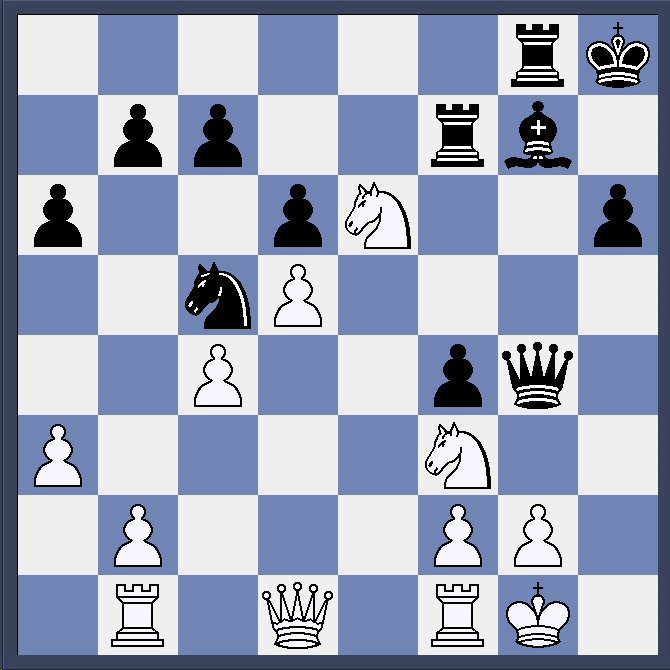
White to move. How would you assess this position? Which side would you prefer? What would you do next?

Chess Daily News from Susan Polgar

White to move. How would you assess this position? Which side would you prefer? What would you do next?
Just like that, without analyzing, I would intuitively play Nf3-g5 in a Blitz game…(white takes the rook with check if black exchange queens). Don’t have time to look at it deeper right now…see ya all later…
Looks like 1. Nfg5 winning the exchange.
1. -, Qf5 (what else?) 2. Nxf7+, Qxf7
I am not quite sure how to proceed now to make sure black does not get counterplay versus the white king.
I probably would exchage nights (3. Nxc5, dxc5) and play 4. Qf3.
Black can try 4. – ,Be5 and 5. -, Qg6/7, white’s king position can’t be improved easily (pawn f4 is a “Sargnagel”)) but it is tightened enough and white can counterplay with his rooks (b4! and open the b line).
Should be won for white or am I missing anything?
Greetings
Jochen
I concur with jochen, that Nfg5 is the move.
After 10 seconds of staring at the position, I saw that the black queen was undefended, so that if there were a tactical swindle here, it was moving the f3 knight to take advantage of the discovered attack on black’s unprotected queen.
I looked for the cheapo and two moves jumped out: Ne5 and Nfg5. While Ne5 has the added bonus of a double attack on the queen, this would only be a monster move if it were a double-check instead. Unfortunately, after …BxN, the g-rook now defends the queen, thus ruining the whole theme of taking advantage of the queen sitting there unprotected. So Nfg5 it is, threatening NxR+ and QxQ simultaneously.
Jochen said…
“Looks like
1. Nfg5 winning the exchange.
1. … Qf5 (what else?)
2. Nxf7+, Qxf7
I am not quite sure how to proceed now to make sure black does not get counterplay versus the white king.
I probably would exchage nights (3. Nxc5, dxc5) and play 4. Qf3.”
That all looks exactly right to me.
“Black can try 4. – ,Be5 and 5. -, Qg6/7, white’s king position can’t be improved easily (pawn f4 is a “Sargnagel”)) but it is tightened enough and white can counterplay with his rooks (b4! and open the b line).
Should be won for white or am I missing anything?”
I think just winning the exchange there is all that white can squeeze out of the discovered attack on black’s queen. Now:
1 (Nfg5) (Qf5)
2 (NxR) (QxN)
3 NxN — btw, white could play NxB, but I also prefer NxN, because black’s bishop is ‘bad’, and white can post pawns on the light squares and, whereas knights and queens are complementary and work well together. So better to eliminate the knight and saddle black with a bad bishop.
3 (NxN) (dxc5)
4 Qf3 Be5
5 Rfe1 Qg7 and white is up the exchange without any compensation.
Perhaps 6 b4 here is good, or just 6 b3 and a4 to move the pawns off of dark squares, and then double the rooks on the open e-file. I might even just play 6 Kf1, to move the king away from the g2 mate threat so that the queen isn’t pinned as well as move the king off the dark squares to avoid bishop checks, and finally to avoid later back-rank mates.
Finally, just playing Re2 right away followed by Rbe1 seizing full control of the only open file — well, that’s got to be good too, and then play Kf1, and b3, a4 and maybe h3 at some point to take the open file and get the king and pawns off the dark squares.
Any of those 4 possibilities will probably win for white at this point.
Now, let’s move the Black Rook on g8 to f6. So Black now has Rooks doubled on the f-file, on f7 and f6.
Does the move suggested by the first 3 commenters work now, or does Black have an effective response?
Going back to the original diagram, make sure that 1.Nfg5 isn’t troubled by that response. Finally, alter the original diagram in a different way by nudging White’s Rook on b1 over to a1, and putting Black’s b-pawn on b6 rather than on b7. Then what happens? [This IM is doing this quickly in my head, sans-machine, so apology if I’ve missed something that makes these variations of Susan’s problem less interesting than I think they are.]
Hello kwregan,
I looked at 1. -, f3 (and I think the other did so, too) and found that it was no good counter move in the original diagram because of Nxf7+ (check!) and Qxf3 afterwards.
Putting the rook to f6 1. Nfg5? will fail to f3!. 2. Nxf7+ loses to Rxf7 and white will have to sac the queen.
Best seems to be 2. Nxf3 but after Rxf3 white is down a knight.
I do not see what the last change brings but the posibility for black to win b2. I’d play Nfg5 in the last position, too.
Greetings
Jochen
PS:
“and maybe h3 at some point”
It is f3, of course.
KWRegan said…
“Now, let’s move the Black Rook on g8 to f6. So Black now has Rooks doubled on the f-file, on f7 and f6. Does the move suggested by the first 3 commenters work now, or does Black have an effective response?”
An interesting variation. Cool!
Jochen responded…
“Hello kwregan,
I looked at 1. -, f3 (and I think the other did so, too) and found that it was no good counter move in the original diagram because of Nxf7+ (check!) and Qxf3 afterwards.
Putting the rook to f6 1. Nfg5? will fail to f3!. 2. Nxf7+ loses to Rxf7 and white will have to sac the queen. Best seems to be 2. Nxf3 but after Rxf3 white is down a knight.”
What’s handy here, though, is that now my original free-associating comment comes in handy, as I babbled:
“I looked for the cheapo and two moves jumped out: Ne5 and Nfg5. While Ne5 has the added bonus of a double attack on the queen, this would only be a monster move if it were a double-check instead. Unfortunately, after …BxN, the g-rook now defends the queen, thus ruining the whole theme of taking advantage of the queen sitting there unprotected. So Nfg5 it is”
However, with the rook on f6 instead of g8, the bish is blocked, you see. So my other candidate move that didn’t work – Ne5 – now works beautifully in this variation. Whew Who!
(Rf6 variation:)
1 Ne5! and now …f3 is met simply by NxQ. So black’s only way to avoid material loss is to exchange queens:
1 (Ne5) QxQ
2 NxR+ RxN
3 RfxQ and white is up the exchange again.
“PS: ‘and maybe h3 at some point’
It is f3, of course.”
Actually, I set up my board wrong and added a phantom pawn on h2, but it made no difference — yes, f3 at some point though, to make the black bishop more ‘bad’.
I prefer White.
At first glance, I would say that I would move on to win the exchange by making the move knight f3 to g5. (Queen g4 to f5 is forced, otherwise Black ends up a whole rook down.)
P.S. I also meant to say that in the rook-on-f6 variation, not only is the bishop blocked, but with no rook on g1, the queen can’t be protected if the bishop moves, so Ne5 works better because it doubly attacks the queen, and without the trick of capturing the knight and defending the queen at the same time, the queen is now forced to move, and white wins the exchange again with the zwischenzug NxR+ before recapturing the queen. So here the double-attack on the queen with the knight is much stronger, much like a double-check.
Say, I didn’t realize that moving the g8-Rook to f6 makes 1.Ne5 work! I was just focusing on the 1…f3 response. Thus the position embodies what chess problemists call a twin, with a pretty “switch” between Ne5 and Nfg5. Well done!
My intent wasn’t to talk about chess-problem composing, but rather to illustrate how chess masters think in terms of themes, for both players. Here the theme for White is the Knight discovery, but for Black it is the freedom enjoyed by a Pawn when its blockader steps away. Always one should look at such a Pawn move, even if in 1 second you can tell that the pawn would just be lost.
Even when ey concludes the theme won’t work in the present position, a master sometimes checks eir thinking by asking, “under what conditions could it work—am I sure those conditions don’t hold here?” Susan herself posted a fantastic example where a top GM lost because he didn’t appreciate a difference in the conditions of a “theme” he had recently witnessed: see this and then this!
test
KWRegan said…
“Say, I didn’t realize that moving the g8-Rook to f6 makes 1.Ne5 work! I was just focusing on the 1…f3 response. Thus the position embodies what chess problemists call a twin, with a pretty ‘switch’ between Ne5 and Nfg5. Well done!”
Thanks. Though with all the fancy German lingo like ‘zugzwang’ and ‘zwischenzug’, you’d think that instead of a ‘twin’, chess problemists would call it a ‘doppelganger’! Heh.
English speakers happily adopt nifty terms from other languages “by osmosis”, but we’d never change a nice word like “twin” into a German word zwillingly.
🙂
My idea with the WR on a1 and Black b-pawn on b6 (well, also move White’s c-pawn from c4 back to c2 to stop a painful 3.Qc2+!) was that after 1.Nfg5 f3 2. Nxf7+ Kh2 3.Qxf3, Black could play 3…Qxf3 4.gxf3 Bxb2+ 5.Kh2 Bxa1 6.Rxa1 Kg6, “trapping White’s Knight”. Alas, here either Knight can go to d8! But to use one of your German words, White also has a Zwischenzug at move 4, playing either Knight to g5+ so as to recapture on f3 with a Knight, winning easily. So even here, 1.Nfg5! is just a killer.
Nice position. I found Nf3-g5 quickly too, but don’t see f3 for black. When i read Qxf3 didn’t work, i found this line :
Nfg5 f3 Nxf7+ Kh7 Qc2+ Ne4 Qxe4+ Qxe4 Nfg5+ hxg5 Nxh5+ Kh8 Nxe4
So f3 is not a problem afterall.
Woohoo, Krwegan, very nice!
And Tom, you did a good job finding Ne5…. I’m almost sure I would have found that having used a board (in the original one I tried 1. Ne5? Bxe5!, too) but I made the exchanges even without watching the diagramme and so this move didn’t even come to my mind (deep in my mind I probably remembered that this move was bad and not worth looking at it – argh.).
Btw: There is no germe word “Zwillingly” it is only “Zwilling”. And this is really the correct problem term, it is not “Doppelgänger” (see this odd letter ä :)).
In Germany we use many english words (“Internet”, “Browser”, “cool”…) why shouldn’t you use some German ones? 🙂
Greetings
Jochen
Maybe “zwillingly” should replace the term “half-willingly”, as a combination of “Zwang” + “willingly”. [Or as “Zweifel” (second thought, doubt) + “willingly”.] E.g., Topalov and Danailov zwillingly co-operated with the FIDE Ethics Commission.
I think that a leitmotiv in the current Zeitgeist will be a waltz toward a Euro language. Foreign things may give angst to Americans in the hinterlands, but just like kids learn to eat frankfurters in kindergarten and take care of pet hamsters, we’ll find it gemütlich soon enough. I wouldn’t blitz the idea or take ersatz measures like Esperanto, but so long as people don’t react like Neanderthals or Rottweilers, it won’t cause too much flak or go kaput.
Enjoyed this conversation, I want to add my most humble share.
Going back to the original position.
I try to improve to black’s counter attack. So following Tvtom
1 (Nfg5) (Qf5)
2 (NxR) (QxN)
3 (NxN) (dxc5)
4 Qf3 Be5
I suggest 4..Bd4 with interesting ideas as Rg3, advance of the rook pawn, Queen checks on the h file..etc
For example:
4 ..Bd4
5. b4 Rg3
6. Qe4 f3 and black wins