

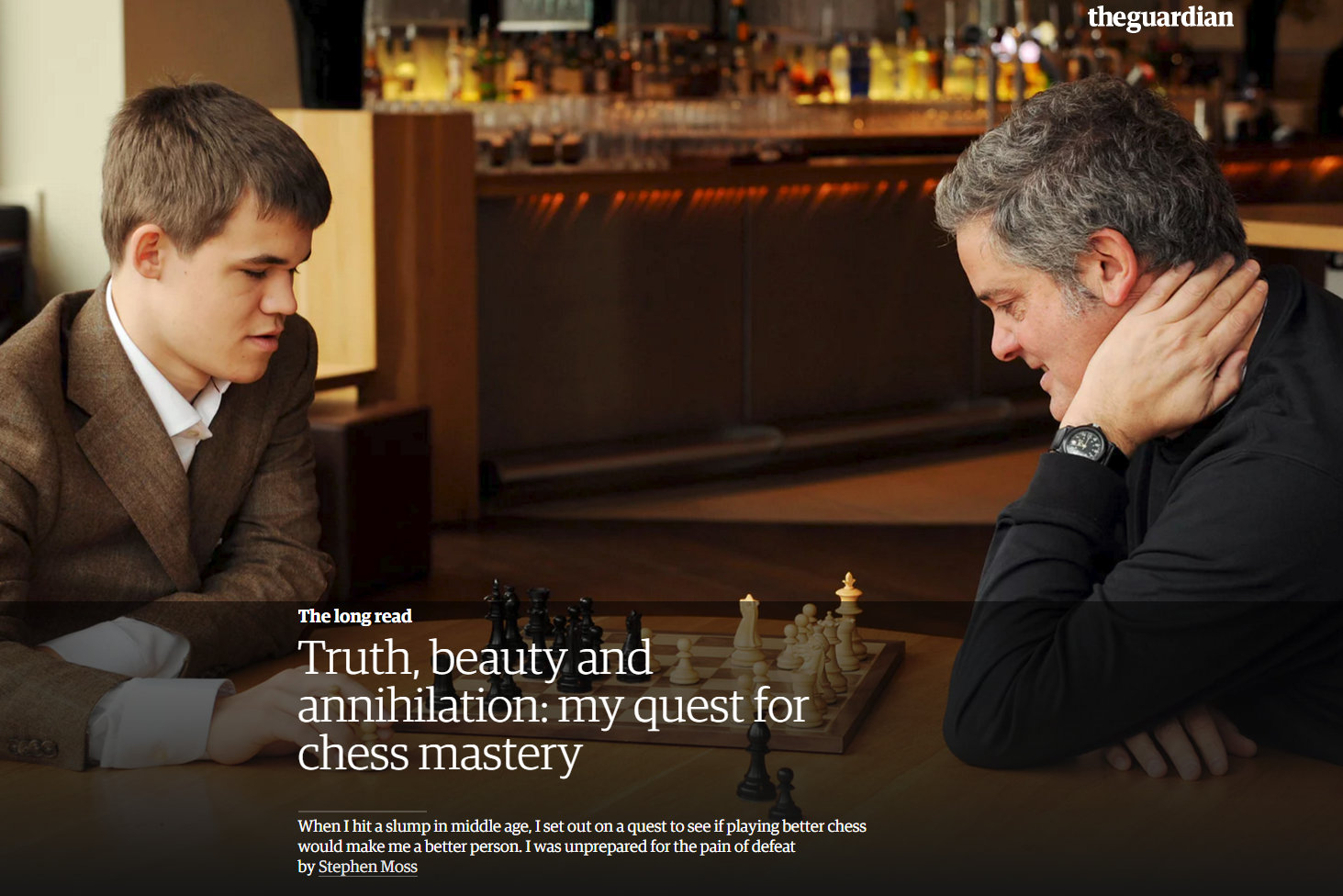
When I hit a slump in middle age, I set out on a quest to see if playing better chess would make me a better person. I was unprepared for the pain of defeat
by Stephen Moss
Wednesday 14 September 2016 01.00 EDT
I was probably the most average chess player in the world. But there came a point where being average was no longer enough. I had become good enough to know how bad I was. I was attached to two clubs in south-west London, Surbiton and Kingston, and was mixing with players who were very good, who had international master titles, one notch below the coveted grandmaster title. I wanted to be like them. I wanted to feel at home on the 64 squares.
I was a middle-aged man who had done OK in life, but there was something missing. I hadn’t created anything substantial; hadn’t mastered a discipline. I craved substance, and saw in chess a possible way of laying down a marker. I would become an expert, demonstrate that I wasn’t just a dilettante. After a lifetime of chess mediocrity, I set out to achieve excellence, for the first time in my life to truly master a world, to become good – not just good at chess, but at living. To get really expert I would have to be focused, disciplined, ruthless even – all the things I had found it difficult to sustain in an often rackety life.
My intermittent love affair with chess began when I was 11. I was certainly no prodigy. For one thing, I started too late – some 11-year-olds are virtually grandmaster standard. I was OK but, as with most other things in my life, didn’t work hard enough at the game. I wanted instant brilliancies; refused to do the slog of reading books, and saw chess as an art not a science. I had a friend who saw it as a science not an art, read books on opening theory, and always beat me. I played for my school, and had a decent record, but what I mainly remember is that we always got biscuits and orange juice before each match. Schools admired boys who played chess. Unlike the girls at the school, who tended to favour rugby players.
As part of my quest, I thought it might make for a poetic experience to return to Newport, the place of my birth, to play in the South Wales summer congress. I was staying with my parents, who acted as if the intervening 38 years had never happened, making me sandwiches and giving me a Thermos flask of tea to see me through the rigours of the day. My first game was on Saturday morning. My opponent had a relatively low grade (grades in chess are not unlike golf handicaps, and designate how good players are: the top-rated player in the UK has a grade of around 280, mine was around 133) and he played like it, giving up a pawn for nothing in the opening, and then losing a piece. The game was effectively over, and it irritated me that he insisted on playing on. I don’t know if it was boredom, fury, tiredness or simple incompetence but, as we approached the endgame, I committed the mother of all mistakes, blundering away a rook.
He was in a position where he could endlessly check my king with his queen if he wished. He offered me a draw, trying to mask his relief and disbelief at the mistake that I had made, and I had to accept. I had thrown away an easy win and felt ridiculous. I fled the tournament hall, sat beside the murky waters of the River Usk, bolted my sandwiches, and tried not to burst into tears. This was the most abject failure I had yet had to endure, and it would be difficult to recover. So much for the poetry of my return to Wales.
In the middle of one of my later games at the Newport congress, I suddenly asked myself whether I was really enjoying playing. I had the same thought as I watched the deciding game in my section, in which a 17-year-old was playing a crop-haired, middle-aged man to decide who would take first place. Both were down to their last few seconds, the youngster was shaking, and almost every move they made was an error, a rook mislaid here, a bishop casually tossed away there. Eventually the crop-haired man lost on time – in tournament chess, moves have to be made in a set time limit – and the 17-year-old had his prize. But the youth looked drained, shell-shocked, incapable of feeling any pleasure at his victory. Why did we put ourselves through this?
I had had similar doubts after that earlier game in Newport when I had thrown away a rook with what may have been the most ridiculous move in the history of chess. Why was I here making a fool of myself? What was the point? John Saunders, a former Welsh international, was giving me occasional coaching as I tried to crack the chess code. But he was also good at offering homilies. “Playing chess is a vale of tears,” he said during one of our training sessions as we examined an especially egregious, error-riddled game I had played. “This teaches us a very valuable lesson. It doesn’t matter what you do, how you play or how you change your approach to the game. Chess is just a bitch that bites you in the arse.”
Saunders was expressing, albeit less elegantly, a view propounded by HG Wells in an essay entitled Concerning Chess in 1901. “The passion for playing chess is one of the most unaccountable in the world,” wrote Wells, who at times shared that passion but never appears to have become very adept at the game. “It is the most absorbing of occupations, the least satisfying of desires, an aimless excrescence upon life. It annihilates a man.”
Does the pain always outweigh the pleasure? Siegbert Tarrasch, the best player in the world (though never world champion) in the 1890s, thought not. “Chess, like love, like music, has the power to make men happy,” he wrote in the preface to his book The Game of Chess, published in 1931, three years before his death. But is that really true? A blog by the English grandmaster Danny Gormally encapsulated the nightmares chess can induce. “I played a game a couple of days ago where I lost from a rook up,” wrote Gormally. “At the end of the game I completely lost my rag and started screaming, which was quite embarrassing in hindsight. Really I was angry at myself. Other players in the tournament, including my opponent, saw this meltdown and must have thought, ‘What a nutter’. Increasingly I’m suffering from poor emotional control. You’d think I’d get calmer as I get older, but at times I even feel I’m teetering on the brink of madness.”
Full article here: https://www.theguardian.com
1 Comment