1.f4 f6 and now what? Ke3, planning to infiltrate via f4 and g5 is an idea. I am thinking of a position where White gives up his d-pawn, munches the Black pawns, and is left with an h-pawn with King controlling the key g7 square.
“1.f4 f6 and now what? Ke3, planning to infiltrate via f4 and g5 is an idea.”…what? I don’t think the white king can infiltrate f4 anymore…
The line I’m looking at is 1.f4 f6 (King backwards to c6,d6, or e6 should allow white to safely push the pawn another rank…certainly not an improvement of black’s position) 2. Kc3! Ke4 Kc4.
The white pawn should queen easily with a worst case scenario of 4 pawns vs. queen (should be winning in this particular endgame with the black pawns so far from promoting)
BTW, note that if not 1. f4, black will have tactical ideas of creating a passer, such as in the case of 1. Kc3?? g5
1 f4 has to be right, as by double-protecting the g5 square, black is prevented from making a passed pawn and his extra pawn is useless, whereas his king will be forced back.
1 f4 f6 2 Kc3 seems to work. I like it much better than Ke3?, as the black King dare not advance to e4 or else 3 Kc4! and the pawn marches to the endzone before black can gobble two pawns and even begin advancing one. So he has to retreat to d6 or e6 and allow Kc4 and d5. Also, after 2 Ke3 Kc4, white is in trouble, as now it’s the white king that can’t advance! So 2 Kc3 is crucial in terms of forcing the black king back.
And now white has the pleasant choice between gobbling all the pawns or trapping the king in a zugzwang (notice that this would be stalemate without the other pawns). Black has to toss away the g-pawn, which white gobbles; then white marches his g-pawn to the endzone and scores with checkmate on the back rank, while black is pushing his other pawn that was freed after the capture. For example:
No matter how black plays it, white can get to a position with his pawn on d6 and his king on c5 or d5. If the black king on d7 blocking the pawn (on d6) moves back to the 8th rank, then the king steps in to e6 and gobbles the pawns. Or the black king steps up to e6 and the white king moves to c6 and c7 and queens the pawn.
Note that the ‘V’ formation of pawns on f4, g3, and h4 creates an impenetrable wall, and so the initial f4 is crucial. Without other pieces there is now no way to sacrifice and create a passed pawn, even with a 4-3 pawn advantage, as if black ever pushes the g-pawn, white doesn’t have to respond, and will capture either way with the g-pawn, stuffing all of black’s remaining pawns. I remember the fellow that taught me that ‘V’ formation when I was 13. I haven’t seen it in a book, so I don’t know if it has a name.
charles said… “BTW, note that if not 1. f4, black will have tactical ideas of creating a passer, such as in the case of 1. Kc3?? g5”
I didn’t see your comment until I wrote mine, but yes, not only is f4 crucial, but 1 Kc3?? g5 allows black to queen a pawn, even though white gets a queen as well, which is still a disaster for white, as the game will end a draw most likely. This can’t me emphasized more, and is an easy blunder to make.
The trick would go something like this (there are many variations, so I’ll pick the most obvious one):
1 Kc3?? g5! 2 hxg5? f4! 3 gxf4 h4! And the h-pawn queens, even though white can queen a move later after f5 and g6, etc.
and after 1 Kc3?? g5! 2 f4 — well, now the previously winning move is too little too late, because of… 2 (f4) gxh4 3 gxh4 Ke4! and now the king penetrates and snatches the f-pawn and again you get a race where both sides queen, ending in a draw most likely.
Doubleletter said… “I’d say: 1.Kc3! Black has no option but to play 1…f6″
Nooooo — 1…g5!! and white gives up the win — see my above rambling.
“The problem with f4 is that: 1.f4 f6 2.Kc3 Ke4!!”
Except that 3 Kc4!! wins for white! D’oh!
3 Kc4 Kf3 4 d5 Kxg3 5 d6 Kxh4 6 d7 Kg3 7 d8=Q and white has a queen before black has even advanced one of his pawns a single square. Now granted, this is black’s best try, as after …Kxf4 black has an army of 4 passed pawns. But they aren’t advanced passed the 4th rank and the queen should be able to pick them off while the king moves in to trap the black king, and white will win eventually.
And just to be obsessive-compulsive, I looked at the Queen vs. 4-pawn endgame and black is mated in about 10 moves or so. Here’s one way it can play out, with black playing the obvious moves to hold onto the pawns:
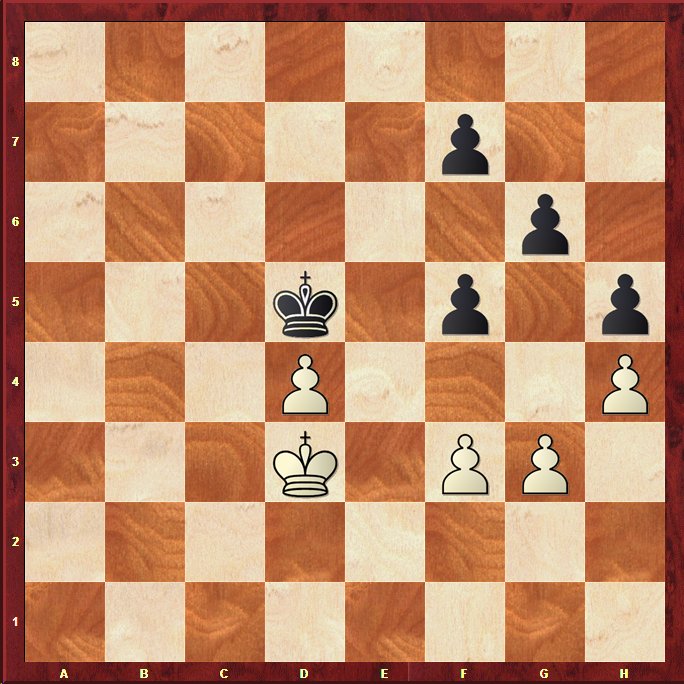


1.f4 wins.
1.f4 f6 and now what? Ke3, planning to infiltrate via f4 and g5 is an idea. I am thinking of a position where White gives up his d-pawn, munches the Black pawns, and is left with an h-pawn with King controlling the key g7 square.
“1.f4 f6 and now what? Ke3, planning to infiltrate via f4 and g5 is an idea.”…what? I don’t think the white king can infiltrate f4 anymore…
The line I’m looking at is 1.f4 f6 (King backwards to c6,d6, or e6 should allow white to safely push the pawn another rank…certainly not an improvement of black’s position) 2. Kc3! Ke4 Kc4.
The white pawn should queen easily with a worst case scenario of 4 pawns vs. queen (should be winning in this particular endgame with the black pawns so far from promoting)
BTW, note that if not 1. f4, black will have tactical ideas of creating a passer, such as in the case of 1. Kc3?? g5
1 f4 has to be right, as by double-protecting the g5 square, black is prevented from making a passed pawn and his extra pawn is useless, whereas his king will be forced back.
1 f4 f6
2 Kc3 seems to work. I like it much better than Ke3?, as the black King dare not advance to e4 or else 3 Kc4! and the pawn marches to the endzone before black can gobble two pawns and even begin advancing one. So he has to retreat to d6 or e6 and allow Kc4 and d5. Also, after 2 Ke3 Kc4, white is in trouble, as now it’s the white king that can’t advance! So 2 Kc3 is crucial in terms of forcing the black king back.
2 Kc3 Kd6
3 Kc4 Ke6
4 d5+ Kd6
5 Kd4 Kd7
6 Kc5 Kc7
7 d6+ Kd7
8 Kd5 Kd8
9 Ke6 Ke8
And now white has the pleasant choice between gobbling all the pawns or trapping the king in a zugzwang (notice that this would be stalemate without the other pawns). Black has to toss away the g-pawn, which white gobbles; then white marches his g-pawn to the endzone and scores with checkmate on the back rank, while black is pushing his other pawn that was freed after the capture. For example:
10 d7+ Kd8
11 Kd6 g5 (I love zugzwang!)
12 hxg5 fxg5
13 fxg5 h4
14 g6 hxg3
15 g7 g2
16 g8=Q++ Touchdown!!!
No matter how black plays it, white can get to a position with his pawn on d6 and his king on c5 or d5. If the black king on d7 blocking the pawn (on d6) moves back to the 8th rank, then the king steps in to e6 and gobbles the pawns. Or the black king steps up to e6 and the white king moves to c6 and c7 and queens the pawn.
Note that the ‘V’ formation of pawns on f4, g3, and h4 creates an impenetrable wall, and so the initial f4 is crucial. Without other pieces there is now no way to sacrifice and create a passed pawn, even with a 4-3 pawn advantage, as if black ever pushes the g-pawn, white doesn’t have to respond, and will capture either way with the g-pawn, stuffing all of black’s remaining pawns. I remember the fellow that taught me that ‘V’ formation when I was 13. I haven’t seen it in a book, so I don’t know if it has a name.
I’d say:
1.Kc3!
Black has no option but to play
1…f6
2. Kd3 !
And black king must move
—
the problem with f4 is that: 1.f4 f6 2.Kc3 Ke4 !!
charles said…
“BTW, note that if not 1. f4, black will have tactical ideas of creating a passer, such as in the case of 1. Kc3?? g5”
I didn’t see your comment until I wrote mine, but yes, not only is f4 crucial, but 1 Kc3?? g5 allows black to queen a pawn, even though white gets a queen as well, which is still a disaster for white, as the game will end a draw most likely. This can’t me emphasized more, and is an easy blunder to make.
The trick would go something like this (there are many variations, so I’ll pick the most obvious one):
1 Kc3?? g5!
2 hxg5? f4!
3 gxf4 h4!
And the h-pawn queens, even though white can queen a move later after f5 and g6, etc.
and after
1 Kc3?? g5!
2 f4 — well, now the previously winning move is too little too late, because of…
2 (f4) gxh4
3 gxh4 Ke4! and now the king penetrates and snatches the f-pawn and again you get a race where both sides queen, ending in a draw most likely.
So 1 f4 is the key to white’s victory.
Doubleletter said…
“I’d say:
1.Kc3!
Black has no option but to play
1…f6″
Nooooo — 1…g5!! and white gives up the win — see my above rambling.
“The problem with f4 is that: 1.f4 f6 2.Kc3 Ke4!!”
Except that 3 Kc4!! wins for white! D’oh!
3 Kc4 Kf3
4 d5 Kxg3
5 d6 Kxh4
6 d7 Kg3
7 d8=Q and white has a queen before black has even advanced one of his pawns a single square. Now granted, this is black’s best try, as after …Kxf4 black has an army of 4 passed pawns. But they aren’t advanced passed the 4th rank and the queen should be able to pick them off while the king moves in to trap the black king, and white will win eventually.
And just to be obsessive-compulsive, I looked at the Queen vs. 4-pawn endgame and black is mated in about 10 moves or so. Here’s one way it can play out, with black playing the obvious moves to hold onto the pawns:
1 f4 f6
2 Kc3 Ke4
3 Kc4!! Kf3
4 d5 Kxg3
5 d6 Kxh4
6 d7 Kg3
7 d8=Q Kxf4 and now…
8 Qxf6 g5
9 Qd4+ Kf3
10 Qd5+ Kf4
11 Qd2+ Kg4
12 Qg2+ Kf4
13 Kd4! g4 (13…h4? 14 Qh3!! g4 15 Qe3++ is a cute little mate)
14 Qf2+ Kg5
15 Ke5 Kg6
16 Qxf5+ Kh6
17 Kf6 h4
18 Qg6++
1.f4! and Black is in zsuzsa