If white declines the sacrifice, black just pushes d2 and then plays Qe1+ or Rc1+ and probably has a mating net. Continuing:
2. …..Ne4 with check and fork wins a full piece.
Taking at e4 with check is important since if black had captured here on the first move he likely only gets the draw:
1. …..Ne4? 2. Qe7 Kg8 (Kh8/h6 no better) 3. Qe4 Rc2 4. Rf1 Ra2 5. Qd3 and black has, maybe, some slight edge with the more active pieces, but his exposed king is a liability. In all honesty, I would rather be white here.
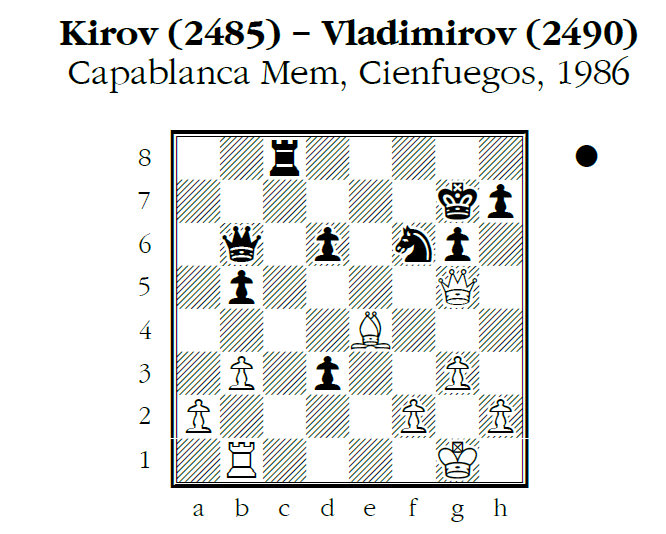


Surely it’s as simple as Qxf2+ (if Kxf2 then NxB+ forking the King and Queen…
QXf2 wins a piece and a pawn!
1.-Qxf2+, of course…
… Qxf2
Kxf2 (if Kh1 the pawn of d3 is decisive) Nxe4+
Ke3 Nxg5 black won a piece and white should resign
1….Qxf2+! 2.Kxf2 Nxe4+ follows by Nxg5 and wins!
The white bishop cannot be immediately taken with Nxe4 as white can regain the piece after Qe7 – Qxe4.
1…….. Qxf2+!
2. Kh1!
( 2. Kxf2 Nxe4+
3. K– Nxg5-+ )
2…….. d2!
(threatening Qe1 – d1Q)
3. Qf4
( 3. Bc2 d1Q!
4. Bxd1 Qf1#)
3…….. Qe1+
4. Qf1 Qxe4
0-1
Qf2 seems obvious:
1. …..Qf2
2. Kf2
If white declines the sacrifice, black just pushes d2 and then plays Qe1+ or Rc1+ and probably has a mating net. Continuing:
2. …..Ne4 with check and fork wins a full piece.
Taking at e4 with check is important since if black had captured here on the first move he likely only gets the draw:
1. …..Ne4?
2. Qe7 Kg8 (Kh8/h6 no better)
3. Qe4 Rc2
4. Rf1 Ra2
5. Qd3 and black has, maybe, some slight edge with the more active pieces, but his exposed king is a liability. In all honesty, I would rather be white here.
…Q x f2+, the N x Bishop…
I’d rather take Bishop e4 with knight and make ground for Q F2 next. I’m not a chess geek though.
To Jassi:
To take Be4 with knight wins nothing.
It fails to Qe7+ followed by Qxe4.
That’s the reason why Qxf2 must be played first.