Menu   ≡ ╳
  • News
    • Major Tournaments
    • General News
    • USA Chess
  • Puzzles
  • Improvement
  • Event
  • College
  • Scholastic
  • Women
  • Search

        More results...

        Or you can try to:
        Search in Shop
        Exact matches only
        Search in title
        Search in content
        Search in comments
        Search in excerpt
        Search for News
        Search in pages
        Search in groups
        Search in users
        Search in forums
        Filter by Categories

        Try these: Sicilian Defense, Empire Chess, USA Chess

    • SPICE
    • Videos
    • Susan’s Blog
    • About Us
    • Contact Us
    • SPICE
    • Videos
    • Susan’s Blog
    • About Us
    • Contact Us
    Menu   ≡ ╳
    • News
      • Major Tournaments
      • General News
      • USA Chess
    • Puzzles
    • Improvement
    • Event
    • College
    • Scholastic
    • Women
    • Search

          More results...

          Or you can try to:
          Search in Shop
          Exact matches only
          Search in title
          Search in content
          Search in comments
          Search in excerpt
          Search for News
          Search in pages
          Search in groups
          Search in users
          Search in forums
          Filter by Categories

          Try these: Sicilian Defense, Empire Chess, USA Chess

      Home  >  Chess Puzzles • Chess Research  >  Solving unsolvable counting problems

      Solving unsolvable counting problems

      Math, Problem Solving, Science


      A new kind of counting: Scientists develop computer algorithm to solve previously unsolvable counting problems
      February 11th, 2009 in General Science / Mathematics

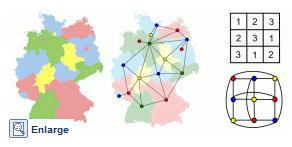
      Left and center: A map of Germany with corresponding representation as a network. Top right: A simplified sudoku with three rows of three boxes. Bottom right: The representation as a network. “1” is represented in “red”, “2” in “blue” and “3” in “yellow”. Image: Max Planck Institute for Dynamics and Self-Organization

      (PhysOrg.com) — How many different sudokus are there? How many different ways are there to color in the countries on a map? And how do atoms behave in a solid? Researchers at the Max Planck Institute for Dynamics and Self-Organization in Göttingen and at Cornell University (Ithaca, USA) have now developed a new method that quickly provides an answer to these questions.

      In principle, there has always been a way to solve them. However, computers were unable to find the solution as the calculations took too long. With the new method, the scientists look at separate sections of the problem and work through them one at a time. Up to now, each stage of the calculation has involved the whole map or the whole sudoku. The answers to many problems in physics, mathematics and computer science can be provided in this way for the first time. (New Journal of Physics, February 4, 2009)

      Whether sudoku, a map of Germany or solid bodies – in all of these cases, it’s all about counting possibilities. In the sudoku, it is the permitted solutions; in the solid body, it is the possible arrangements of atoms. In the map, the question is how many ways the map can be colored so that adjacent countries are always shown in a different color. Scientists depict these counting problems as a network of lines and nodes. Consequently, they need to answer just one question: How many different ways are there to color in the nodes with a certain number of colors? The only condition: nodes joined by a line may not have the same color. Depending on the application, the color of a node is given a completely new significance. In the case of the map, “color” actually means color; with sudoku the “colors” represent different figures.

      Here is the full article.

      Special thanks to Gene for sending us the link.

      Posted by Picasa
      Chess Daily News from Susan Polgar
      Previous Article Thursday Afternoon Chess Tactic
      Next Article President Obama in Peoria, IL

      About Author

      Susan Polgar

      Related Posts

      • Chess Science

        December 3, 2016
      • Science Park Amsterdam Open Tournament

        July 6, 2013
      • Practice makes perfect? Not so much

        May 21, 2013

      3 Comments

      1. potato wedge Reply
        February 13, 2009 at 4:52 am

        Nice article. Is there a mathematical explanation for the failure of Goichberg and his cronies?

      2. Anonymous Reply
        February 13, 2009 at 10:28 pm

        Chess politics – I suppose the powers that be will let the above stand – I wonder why?

      3. Stray Cat Reply
        February 14, 2009 at 12:03 am

        “Chess politics – I suppose the powers that be will let the above stand – I wonder why?”

        Because you are a Jackass Brian?

      Leave a Reply

      Cancel reply

      Improvement

      • Important Scholastic Coaching Tips
      • My Chess Quotes Over The Years
      • My kids know chess rules. What’s next?
      • Chess Parenting

      Events

      • My Top 10 Most Memorable Moments in Chess (Part 3) May 13, 2021
      • My Top 10 Most Memorable Moments in Chess (Part 2) May 12, 2021
      • My Top 10 Most Memorable Moments in Chess (Part 1) May 10, 2021
      • About Susan Polgar April 9, 2021
      • About Us
      • Contact Us
      • Daily News
      • My Account
      • Terms & Conditions
      • Privacy Policy

      Anand Armenia Breaking News Chess Club and Scholastic Center of St Louis Chess interview Chess Olympiad Chess tactic Chess tournament chess trivia China FIDE Grand Prix Holland India Khanty-Mansiysk LIVE games Lubbock Magnus Carlsen Moscow National Championship Norway OnlineChessLessons Philippines Puzzle Solving Russia Scholastic chess Spain SPF SPICE SPICE Cup St Louis Susan Polgar Tata Steel Chess Texas Tech Tromsø TTU Turkey Webster University Wesley So Wijk aan Zee Women's Chess Women's Grand Prix Women's World Championship World Championship World Cup

      April 2026
      M T W T F S S
       12345
      6789101112
      13141516171819
      20212223242526
      27282930  
      « Sep