1. Nxg6 Kxg6 2. Bh5+ Kf6 3. Bxe5+ forking the King and Queen.
2… Kxh5 3. Qxf5 Mate.
If Black does not take the Knight e.g. 1..e4 than 2. Nxh8+ Ke6 [best try] 3. Bxc7 e4xd3 4.Bxd3+ Kd7 5.Bxb6 Bxh8 and White has an enormous lead in material.
I found Nxg6, too, but I didn’t find the hole variation. First at all let’s add some facts (or some things – I hope they are facts):
Game is not over after 3. Bxe5+ After Qxe5 4. Rxe5, Kxe5 black has BNR vs the queen and is (for a short time) up with material! To declare that white is better we should take a look at some more moves: 5. Qg3+! wins the bishop (Kf6?? 6. Qg6+ and 7. Qg7+ and the rook will fall, too!). Another possibility seems to be 5. Qb5!, Rc6!? 6. Bf3
Now (in both cases) white has more material then black. Which variation (Qg3+/Qb5) is better or is there even something stronger?
Another thing I want to add: 2.-, Kg5 is also possible (not only Kf6 and Kxh5). White can play 3. h4 there to reget to the old variation.
By the way I tried: 1. Nxg6, Kxg6 2. Bh5+, Kf6 3. Bh4+, Ke6 but I just don’t see any attack on that center king. In addition to that after 2. -, Kg5 there would have to be something different to h4+ blocking h4 for the bishop…
So probably the material winning variation (which I didn’t even look at….) starting with 3. Bxe5 is the best – I’d prefer a mating attack here but I don’t see one.
Greetings Jochen
PS to anonymous: What does Alexandra Kosteniuk have to do with this task? Post in the “saturday open forum” but not here, please.
This is why I have moderation in this blog. Some people just simply cannot behave properly.
A. This thread has nothing to do with any players. It is a puzzle solving post.
B. It disgusts me when posters make ridiculously false comments just for the sake of attention. Kosteniuk is one of the most mentioned females players on this blog. But of course the poster was simply trying to get cheap advertisement.
C. This blog is to promote chess and to help promote players who are underpromoted, not people who have no problem promoting themselves.
Although I can´t see a win for 2. Kf6, 3. g4 could be an option. I believe that a mating attack exists in all variations. For example, after 1.Nxg6, Kxg6; 2.Bh5+, Kg5; 3.f4+, exf4; 4.Bh4+, Kxh5; 5.Qxf5+, Kxf4; 6.Re4 ( threathens Nf3 and g3), Bxe4; 7.Nxe4 with Qh3++ or g3+. And if 4. Kxh4; 5.Qxf5, Nf6; 6.Re4, Bxe4; 7.Nxe4, Qc7, 8.g3+.
Hey, I found the main line in 10 seconds, as my first guess was Nxg6, seeing how the bishops and queen could jump into action after KxN.
The problem is, looking deeply with a chessboard, I am convinced that black cannot reasonably take the knight at all; taking the knight looks disastrous to me. Yet nobody has yet analyzed black’s better tries.
That said, there is a nice line in the …KxN line that nobody mentioned, so first dealing with that, Rail said… “I mean, after 2. Bh5+, Kf6; 3.Bh4+, Ke6; then, maybe 4.g4.”
Not 3 Bh4+?? Ke6! where black gets away (after g4 Be4 frees black up). Rather:
3 Bxe5+! QxB 4 RxQ KxR and here Jochen has pointed out: “5. Qg3+! wins the bishop (Kf6?? 6. Qg6+ and 7. Qg7+ and the rook will fall, too!). Another possibility seems to be 5. Qb5!, Rc6!? 6. Bf3″
And maybe most crushing of all, I think, is: 5 Re1+!! Kf6 (…Kf4 Qe3++ or Qf3++) 6 Qg3! (threatening Q66++) 6 … Be4 (or e5 Qxe5+ and mate follows) 7 NxB+ fxe4 8 Qg6+ Ke5 9 Rxe4+ Kd5 10 Qe6++
or 5 (Re1+!) Be4 6 NxB+ Nd5 (to flee to d6; all else mates in two or three moves) and now there are all-check mate variations that are not hard to find, e.g.: 7 f4+ Ke6 (or Nxf4 8 Ng3+ Ne2+ 9 Kf6 9 Qxf5++) 8 Nxc5+ Kd6 (Kf6 Nd7++) 9 Re6+ Kc7 (KxN Qc4++) 10 Na6+ Kb7 (any other and QxN++) 11 QxN+ Ka7 (or …Rc6, QxR+ etc.) 12 Qd7+ Ka8 13 Bf3+ (or QxR+ Ka7 Qb8++) 13 … Rc6 14 BxR++
In any case, 5 Re1+ leads to mate in each variation I have found. So that means that black can’t take the knight in the first place.
After 1 Nxg6! I think black has to play either …Bf6 or Nf6 to avoid mate. White will be up, but either of these are better than taking the knight, given how strong an attack Bh5+ and Bxe5+ give white.
I can’t find any mates for white in either of these lines. First:
1 (Nxg6) Bf6 2 Qxf5 followed by NxR or Nxe5 looks really good, with white up the exchange plus a strong attack.
1 (Nxg6) Nf6 2 Qxf5 (or NxR+ but Qxf5 looks more aggressive) 2 … Rhd8 3 Nxe5+ Kg8 4 Qe6+ Kh7 5 Bd3+ RxB (Ne4 RxN followed by Rg4+ or if BxR BxB+) 6 PxR and now white is up the exchange plus pawn as well as maintaining a very tough attack against the black king.
Or finally, instead of KxN, black can try pushing one of the e or f-pawns:
1 (Nxg6) f4 2 Bh5! and white has so many threats with the double checks that black is practically mated and at the very least loses tons of material. Or
1 (Nxg6) e4 2 NxR+ BxN 3 BxQ PxQ 4 Bh5+ and again white is up the exchange and a pawn and still has a strong attack, as in the 1…Nf6 line.
But all of those look better for black than 1…KxN, even though white is more than than an exchange up in all of them. So if black has any chances, they have to involve conceding the exchange and avoiding 1…KxN.
after 1 Nxg6 e5 how does white continue? anythinng other than check loses a queen to the pawn and NxR+ allows black to escape and or retake the knight. I am sure I am missing something here.
Adrenaline101a said… “question: after 1 Nxg6 e4 how does white continue? anything other than check loses a queen to the pawn and NxR+ allows black to escape and or retake the knight. I am sure I am missing something here.”
In a sleep-deprived rant last night, TVTom babbled: “1 (Nxg6) e4 2 NxR+ BxN 3 BxQ PxQ 4 Bh5+ and again white is up….”
But now, awake and sober, I see that white can ignore the attack on the queen and get cute with the elegant and crushing Bh5!! Yeah, NxR+ works, but Bh5!! is so much better, and the tactics are pretty and worth a look. Not being a check, can black take the queen? Well, um, No! Black gets mated!
1 Nxg6 e4 2 Bh5 PxQ 3 Nf4+!! and now either: 3 …Kf6 Bh4++ mate or 3 …Kf8 Ne6++ with a royal fork checkmate — a razzle-dazzle finish, with a queen sacrifice and a royal fork mate! I missed all that before, so thanks for asking this, or I’d never have looked and seen this pretty finish.
Black can avoid the mate, but really has nothing better that I can see than:
1 Nxg6 e4 2 Bh5! Nf6 3 BxQ PxQ 4 Rxe7+ Kg8 5 BxN and white snags a free piece (this looks nasty, much better to me than 4 NxR, which still would put white up in material but without the fierce attack with a 7th rank rook invasion)
Or 1 (Nxg6) (e4) 2 (Bh5) Bd5 perhaps, and then again either the simplifying but horribly boring BxQ PxQ NxR+, or again white can go for the gusto and do something more decisive here as well, smashing the center with: 3 Nxe4! PxN 4 RxP! BxR 5 QxB and black is toast, as now not only is white still threatening BxQ, but his own queen is now out of danger and unleashed on a wide open board against an exposed king, and white still threatens a double or discovered check with the knight.
Black has to give up the queen for the bish or get mated here. Note that if the queen goes to a white square, a discovered check with the knight wins the queen, and if Qd8 or Qa7, 6 Nf4+ is mate it two.
And if 5 (QxB) Ng6 attacking the white queen, 6 Nf4+!! NxB 7 Qg6+ Kf8 8 Ne6++ with another royal fork mate!
Wow, what a bunch of pretty combinations all stemming from this variation. Cool. Was well worth going over them. In fact, after 2 Bh5, white seems to have endless tactics and finesses no matter what black does. Game over.
“Fair enough. White cannot take the Queen. but if white decides to escape what then?”
I think you mean black, not white here. How can black escape after: 1 Nxg6 e4 2 Bh5
“Moving the king to f8 means NxR is not check or discovered check and there are no forks. At that point Black has to move the queen, no?”
Again, I think you mean white, not black. The f8 square is covered by the knight on g6, so the king can’t retreat there. The white queen doesn’t need to retreat in any variation, though.
If 2…Ke6, 3 BxQ and black can’t recapture PxQ because the pawn is pinned to the king by the rook; if 2…Ke8, there is another royal fork mate with 3 Nf4+ Kf8 4 Ne6++; and if 2…Kf6, there is a queen sack with mate: 3 Nxe4+ PxN 4 Qf3+!! PxQ 5 Bh4+ Kf7 6 Nf4+ Kf8 7 Ne6++ — yet another royal fork mate variation — yippee!
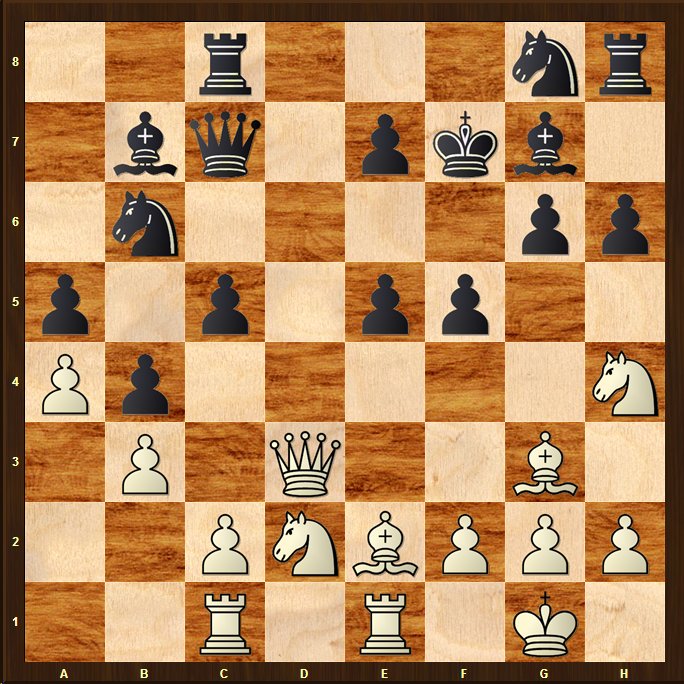


1. Nxg6 Kxg6
2. Bh5+ Kf6
3. Bxe5+ forking the King and Queen.
2… Kxh5
3. Qxf5 Mate.
If Black does not take the Knight e.g. 1..e4 than 2. Nxh8+ Ke6 [best try] 3. Bxc7 e4xd3 4.Bxd3+ Kd7 5.Bxb6 Bxh8 and White has an enormous
lead in material.
I found Nxg6, too, but I didn’t find the hole variation.
First at all let’s add some facts (or some things – I hope they are facts):
Game is not over after 3. Bxe5+
After Qxe5 4. Rxe5, Kxe5 black has BNR vs the queen and is (for a short time) up with material!
To declare that white is better we should take a look at some more moves:
5. Qg3+! wins the bishop (Kf6?? 6. Qg6+ and 7. Qg7+ and the rook will fall, too!).
Another possibility seems to be 5. Qb5!, Rc6!? 6. Bf3
Now (in both cases) white has more material then black.
Which variation (Qg3+/Qb5) is better or is there even something stronger?
Another thing I want to add:
2.-, Kg5 is also possible (not only Kf6 and Kxh5). White can play 3. h4 there to reget to the old variation.
By the way I tried:
1. Nxg6, Kxg6 2. Bh5+, Kf6 3. Bh4+, Ke6 but I just don’t see any attack on that center king.
In addition to that after 2. -, Kg5 there would have to be something different to h4+ blocking h4 for the bishop…
So probably the material winning variation (which I didn’t even look at….) starting with 3. Bxe5 is the best – I’d prefer a mating attack here but I don’t see one.
Greetings
Jochen
PS to anonymous:
What does Alexandra Kosteniuk have to do with this task?
Post in the “saturday open forum” but not here, please.
This is why I have moderation in this blog. Some people just simply cannot behave properly.
A. This thread has nothing to do with any players. It is a puzzle solving post.
B. It disgusts me when posters make ridiculously false comments just for the sake of attention. Kosteniuk is one of the most mentioned females players on this blog. But of course the poster was simply trying to get cheap advertisement.
C. This blog is to promote chess and to help promote players who are underpromoted, not people who have no problem promoting themselves.
Best wishes,
Susan Polgar
Although I can´t see a win for 2. Kf6, 3. g4 could be an option.
I believe that a mating attack exists in all variations.
For example, after 1.Nxg6, Kxg6; 2.Bh5+, Kg5; 3.f4+, exf4; 4.Bh4+, Kxh5; 5.Qxf5+, Kxf4; 6.Re4 ( threathens Nf3 and g3), Bxe4; 7.Nxe4 with Qh3++ or g3+.
And if 4. Kxh4; 5.Qxf5, Nf6; 6.Re4, Bxe4; 7.Nxe4, Qc7, 8.g3+.
I mean, after 2. Bh5+, Kf6; 3.Bh4+, Ke6; then, maybe 4.g4.
Hey, I found the main line in 10 seconds, as my first guess was Nxg6, seeing how the bishops and queen could jump into action after KxN.
The problem is, looking deeply with a chessboard, I am convinced that black cannot reasonably take the knight at all; taking the knight looks disastrous to me. Yet nobody has yet analyzed black’s better tries.
That said, there is a nice line in the …KxN line that nobody mentioned, so first dealing with that, Rail said…
“I mean, after 2. Bh5+, Kf6; 3.Bh4+, Ke6; then, maybe 4.g4.”
Not 3 Bh4+?? Ke6! where black gets away (after g4 Be4 frees black up). Rather:
3 Bxe5+! QxB
4 RxQ KxR and here Jochen has pointed out:
“5. Qg3+! wins the bishop (Kf6?? 6. Qg6+ and 7. Qg7+ and the rook will fall, too!).
Another possibility seems to be 5. Qb5!, Rc6!? 6. Bf3″
And maybe most crushing of all, I think, is:
5 Re1+!! Kf6 (…Kf4 Qe3++ or Qf3++)
6 Qg3! (threatening Q66++)
6 … Be4 (or e5 Qxe5+ and mate follows)
7 NxB+ fxe4
8 Qg6+ Ke5
9 Rxe4+ Kd5
10 Qe6++
or
5 (Re1+!) Be4
6 NxB+ Nd5 (to flee to d6; all else mates in two or three moves) and now there are all-check mate variations that are not hard to find, e.g.:
7 f4+ Ke6 (or Nxf4 8 Ng3+ Ne2+ 9 Kf6 9 Qxf5++)
8 Nxc5+ Kd6 (Kf6 Nd7++)
9 Re6+ Kc7 (KxN Qc4++)
10 Na6+ Kb7 (any other and QxN++)
11 QxN+ Ka7 (or …Rc6, QxR+ etc.)
12 Qd7+ Ka8
13 Bf3+ (or QxR+ Ka7 Qb8++)
13 … Rc6
14 BxR++
In any case, 5 Re1+ leads to mate in each variation I have found. So that means that black can’t take the knight in the first place.
After 1 Nxg6! I think black has to play either …Bf6 or Nf6 to avoid mate. White will be up, but either of these are better than taking the knight, given how strong an attack Bh5+ and Bxe5+ give white.
I can’t find any mates for white in either of these lines. First:
1 (Nxg6) Bf6
2 Qxf5 followed by NxR or Nxe5 looks really good, with white up the exchange plus a strong attack.
1 (Nxg6) Nf6
2 Qxf5 (or NxR+ but Qxf5 looks more aggressive)
2 … Rhd8
3 Nxe5+ Kg8
4 Qe6+ Kh7
5 Bd3+ RxB (Ne4 RxN followed by Rg4+ or if BxR BxB+)
6 PxR and now white is up the exchange plus pawn as well as maintaining a very tough attack against the black king.
Or finally, instead of KxN, black can try pushing one of the e or f-pawns:
1 (Nxg6) f4
2 Bh5! and white has so many threats with the double checks that black is practically mated and at the very least loses tons of material. Or
1 (Nxg6) e4
2 NxR+ BxN
3 BxQ PxQ
4 Bh5+ and again white is up the exchange and a pawn and still has a strong attack, as in the 1…Nf6 line.
But all of those look better for black than 1…KxN, even though white is more than than an exchange up in all of them. So if black has any chances, they have to involve conceding the exchange and avoiding 1…KxN.
question:
after
1 Nxg6 e5
how does white continue?
anythinng other than check loses a queen to the pawn and NxR+ allows black to escape and or retake the knight. I am sure I am missing something here.
After 1 Nxg6 e4 2 Nxh8+ Bxh8 3 Bxc7 exd3 4 Bh5 K moves 5 Bxb6 white is up a rook.
Adrenaline101a said…
“question: after
1 Nxg6 e4
how does white continue?
anything other than check loses a queen to the pawn and NxR+ allows black to escape and or retake the knight. I am sure I am missing something here.”
In a sleep-deprived rant last night, TVTom babbled:
“1 (Nxg6) e4
2 NxR+ BxN
3 BxQ PxQ
4 Bh5+ and again white is up….”
But now, awake and sober, I see that white can ignore the attack on the queen and get cute with the elegant and crushing Bh5!! Yeah, NxR+ works, but Bh5!! is so much better, and the tactics are pretty and worth a look. Not being a check, can black take the queen? Well, um, No! Black gets mated!
1 Nxg6 e4
2 Bh5 PxQ
3 Nf4+!! and now either:
3 …Kf6 Bh4++ mate or
3 …Kf8 Ne6++ with a royal fork checkmate — a razzle-dazzle finish, with a queen sacrifice and a royal fork mate! I missed all that before, so thanks for asking this, or I’d never have looked and seen this pretty finish.
Black can avoid the mate, but really has nothing better that I can see than:
1 Nxg6 e4
2 Bh5! Nf6
3 BxQ PxQ
4 Rxe7+ Kg8
5 BxN and white snags a free piece (this looks nasty, much better to me than 4 NxR, which still would put white up in material but without the fierce attack with a 7th rank rook invasion)
Or 1 (Nxg6) (e4)
2 (Bh5) Bd5 perhaps, and then again either the simplifying but horribly boring BxQ PxQ NxR+, or again white can go for the gusto and do something more decisive here as well, smashing the center with:
3 Nxe4! PxN
4 RxP! BxR
5 QxB and black is toast, as now not only is white still threatening BxQ, but his own queen is now out of danger and unleashed on a wide open board against an exposed king, and white still threatens a double or discovered check with the knight.
Black has to give up the queen for the bish or get mated here. Note that if the queen goes to a white square, a discovered check with the knight wins the queen, and if Qd8 or Qa7, 6 Nf4+ is mate it two.
And if
5 (QxB) Ng6 attacking the white queen,
6 Nf4+!! NxB
7 Qg6+ Kf8
8 Ne6++ with another royal fork mate!
Wow, what a bunch of pretty combinations all stemming from this variation. Cool. Was well worth going over them. In fact, after 2 Bh5, white seems to have endless tactics and finesses no matter what black does. Game over.
Fair enough. White cannot take the Queen. but if white decides to escape what then?
Moving the king to f8 means NxR is not check or discovered check and there are no forks. At that point Black has to move the queen, no?
Adrenaline101a said…
“Fair enough. White cannot take the Queen. but if white decides to escape what then?”
I think you mean black, not white here. How can black escape after:
1 Nxg6 e4
2 Bh5
“Moving the king to f8 means NxR is not check or discovered check and there are no forks. At that point Black has to move the queen, no?”
Again, I think you mean white, not black. The f8 square is covered by the knight on g6, so the king can’t retreat there. The white queen doesn’t need to retreat in any variation, though.
If 2…Ke6, 3 BxQ and black can’t recapture PxQ because the pawn is pinned to the king by the rook; if 2…Ke8, there is another royal fork mate with 3 Nf4+ Kf8 4 Ne6++; and if 2…Kf6, there is a queen sack with mate: 3 Nxe4+ PxN 4 Qf3+!! PxQ 5 Bh4+ Kf7 6 Nf4+ Kf8 7 Ne6++ — yet another royal fork mate variation — yippee!