Menu   ≡ ╳
  • News
    • Major Tournaments
    • General News
    • USA Chess
  • Puzzles
  • Improvement
  • Event
  • College
  • Scholastic
  • Women
  • Search

        More results...

        Or you can try to:
        Search in Shop
        Exact matches only
        Search in title
        Search in content
        Search in comments
        Search in excerpt
        Search for News
        Search in pages
        Search in groups
        Search in users
        Search in forums
        Filter by Categories

        Try these: Sicilian Defense, Empire Chess, USA Chess

    • SPICE
    • Videos
    • Susan’s Blog
    • About Us
    • Contact Us
    • SPICE
    • Videos
    • Susan’s Blog
    • About Us
    • Contact Us
    Menu   ≡ ╳
    • News
      • Major Tournaments
      • General News
      • USA Chess
    • Puzzles
    • Improvement
    • Event
    • College
    • Scholastic
    • Women
    • Search

          More results...

          Or you can try to:
          Search in Shop
          Exact matches only
          Search in title
          Search in content
          Search in comments
          Search in excerpt
          Search for News
          Search in pages
          Search in groups
          Search in users
          Search in forums
          Filter by Categories

          Try these: Sicilian Defense, Empire Chess, USA Chess

      Home  >  Chess Research • Daily News  >  Thomas Harriot not Galileo Galilei

      Thomas Harriot not Galileo Galilei

      Galileo Galilei, Science, Thomas Harriot


      Old Moon Map Corrects History
      Space.com

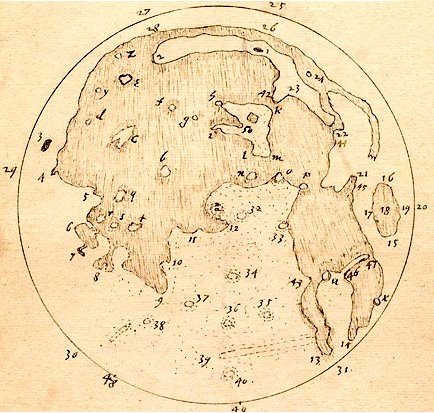
      (Jan. 14) — Galileo Galilei is often credited with being the first person to look through a telescope and make drawings of the celestial objects he observed. While the Italian indeed was a pioneer in this realm, he was not the first.

      Englishman Thomas Harriot made the first drawing of the moon after looking through a telescope several months before Galileo, in July 1609.

      Historian Allan Chapman of the University of Oxford details that 400-year-old breakthrough in astronomy in the February 2009 edition of Astronomy and Geophysics, a journal of the Royal Astronomical Society.

      Chapman explains how Harriot preceded Galileo and went on to make other maps of the moon’s surface that would not be bettered for decades.

      The Story

      Harriot lived from 1560 to 1621. He studied at St Mary’s Hall (now part of Oriel College), Oxford, achieving his BA in 1580.

      He then became a mathematical teacher and companion to the explorer Sir Walter Raleigh. In the early 1590s Raleigh fell from royal favor and was imprisoned in the Tower of London. Harriot was passed to the patronage of Henry Percy, the Ninth Earl of Northumberland who was himself imprisoned as one of the Gunpowder Plotters in 1605 but continued to support Harriot in his residence at Sion (now Syon) Park, in what is now west London.

      Harriot became a leading force in mathematics, Chapman explains, working on algebraic theory and corresponding with scientists across Europe.

      By 1609, Harriot had acquired his first “Dutch trunke” (telescope), which had been invented in The Netherlands in 1608. He turned it on the moon on July 26, becoming the first astronomer to draw an astronomical object after viewing it through a telescope. The crude lunar sketch shows a rough outline of the lunar terminator (the line marking the division between night and day on the moon, as seen from the Earth) and includes a handful of features like the dark areas Mare Crisium, Mare Tranquilitatis and Mare Foecunditatis.

      Harriot went on to produce more maps from 1610 to 1613, Chapman said in a statement released today. Not all of these are dated, but they show an increasing level of detail. By 1613 he had created two maps of the whole moon, with many identifiable features such as lunar craters that crucially are depicted in their correct relative positions.

      The earliest telescopes of the kind used by Harriot (and Galileo) had a narrow field of view, meaning that only a small portion of the moon could be seen at any one time and making this work all the more impressive. No better maps would be published for several decades.

      Here is the full article.

      Posted by Picasa
      Chess Daily News from Susan Polgar
      Previous Article Thursday morning chess tactic
      Next Article King Day celebration with Salome Thomas-EL

      About Author

      Susan Polgar

      Related Posts

      • Chess Science

        December 3, 2016
      • Science Park Amsterdam Open Tournament

        July 6, 2013
      • Practice makes perfect? Not so much

        May 21, 2013

      2 Comments

      1. Anonymous Reply
        January 15, 2009 at 5:45 pm

        That’s shocking. I never knew that.

      2. crack-head Reply
        January 15, 2009 at 11:27 pm

        Because of this, the moon is no longer a moon. It is now a candidate for the USCF EB.

        Vote for candidate formely known as the moon!

      Leave a Reply

      Cancel reply

      Improvement

      • Important Scholastic Coaching Tips
      • My Chess Quotes Over The Years
      • My kids know chess rules. What’s next?
      • Chess Parenting

      Events

      • My Top 10 Most Memorable Moments in Chess (Part 3) May 13, 2021
      • My Top 10 Most Memorable Moments in Chess (Part 2) May 12, 2021
      • My Top 10 Most Memorable Moments in Chess (Part 1) May 10, 2021
      • About Susan Polgar April 9, 2021
      • About Us
      • Contact Us
      • Daily News
      • My Account
      • Terms & Conditions
      • Privacy Policy

      Anand Armenia Breaking News Chess Club and Scholastic Center of St Louis Chess interview Chess Olympiad Chess tactic Chess tournament chess trivia China FIDE Grand Prix Holland India Khanty-Mansiysk LIVE games Lubbock Magnus Carlsen Moscow National Championship Norway OnlineChessLessons Philippines Puzzle Solving Russia Scholastic chess Spain SPF SPICE SPICE Cup St Louis Susan Polgar Tata Steel Chess Texas Tech Tromsø TTU Turkey Webster University Wesley So Wijk aan Zee Women's Chess Women's Grand Prix Women's World Championship World Championship World Cup

      April 2026
      M T W T F S S
       12345
      6789101112
      13141516171819
      20212223242526
      27282930  
      « Sep