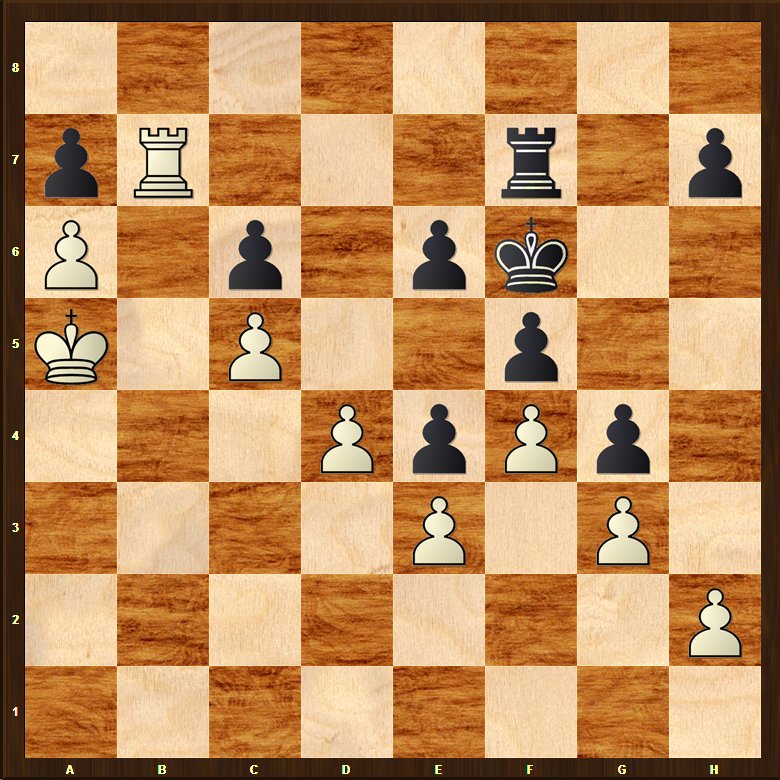
White to move. This could have been an actual game of mine. The actual game varied a little bit and I won. Is this a win for White or is it a draw? If you analyze correctly, it should be more than 30 moves long 🙂

Chess Daily News from Susan Polgar

White to move. This could have been an actual game of mine. The actual game varied a little bit and I won. Is this a win for White or is it a draw? If you analyze correctly, it should be more than 30 moves long 🙂
Rxa7
Yeah, that’s what I was thinking too. Rxa7.
Yea, why does it become difficult after that?
– Vinay
1. Rxa7 Rxa7
2. Kb6 Rxa6!
3. Kxa6 Ke7
4. Kb6 Kd7
5. Kb7 h6! Now a kind of zugzwung (is the spelling correct? 🙁
And I think black is better because he can move his h pawn as intermediate moves to force white.
— P. Anandh
Oops, I did a mistake. White king can move between b6 and b7 and black is in trouble
If black responds not giving his rook
1. Rxa7 Rxa7
2. Kb6 Re6 etc.
White should remove c6 pawn first, c5-c6 and then exchange a8=Q with Rxa8 and Kxa8. Without c5-c6, Black will give repeated checks, after white plays c6, if black gives check, white can play c7. The best strategy for black is to bring the king near the battlefield. Looks like black can occupy c6/c7 and give trouble to white’s king
The one line could be
1. Rxa7 Rxa7
2. Kb6 Rf7
3. Kxc6 Ke7
4. a7 Rf8
5. Kb7 Kd7
6. a8=Q Rxa8
7. Kxa8 Kc7
8. Ka7 Kc6
9. Ka6 Kc7
10. Kb5 Kd7
11. Kb6 Kd8
12. Kc6 Kc8 (12. .. Ke8 13. Kb7 and white wins)
13. Kd6 and black cannot stop white taking its pawn.
1. Rxa7 Rxa7
2. Kb6 Rxa6
3. Kxa6 e5!
4. Kb6? exd4 and black wins
1. Rxa7 Rxa7
2. Kb6 Rxa6
3. Kxa6 e5!
4. dxe5 Ke6
5. Kb6 Kd5
6. e6! Kxe6
7. Kxc6 Ke7
8. Kb7 and white wins
Hi Susan,
You mentioned longest line could take upto 30 moves. It looks like I’m missing something obvious (the theme). Can you please educate me on the theme.
— P. Anandh
1. Rxa7 – Rxa7
2. Kb6 – Rd7
3. a7 – Rd8
What now?
If king comes to 7th rank, it’s always check from d7 and back to d8. If king comes to c7 then ke7 protects the rook.
I prefere win my game in middle game.
🙂
: tr0piiic
quote:”If you analyse correctly, it should be more than 30 moves long :)”
This is so wrong, usually it states the other way around – If your analysis is more than 30 moves long, it is definitely not correct 🙂
other anonymous: 1. Rxa7 Rxa7 2. Kb6 Rd7 3. a7 Rd8 and now white will play 4. Kxc6 and use his c-pawn to stop the checks on 7th rank, e.g. 4. … Ke7 5. Kb7 Rd7+ 6. Kb6 Rd8 7. c6 and you cannot prevent 8. Kb7
Greetings,
1. Rxa7! Rxa7
2. Kb6 Rd7!? (Best try; to allow the King come to aid without blocking the 7th rank.)
3. a7 Rd8
4. Kb7 Rd7+
5. Kb6 Rd8
6. Kxc6 Ke7
7. Kb7 Rd7+
8. Kb6 Rd8
9. Kc6!!
(And Black is in Zugswang,)
10…h6 (What else?)
(if 10…Ke8 11. Kb7 Rd7+ 12.Kb6 Rd8 13. c6 Ke7 14. Kb7 Rg8 15 a8Q! [15 c7?? Kd7!] Rxa8 16.Kxa8 Kd6 17. Kb7 is the end;
and if 10…Rg8 Kb7! is clinical, the Black King blocks the 7th rank)
11. Kb7 Rd7+
12. Kb6 Rd8
13. Kc6!! (Zugswang again)
13…h5
14. Kb7 (And the merry-go- round continues until black runs out of pawn moves; then the Black King will have to take an unfortunate square on ‘e8’ as shown above or further away on ‘f6’ when the White King with a & c pawns will triumph against the Lonely Rook; further analysis not necessary but will indeed go beyond 30 moves).
My Regards
King.
“7. c6 and you cannot prevent 8. Kb7”
Yes, but king is too close. a8Q, black just takes it with rook and takes C-pawn with king next move. I think king-pawn endgame is draw.
And to you “king”, 13. c6, black plays Rc8. White can play Kb7, but just Kd8. Now a8Q, black takes and then C-pawn will fall too. Same king-pawn endgame.
Greetings again,
An important point I failed to add, if 10…e5 11.dxe5! and Black is in Zugswang again; for if 11…h6 (or 11…Ke6) 12. Kb7 Rd7+ 13. Kb6 Rd8 14.c6 Kd6 15. Kb7;
There’s a Black Rook tag on those white pawns and the King endgame is trivial.
My Regards
King.
There is no Zugswang!
Ke8 variation. 13. c6 – Rc8 is surely draw.
To Anonym;
How does the c5 pawn fall?
King.
“How does the c5 pawn fall?”
Easy, a8Q – Rxa8
Kxa8 – Kc7.
There is no way to protect C-pawn.
Dear King,
there is another defence for black:
1. Rxa7 Rxa7 2. Kb6 Rd7 3. a7 Rd8 4. Kxc6 Ke7 5. Kb7 Rd7+ 6. Kb6 Rd8 7. Kc6 Ra8! 8. Kb7 Kd7! Now white cannot take Ra8 because after Kc7 (or Kc8) he would be busted (this is kind of a Shirov-Aronian 2006 Tal memorial position). So 9. c6+ Kd8 10. c7+ Kd7 11. c8Q+ Rxc8 12. a8Q Rxa8 13. Kxa8 (note that white could vary in the move 7. to get the same position one move quicker – 7. c6 Kd6 8. Kb7 Ra8! 9. c7 Kd7 10. c8Q+ Rxc8 11. a8Q Rxa8 12. Kxa8)
I think that evaluation of this position is crutial for the whole Rxa7 combination to work. It is clear, that black cannot let white king to go to c5 and then play d5 – that would be an easy matter. Black also cannot hold white in opposition because he has not the square c5 at his disposal. So after all it will come out to be a race – black king going for e3 pawn and white king going for e6 pawn. The whole think has to end in some Q vs. Q endgame which is probably a win for white – e.g.
13. … Kc8 14. Ka7 Kc7 15. Ka6 Kc6 16. Ka5 Kd5 17. Kb5 Kd6 18. Kb6 Kd5 (here 18. … h6 does not really help – it only postpone the whole think… – 18. … h6 19. Kb4 Kd6 20. Ka5 Kc6 21. Ka6 Kd5 22. Kb5 Kd6 23. Kb6 etc…) 19. Kc7 Kc4 20. Kd6 Kd3 21. Kxe6 Kxe3 22. d5 Kf3 23. d6 e3 24. d7 e2 25. d8Q e1Q+. Now in this position it seems that f4 pawn can be a very fast runner but it still needs a lot of analysis…
To Anonym… But the pawn is on c5 protected by the pawn on d4. Are we looking at the same board here?
King.
I think the second Anonym has a good point. …Ra8!! Great Defence, Missed that one.
King
“But the pawn is on c5 protected by the pawn on d4.”
After you 13. c6 move it’s not. Look your own Ke8 variation.
“(if 10…Ke8 11. Kb7 Rd7+ 12.Kb6 Rd8 13. c6 Ke7 14. Kb7 Rg8 15 a8Q! [15 c7?? Kd7!] Rxa8 16.Kxa8 Kd6 17. Kb7 is the end;”
13. c6 – Ke7 is bad! But Rc8 draws.
So after all we are getting close to the 30 move long variants 🙂
-Ra8!!
Kb7 – Kd8.
Kxa8?? -Kc7, and white is in Zugswang and must lose!
To First Anonym, Thanks to Second Anonym’s enlightenment, Rc8 would still transpose to the pretty Ra8 line which ends up in a Queen endgame which looks won for white.
My Regards
King
King – pawn endgame looks draw. Quickly played it on board. I get position where white king is in f5 and pawn f4. Black king g3 and pawn g4. Obviously draw, both queen at same time.
To First Anonym… if you played the sequence I think you did; i.e., moving the h-pawn while the White King dances around c6 and b7 as suggested by myself; then after h5-h4 white would simply play gxh4. and the Ra8 Stalemating idea or Rc8 no longer works.
Read the Second Anonyms Variation again. I think his/her variation is more accurate.
Until you prove otherwise I believe this position is won.
My Regards
King.
Black will never move h-pawn. He just plays ke8.
Then how did the Black King end up at g3?? in the structure you suggested above.
King.
First part:
1.Rxa7 Rxa7
2.Kb6 Re7
3.a7 Re8
4.Kxc6 h5
5.Kb7 Re7+
6.Ka6 Re8
7.Kb6 Kf7! waiting
8.c6 Ke7
9.Kb7 Kd6
10.a8=Q Rxa8
11.Kxa8 Kxc6 End of first part. Second part:
12.Kb8 Kd5
13.Kc7 Kc4
14.Kd6 Kd3
15.Kxe6 Kxe3
16.d5 Kf2
17.d6 e3
18.d7 e2
19.d8=Q e1=Q+
20.Kxf5 Kg2!
21.Kg6 Kxh2
22.Qh4+ Kg2
23.Kxh5 Qe8+!
24.Kxg4 Qc8+
25.f5 Qc4+
26.Kg5 Qg8+, etc ½–½
DBI
To DBI,
9.Kc7! is stronger than 9.Kb7?!
King.
DBI: 25. f5? in your variant is a spoiler. Why not Kg5 instead? There is no perpentual after that, white can force his king to f7/g6 and then interpose his queen and start advancing… e.g.
25. Kg5 Qd8+ 26. Kf5 Qc8+ 27. Kf7 Qc4+ 28. Kg6 Qd6+ 29. Qf6 etc…
Of course there are lot of other variants, but I don’t see a way to draw for black…
DBI: OK, sorry, please ignore my previous post… Clearly my given line is illegal (there are some moves missing), but more importantly the whole idea is not suffitient. I was so eager about the position that I checked it in a 6-pieces-tablebase and it comfirmes that either after 25. f5 or 25. Kg5 both positions are draw… How sad for white…
DBI: It seems to me now that in the Q vs Q ending (with black h-pawn on h5) white still can be won:
19. d8Q e1Q+ 20. Kxf5 Kg2 21. Qh4! now black will not be able to grab h2 pawn while white will eventually grab the h5 and g4 pawn. It should be won for white.
This is so complex! Let me first summarize what I believe we can agreed on so far:
1) Starting with 1. Rxa7 the best what white can do is force a K+5p vs K+5p ending with white king on a8 and black K on d7 and black on move (both a and c pawns are gone and h pawn may be eventually pushed to h6 or h5), namely the following position:
white: Ka8, pd4,e3,f4,g3,h2
black: Kd7, pe6,e4,f5,g4,h7 (or h6 or h5). An important note is that it is black’s choice on which square he wants to have his h-pawn.
2) In the following K+5p vs K+5p endgame, the best what white can achieve is the pawn race – white king going for e6 pawn and black king going for e3 pawn. This will end in a K+Q+3p vs K+Q+2p ending, namely the following position:
white: Kf5, Qd8, pf4,g3,h2
black: Kf3 (or f2), pg4,h7 (or h6 or h5) with black to move. The important note remains still valid – it is blacks choice on which square his h-pawn will be. It looks like that the best choice for black pawn is h5-square (because then g4 pawn is protected for a while).
3) If black plays Kg2 in the previous position, we reach this:
white: Kf5, Qd8, pf4,g3,h2
black: Kg2, Qe1, pg4,h5
with white to move.
Now evaluation of this last position seems crutial for the whole combination starting with Rxa7. If black can hold draw here, than the whole game ends in a draw.
White can make several attempts here:
DBI suggested this variation:
1. Kg6 Kxh2 2. Qh4+ Kg2 3. Kxh5 Qe8+ 4. Kxg4 Qc8+ – this does not work for white – it is a tablebase draw – black has a perpentual (or in some variants eventually will later grab white pawn on f5 and still be able to draw…)
I tried annother attempt in the previous post:
1. Qh4 (to prevent Kxh2). But I am not convinced that white can win this e.g. – 1. … Qe8 2. Kg5 Qg8+ 3. Kxh5 Qh8+ 4. Kxg4 Qc8+
I believe that despite white being three pawns up, black can manage to draw this – he has the same perpentual check as in the position without the h2 pawn. The only way for white to get out of the perpentual is to give up pawn on f5 at some point as e.g. in this line:
5. f5 Qc4+ 6. Kg5 Qg8+ 7. Kf6 Qf8+ 8. Ke6 Qc8+ 9. Ke7 Qc7+ (here actually black can alredy play Qxf5 although he is not forced to do so yet) 10. Kf8 Qc5+ 11. Kg7 Qxf5
Now in this position white is 2 pawns up, he is not in a check, it is his move and still it is a tablebase draw! (this remains true even for other positions of white king…). The reason is that white has no check and no way to prevent another perpentual or lose his pawns quickly. The queen on h4 is so badly placed…
So as for now I believe that the whole combination ends in a draw for black (although it would be pretty damn hard to find the accurate defence in an actual game…). It is white’s turn to find some improvement (probably in the K+Q+3p vs K+Q+2p ending) if possible. I am looking forward for your comments 🙂
Pavel
1.Rxa7?? is a blunder and will lead to draw…
my first injection… (wanna lines – ask me!)
but there is an other – an hidden – winning plan – it’s around the h2/g2 squares
great
@Vohaul
I couldnt find the drawing line after Rxh7, please show it to a patzer…
by the way – no comp and no table base will help you finding the road map to victory … 🙂
Rxa7 Rxa7 2.Kb6 Ra8 3.Kb7
(3.a7? Ke7 4.Kb7 Kd7 5.Kxa8 Kc8 6.h4 gxh3 7.d5 exd5 8.g4 h2 9.gxf5 h1Q 10.f6 Qb1 11.f7 Qb7#) 3…Rd8 4.a7 (4.Kxc6 Ke7 5.Kb7 Kd7 6.c6+ Kd6 7.a7 Ra8 8.c7 Kd7 9.c8Q+ Rxc8 10.a8Q Rxa8 11.Kxa8 Kc8 12.Ka7 Kc7 13.Ka6 Kc6 14.Ka5 Kd5 15.Kb4 Kc6 16.Kc4 h6=) 4…Rd7+ 5.Kb6 Rd8 6.Kb7 (6.Kxc6 Ke7 7.Kb7 Rd7+ 8.Kb6 Rd8 9.c6 Kd6 10.c7 Rc8 11.a8Q Rxa8 12.Kb7 Kd7 13.Kxa8 Kc8 14.Ka7 Kxc7=) 6…Rd7+ 7.Kb8 Rd8+=
vohaul: There is no other reasonable winning plan than the one starting with 1. Rxa7
If white does not play Rxa7 at any point, than all K+p endings are dead-end draw… black just need to play h5 and then wait by playing Re7-f7-e7-etc… If you e.g. go with king to g2 and then play h3, black just ignores it and after hxg4 hxg4 you cannot use the h-file in any way, e.g. after Rb1 black simply plays Rh7…
Please give some line if you really think that white has different winning plan…
Pavel
i’ll give you all of my lines …
1.Rb8!! [1.Rxa7 Rxa7 2.Kb6 Ra8 3.Kb7 (3.a7? Ke7 4.Kb7 Kd7 5.Kxa8 Kc8 6.h4 gxh3 7.d5 exd5 8.g4 h2 9.gxf5 h1Q 10.f6 Qb1 11.f7 Qb7#) 3…Rd8 4.a7 (4.Kxc6 Ke7 5.Kb7 Kd7 6.c6+ Kd6 7.a7 Ra8 8.c7 Kd7 9.c8Q+ Rxc8 10.a8Q Rxa8 11.Kxa8 Kc8 12.Ka7 Kc7 13.Ka6 Kc6 14.Ka5 Kd5 15.Kb4 Kc6 16.Kc4 h6=) 4…Rd7+ 5.Kb6 Rd8 6.Kb7 (6.Kxc6 Ke7 7.Kb7 Rd7+ 8.Kb6 Rd8 9.c6 Kd6 10.c7 Rc8 11.a8Q Rxa8 12.Kb7 Kd7 13.Kxa8 Kc8 14.Ka7 Kxc7=) 6…Rd7+ 7.Kb8 Rd8+=] 1…Rc7 2.Kb4 Ke7 3.Rh8 Kf6 4.Kc4 Kg7 5.Re8 Kf6 6.Rg8 Ke7 7.Kb3 [7.Rg7+ Kd8] 7…Kf7 8.Ra8 Kg6 9.Kc2 Kf6 10.Kd2 h6 11.Ke2 Kg7 [11…Kg6] 12.Kf2 Kf6 13.Kg2 Kg7 14.h3 h5 [14…Kf7 15.Rd8 Kg7 16.Rb8 Kf7 17.Rb7 Re7 18.Kh2 Kf6 19.hxg4 fxg4 20.Rb8 Rc7 21.Rg8 Kf5 22.Kg2 Kf6 23.Rxg4 Rc8 24.Rh4 Kg6 25.g4 Rb8 26.f5+ exf5 27.gxf5+ Kxf5 28.Rf4+ Kg5 29.Rxe4 Kf6 30.Rf4+ Kg7] 15.Re8 [15.Kh2 Kf6] 15…Kf7 16.Rh8 Kg6 17.Kh2 [17.Rg8+ Kf7 18.Rd8 Kf6 19.Kh2 Kg7 20.Re8 Kf6 21.Rh8 Kg6 22.Kg2] 17…Kg7 18.Rxh5 gxh3 19.Kxh3 Rc8 20.g4 Rb8 21.gxf5 exf5 22.Rxf5 Rb3 23.Rg5+ Kf6 24.Kg4 Rxe3 25.Rf5+ [25.f5 Rg3+ (25…Rd3 26.Rg6+ Kf7 27.Rd6) 26.Kxg3 Kxg5 27.d5 Kxf5 28.d6 (28.dxc6 Ke6 29.Kf4 Ke7 30.Kxe4 Kd8 31.Kd5) 28…Ke6 29.Kf4 (29.Kf2 Kf6 30.Ke3 Kf7 31.Kxe4 Ke8 32.Kf5 Kd7 33.Kg6 Ke6 34.Kh7 Kf7 35.Kh6 Kf6 36.Kh5 Kf7 37.Kg5 Ke8 (37…Ke6 38.Kg6 Kd7 39.Kf6 Kd8 40.Ke5 Kd7 41.Kf5 Kd8 42.Kf6 Kd7 43.Ke5 Kd8 44.Kd4 Ke8 45.Ke3 Kd8 46.Kf3) 38.Kf6) 29…e3 (29…Kf7) 30.Kxe3 Kd7 31.Kf4 Ke6 (31…Kd8 32.Kf5 Kd7 33.Ke5 Kd8 34.Kf5 (34.Kf6 Kd7) 34…Kd7) 32.Ke4 Kf6 33.Kd3 Ke6 34.Kd4 Kd7 35.Ke5 Kd8 36.Ke6 Ke8] 25…Kg7 26.Re5 Ra3 27.Rxe4 Rxa6 28.Re6 Ra4 29.Rxc6 Rxd4 30.Rc7+ Kf6 31.Rxa7 Rc4 32.Ra6+ Ke7 33.c6 Rc5 34.Ra7+ Kf6 35.Rc7 Rc1 36.Rc8 Kg7 37.f5 Rg1+ 38.Kf3 Rf1+ 39.Ke2 Rxf5 40.Kd3 Rf1 41.Kd4 Rc1 42.Kd5 Kf7 43.Kd6 Rd1+ [43…Kg6] 44.Kc7 Rc1 45.Rd8 Ke7 46.Rd2 Ke6 47.Kb7 Rb1+ 48.Kc8 Rc1 49.c7 Rg1 50.Rb2 Kd6 51.Kb7 +-
vohaul: The line you gave starting with 1. Rxa7 is much more complex than you think. Problem is that you suppose that the K+5p vs. K+5p ending at the end of some of your variations is an easy draw for black, which is WAY FAR from truth. Although I believe black can achieve draw in this ending, it is VERY complicated for him (and our analysis is still not 100% convincing). You should look through our previous posts…
Pavel
i might be wrong – sometimes – but it is the way i try …
🙂
no pavel, no!
white is winning here!
vohaul: When talking about black achieving a draw I was reffering only to a 1. Rxa7 line (but still in an actual game black would have really hard time to achieve a draw). The plan starting with 1. Rb8 (which I totally missed so far…) looks very promising at the first sight. I will look at it more carefully.
Pavel
it’s Rb8!!
isn’t it?
Yes,
1. Rb8 seems to be promising for win.
The plan is to bring the white king to h file and penetrate the pawns structure from there.
By putting the white rook on rank 8, the black rook has no where to go to penetrate from b file, and it forced black to defend c6 and h7 pawn.
Look like a good plan.
Maybe black can defend by forcing white to exchange the rook ?
Dave
Yeah, probably hard to exchange the rook for black.
Black has to defend pawn a7, c6 and h7.
Anytime black intends to do so, the white can move the its rook along rank 8.
Dave
Greetings,
Nice Idea Vohaul; I love fresh views; I have checked your Rb8 line and not fully convinced yet.
Let’s get straight to the structure in question.
White: King on g2, Rook on b8, pawn now on h3, everything else still the same as Diagram.
Black: King on f6, Rook on c7, pawn now on h5, everything else still the same as in Diagram.
White’s idea is to
1. Put pressure on c6, e6,a7, and now h5.
2. Utilize Rb8-Rb7 to win the a7 pawn.
3. If gxh3? Which I consider a blunder, it allows the white King in, as your variation suggested.
So my First question is why gxh3?;
cant the Black King not wait around ‘f6,f7,g6,g7’ squares depending on what White’s Rook does?
If the White Rook comes to b7, then Black simply plays Rc7-f7 or g7.
If you manage to answer this question then I must add, that h7-h5 does not appear fully necessary, Black can ignore h2-h3, in fact if White does play hxg4 after fxg4 Black has some future counter chances with h7-h5-h4.
Looking forward to your response to these questions?
My Regards
King.
To Vohaul,
Ignore the second question regarding ignoring h7-h5; yes h7-h5 is necessary but still needs convincing with the suggestion I mentioned above
My Regards,
King.
Dear King, I think that vohauls key point of the plan is that if white can force black to play h5, then Rh8 puts black into a deadly zugzwang – the king has to be at Kg6 to protect h5 and rook has to be at Rc7 to protect c6.
Can you be more specific, what happens if white does not play h7-h5 at all?
Pavel
Rook is just fine on b7. Play Kg2 and h3. Black must play h7-h5. Now king goes back to a5 and Rb8. There is another weakness on h5.
To Pavel,
With the structure in question (Black pawn on h5), the Black King pivots on g6 and f6 and if White plays Rb8-Rb7 then Black plays Rc7-f7 or g7, I fail to see progress here.
My Regards
King.
To King: Once more; if black plays h5, then (with white Kg7) white plays Re8 Kf6 Rh8 Kg6 Kanywhere (or with white king on g6-f6-f7) black plays Rh8 immediately. Then white is in zugzwang (if king moves, than Rxh5, if rook moves, then Rc8-Rxc6…)
Pavel
Still my question remains unanswered – what happenes if black leaves his rook on c7 shuffles king between f7-g7 and after h3-hxg4 plays fxg4 and leaves his h-pawn on h7?
Pavel
To Pavel
Oh yes Rh8 does indeed lead to zugswang; (I have been analyzing this position without a board, a policy of mine for self improvement)
This brings me back to not playing h7-h5 and Oscillating the White King on g7 and f7. I will thoroughly check this and come back to you later.
My Regards
King.
Greetings,
I have decided to set the position up and move the pieces (To speed the process up)
Rb8!! (Vohaul’ idea does in fact win in all variations)
In the aforementioned position (now known as The Vohaul Position),
The question was what happens if the Black pawn remains on h7?
I will begin a short analyses from this position with a slight adjustment; Black King now on g7 instead of f6 in order to protect g8 square.
1. hxg4! fxg4
Now g4 is weak and the Black King has got to guard the g8 square at all cost.
2. f5! (A fine shot)
2…exf5?!
(2…Kf6!? may be better which leads to many intricate variations, but I am tired to check this now and my intuition tells me White has close to a decisive advantage anyway.)
3.d5! (The breakthrough continues)
3…cxd5
4.Rb7! Rf7
5.c6 Kf6
6.Rxf7+ and wins
Vohaul’s idea of Rb8!! Was really good all connected with this Zugswang concept in quietly creating a new weaknesses on the Kside and tying Black down across the whole board!; As the saying goes ‘The Threat is stronger than the Execution’; Nonetheless this has inspired me to study and take Rook endgames more seriously.
My Regards
King.
This looks like is a draw position.
Vohaul idea is great.
But what if the black just stick his rook at Rc7 and just moves his
king at f6, g6 and g7 only ?
If white put the rook at b7, black
will simply moves his rook next to king.
Then black just ignore white pawn at h3, just dont take it.
White can not advance at all I think.
This is a draw.
@anonym 1.04 – i still think white can win, your analysis did not convince me, because there are good reasons to move the h-pawn for black.
here are my revised lines:
1.Rb8 Rc7 2.Kb4 Ke7 3.Rh8 Kf6 4.Kc4 Kg7 5.Re8 Kf6 6.Rg8 Ke7 7.Kb3 Kf7 8.Ra8 Kg6 9.Kc2 Kf6 10.Kd2 h6
[10…Kg7 11.Ke2 Kf7 12.Kf2 Kg7 13.Kg2 Kf7 14.h3 Kg7 15.hxg4 fxg4 16.Rb8 Kf7 17.f5 exf5 18.Rb7 Re7 19.d5 Ke8 20.Rb8+ Kf7 21.d6 Rd7 22.Rc8+-]
11.Ke2 Kg7 12.Kf2 Kf6 13.Kg2 Kg7 14.h3 h5
[14…Kf7 15.Rd8 Kg7 16.Rb8 Kf7 17.Rb7 Re7 18.Kh2 Kf6 (18…h5 19.Rb8 Rc7 20.Rh8 Kg6 21.Kg2 Zugzwang) 19.hxg4 fxg4 20.Rb8 Rc7 21.Rg8 Kf5 22.Kg2 Zugzwang 22…Kf6 (22…h5 23.Rg5+ Kf6 24.Rxh5) 23.Rxg4 Rc8 24.Rh4 Kg6 25.g4 Rb8 26.f5+ exf5 27.gxf5+ Kxf5 28.Rf4+ Kg5 29.Rxe4 Kf6 30.Rf4+ Kg7; 14…Kg6 15.hxg4 fxg4 16.Rg8+ Kf5 17.Kh2 Zugzwang]
15.Re8 Kf7 16.Rh8 Kg6 17.Kh2 Zugzwang 17…Kg7
[17…Rh7 18.Rc8 h4 19.hxg4 hxg3+ 20.Kxg3 fxg4 21.Kxg4+-; 17…Re7 18.Rc8+-]
18.Rxh5 gxh3 19.Kxh3 Rc8 20.g4 Rb8 21.gxf5 exf5 22.Rxf5 Rb3 23.Rg5+ Kf6 24.Kg4 Rxe3 25.Rf5+! Kg7+- e.g. 26.Re5 Ra3 27.Rxe4 Rxa6 28.Re6 Ra4 29.Rxc6 Rxd4 30.Rc7+ Kf6 31.Rxa7+-
dear GM Susan Polgar, i’m very curious about YOUR analysis of the entire endgame. is it unpolite to ask you to bite the bullet and to share it with us?
THX for reading my question,
greetings