
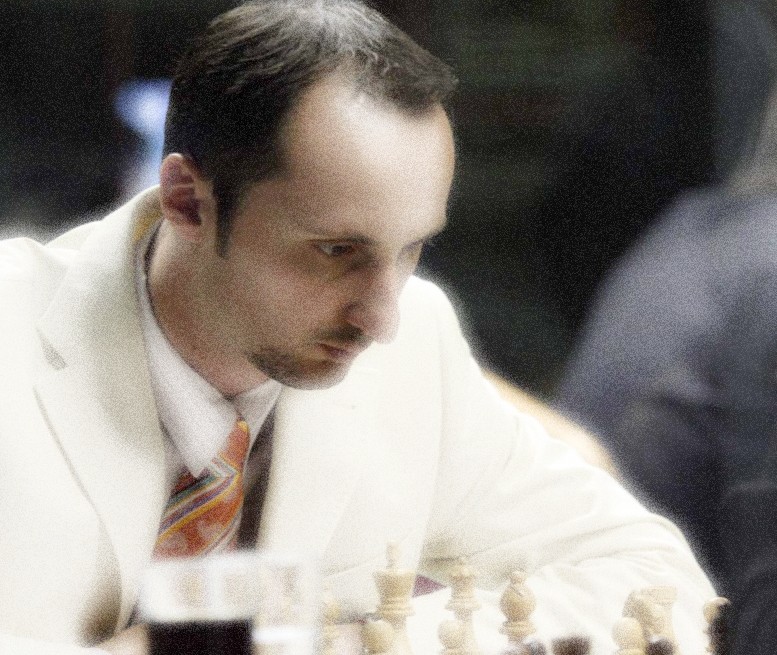
In the mood for Lvov
By Malcolm Pein
Last Updated: 12:01am BST
27/06/2008
Following months of wrangling and uncertainty the world title eliminator between Veselin Topalov of Bulgaria and Gata Kamsky of the USA looks certain to take place at Lvov in Ukraine and have a prize fund of $750,000. The Bulgarians had originally offered to stage the match in Sofia for a fraction of the money but Kamsky was unwilling to play in his opponent’s home city.
One of Kamsky’s advisors was able to raise funds to stage the match in Ukraine which was the least worst option for Topalov and his team who were desperate not to play in Russia after the Toiletgate scandals at Elista during Topalov’s failed attempt to wrest the title from Vladimir Kramnik in the 2006 unification contest.
The eight game match will start on November 28 and will last twenty days including possible tie breaks.
Kamsky’s record against Topalov is dire, four defeats and four draws but perhaps he should take heart from the last American to take a shot at the world title. Bobby Fischer had never beaten Boris Spassky before they played their match at Reykjavik in 1972.
Source: Telegraph

Topalov will spank him silly in an 8 game match.
The thought of Topa spanking anything is quite provacative!
Keep him away from the monkey!
On the Nature of FIDE Legitimacy
by Ricardo Calvo
I have been asked by Paul Sedillo/Chess World to write an article, including a brief bio. My name is Ricardo Calvo, and I love chess. I know several American chess players who may testify to it better than I. To begin with the greatest of all, I know that Fisher knows me. He made some compliments on me in Havana 1966 when I defeated Korchnoi. By the way, a day before I had won a much more fateful game against a Filipino chess player named Florencio Campomanes. A few days later, I watched how Fisher smashed Pomar, while I was losing a somehow crazy game against Addison in the match USA-Spain. Years later, in Siegen 1970, Fisher allowed me to interfere in the post-mortem analysis of his drawish game against Portisch. I appreciated this as an unusual honor. Generally speaking, the deafening silence which covers the figure and the image of Robert J. Fisher is a shame for any chess columnist, and I will try therefore to bear Fisher not only in my mind but also in my keyboard, for instance, in future articles under the title “Who is the World Champion?”.
I have met other American chess players, and my experiences may be interesting to some. My best score is against the brothers Byrne (3-0). I won an endgame of bishops of opposite colors against Donald, and two attacking games against Robert in Spanish tournaments during the 70�s. In Buenos Aires 1978, Robert Byrne came to me with a smile saying: “I wanted to shake hands with you when I am not resigning”. I was a friend of Olaf Ulvestad, whom I defeated always, in tournaments as well as at my home when he was drunk. I drew against Larry Evans in Portugal. I lost once against William Lombardy in Germany, and my most horrible loss was in 1980 against Christiansen in Spain, because a had a clear rook plus in the opening. Christiansen seemed to interpret my stupidity as a sign of honesty, because he send me to pick up his money prize in Linares 1985 when he was too busy in a love affair with a local girl. Well, I didn’t imitate the robbing. I recall kaleidoscopic chess experiences with Americans. Once I have been singing together with Seirawan “I am a poor wayfaring stranger”. Other times, in other tournaments, I have discussed chess politics with Kavalek, philosophical chess issues with Saidy, computer chess with Schiller, or chess methodology with Weinstein. My memory is shaky and probably I am forgetting others.
Anyway, my chess career is irrelevant, because my name is for the records a well known one since FIDE declared me “persona non grata” in 1987. The committee endorsing this decision was headed by USCF representative Arnold Denker. Bearing Fisher in mind, I shall offer in this article some reflections centered on the historical nature of FIDE legitimacy. To begin with, FIDE has usurped an important property: The official title of World Champion. This title was created in 1886 in the USA for the match Steinitz – Zuckertort. The crude and cool chronological data make any theoretical justification unnecessary. When FIDE was born 38 years later, in Paris 1924, Lasker and Capablanca had consolidated the validity of the world tittle regardless of the powers of any international organization. FIDE was in those years involved mainly in promoting the “Tournaments of Nations”, called nowadays Chess Olympics.
A critical turning point was the end of the second World War, when FIDE became politicized in the worst sense of the word. The victorious countries had gained the control not only on the big world board, but also for the future chess battles. One of the first results of this new situation was the exclusion of the reigning world champion, Alekhine, from the list of participants in the Victory Tournament in London 1946. The official reason were a couple of articles of anti-Jewish content published during the war in the “Pariser Zeitung” under the signature of Alekhine. The real authorship is still a controversial subject, but the sad point is that this exclusion in fact killed Alekhine, who died in strange circumstances shortly after he was notified of the exclusion. As a medical doctor, I have witnessed similar cases outside chess. Alekhine�s case is particularly illustrative, because the medical reports on his self-destruction were commented to me by Prof. Rey Ardid, who was not only a notorious professor of psychiatry, but at the same time was the strongest Spanish chess champion. Rey Ardid narrowly lost a match against Alekhine, and extended his care for Alekhine to medical treatments during the last “Spanish years” of Alekhine�s life. So, Rey Ardid knew very well what was he talking about.
Poor Alekhine lived only for chess. He may have chosen alcoholism as an escape, but he was never active in politics. Only for chess passion he played in the first Soviet Championship. Only for chess he emigrated outside Russia, wandering through the whole world, becoming a French citizen and trying to settle down in some quiet place. For instance, he intended in 1935 to establish his residence in Mallorca, but his American wife disliked the idea. From 1939 till 1943, he played the chess tournaments of the “Great Europe” occupied by Nazi-Germany. Under these circumstances he could hardly protest if, say, a Nazi propagandist (Brinckmann?) published an anti-Jewish pamphlet with the signature of the World Chess Champion. Keres could never protest, in case he wanted to, when his image was being used by Estonian nationalism in a political context.
Anyway, a ban against a chess player based on any political ideas is in itself an intellectual and juridical monstrosity. A non-suspicious authority like Prof. Nathan Divinsky told me once: “I would have accepted the participation of Hitler in any chess tournament”. Yes, any Hitler, Stalin, Pol-Pot, Mao, Sadam or Ilyumzhinov has the right, if he wishes, to play in a chess tournament. This is the real greatness of our game, a spiritual refuge far above the dirty politics of everyday life in any country. Another completely separate question is whether any dictator has the right to rule the chess world. My personal answer will always be negative, but the USCF has apparently its own point of view on the subject. The killing exclusion of Alekhine may have had other motivations different from high ideals such as struggle for democracy or patriotism, because, as Dr. Johnson put it, such pretended ideals are frequently “the last refuge for a crook”. If you admit that great chess talent usually causes jealousy, envy or even blind hatred among miserable chess players, the explanation of cases like Alekhine or Fisher may lie not in the purity of administrative principles, but in much more bastard interests.
A curious fact is that in London 1946, the most strenuous voice against Alekhine was an American named…Arnold Denker. I never talked personally to Denker, though we made a public exchange of letters in “New in Chess” 1988. I read his book “My best games…” from this year to this year, and I remembered that Alekhine had written a book with the same title with different years. Another more important difference is that Alekhine was a great chess player, and his games as well as his book are equally great. Denker was never a great player, and in my opinion neither his games nor his book are great at all. When I read that FIDE awarded Denker with the tittle “Grandmaster Emeritus”, I asked myself how many of such tittles have been conceded, and on what official rules?. Are there precedents or other examples of similar grandmastership? Answers are welcome. Anyway, I want to say a nice word about Denker�s play. When he obtained a certain notoriety by losing a match against a computer, I never believed that Denker could have been bribed. On the contrary, I have reasons to believe that bribes may have played a role in other victories of machine versus man. In the case of Grandmaster Emeritus Denker, I am sure that the machine was much stronger.
But let us return to FIDE: Its politicization took a clear Soviet pattern since the World Championship of 1948. Reshevsky was left alone, because another great American player like Reuben Fine refused to participate. Fine could write much better than I about the political background of these early FIDE activities. In any case, I don’t feel the necessity to prove that thrown games, political punishments, libels or defamatory propaganda, electoral fraud and administrative manipulations became a Soviet specialty quickly absorbed by FIDE officials of any nationality. They could sincerely say once and again “Gens una sumus”. In the true sense of the word, they are a family.
At the beginning of all this, in the early 50�s, a young Filipino chess player named Florencio Campomanes was studying at the Jesuit-founded Georgetown University, near Washington. One day, I met by chance one of his school comrades who told my that Campomanes was officially expelled not only from the University by also from the USA after the US State Department declared him “persona non grata”. I am not able to obtain from the State Department the pertinent documentary evidence, but perhaps some of the readers can check this point. Does the USCF have any evidence supporting or refuting this story? It is not a matter of political responsibility of the USCF in decisions of the State Department affecting relevant chess personalities like Campomanes or, again, Fisher. For me, it is above all an interesting curiosity, since Campomanes�s lawyer stated before a Swiss court in the case “Calvo vs. FIDE” that declaring a person as “non grata” has no practical effect at all upon his activities.
I shall comment on the long story of my experiences with FIDE in future articles, provided it has any interest for American chess readership. For the moment, when I read in the Internet news groups discussions about “Killer Kirsan” or “Doylegate” or the need for the OMOV rule, I cannot avoid thinking in historical terms. Yes, FIDE has an historical past which explains most of the actual mess. To extract lessons from this past is a must for any columnist interested in chess politics.
That was a short article. Heh.