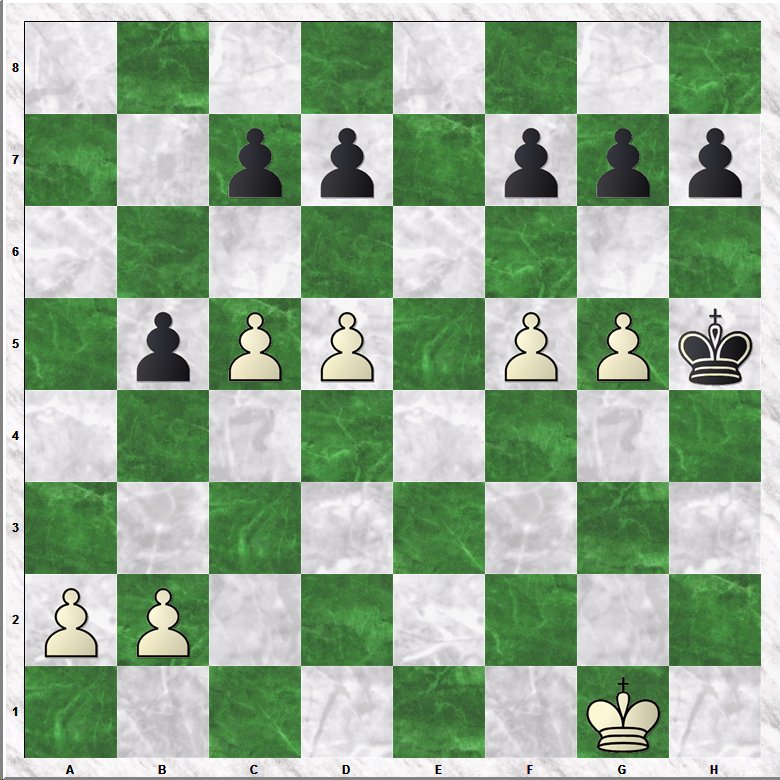
8/2pp1ppp/8/1pPP1PPk/8/8/PP6/6K1 w – – 0 0
White to move and win!!!
This was a composition by Troitzky back 1924 with NO Fritz 🙂

Chess Daily News from Susan Polgar

8/2pp1ppp/8/1pPP1PPk/8/8/PP6/6K1 w – – 0 0
White to move and win!!!
This was a composition by Troitzky back 1924 with NO Fritz 🙂
Wow, what a puzzle! Clearly, white’s winning plan must, absolutely must, involve the maneuver of a3-b3-a4 to create the passer on the a-file, but I can demonstrate that this simply is too slow if white tries it immediately:
1. a3 Kg5
2. b3 Kf6!!
Here, Kf5 is, amazingly, too slow for black to hold this: [2. …Kf5?? 3.a4 ba4 4.ba4 Ke5 5.d6! (if 5.a5?? Kd5 6.a6 Kc6 and black catches the pawn) 5. …cd6 6.c6! and black’s own pawns will prevent him from reaching to cover a8 in time!] Continuing:
3. a4 ba4
4. ba4 Ke7 and black cannot be prevented from entering the square formed by a5/d5/d8/a8 on the next move and stopping the white a-pawn.
For now, that is all I have. Clearly, white must find a way of moving his pawns in the right order to force black to block his king’s path to a8 long enough for the a3-b3-a4 maneuver to work. The question is, what order do you move them in? That, I haven’t solved yet.
Ok, I think I might have it now, or at least a part of it. In my previous comment, I showed how critical the f6 square is to the black king’s approach to cover a8 when white creates his passed pawn, so the idea it to force black to block that square, for a move, with his own pawn:
1. g6!
Black must capture with either hg6 or fg6 since the pawn will queen if he doesn’t capture it. I will take each separately:
1. …..fg6
2. f6! gf6
Same note as before, the capture is forced since white will queen that pawn otherwise. Now, we can proceed with creating the passed a-pawn:
3. a3 Kg4
Here, no better is f5 or Kg5: [3. …f5 4.b3 Kg5 5.a4 ba4 6.ba4 Kf6 7.a5 and the black king cannot enter the square formed by a5/d5/d8/a8 on the next move, and the pawn will queen]; or [3. …Kg5 4.b3 Kf5 5.a4 ba4 6.ba4 Ke5 7.d6! cd6 8.c6! cd6 9.a5 and though the black king can now enter the square formed by a5/d5/d8/a8, he is prevented for a move from traveling diagonally across that square, and will be one move short of stopping the pawn from queening]. Continuing:
4. b3 Kf3 (hopeless, I know)
5. a4 Ke4
No better is ba4: [5. …ba4 6.ba4 Ke4 7.d6! cd6 8.c6 dc6 9.a5 with the same problem as before- the c6 and d6 pawns block the black king from reaching a8 in time.] Continuing:
6. d6! cd6
7. ab5
Here, 7.c6 wins, too, just like before, but ab5 wins as well, and looks more elegant:
7. …..Kd5
8. c6! dc6
9. b6 and the pawn can’t be caught.
I don’t think I have left any holes in this. After 1.g6, almost every move is forced for black in one manner or another, and there is nothing he can do to muck up the a3-b3-a4 plan that doesn’t just cost him a tempo that he doesn’t have to spare. The resulting endgame of Q + K vs K + 5P is actually much easier to win than it might appear to some- the black king cannot protect all 5 pawns, so the new queen will mop up either the g-h pawns, or the c-d pawns in the time it takes black to bring his king and the remaining pawns down the board, and the queen and the king are more than match for that remaining cohort, whether it consists of K + 3P, or K + 2P.
1)a3 k*g5 ( 1)b3? b4 )
2)b3 k*f5
3)a4 bc
4)ba ke5
5)e6 de
6)d6 ed
7)a5 and wins
Sorry solvers, deeply sorry to announce you that this study is incorrect, as all the versions of this study!
This one, a correction by Zinar (a pawn endings wizard like Grigoriev) in 1983 of a study by Troitzky published in 1913, , was busted by Kralin in May 2004.
This one:
8/2pp2pp/8/2PP1P2/1p5k/8/PP4p1/6K1 w – – 0 1
, the original, was cooked by Campioli in June 2001.
Finally, this one:
8/2pp2pp/8/2PP1P1k/1p6/8/PP6/6K1 w – – 0 1
, a version published also in 1913 in the Deutsche Schachzeitung, has its main line both cooked and busted. The incorrections were found in 2004 (Kralin) and 2007 (Mihoci). But the cook in first move is very near Troitzky’s initial intention.
Troitzky is a composer whose many creations were incorrect, so, when you’re dealing with his studies, double-check carefully before posting with a very good database (online or offline) or a program with 5-men tablebases (I strongly recommend Rybka and/or Houdini).
So, the challenge is different this time:
How does black save the game despite White’s attempts?
Regards to all of you, and nonetheless congrats for posting studies. They are always wonderful puzzles!
Does Yancey find the bust in this one?
Hi Susan Polgar,
Well,this puzzle is fairly simple puzzle. I don’t see this puzzle throws any brain challenge – By reading the title I have taken time to double ensure my words,still I will say,its child’s play puzzle to everybody.
I think,this title had been kept to this puzzle just because its week end – lol
Example
=======
1.b3 K*g5
2.a4 K*f5
3.a*b Ke5
4.b6 c*b6
5.c*b6 K*d5
6.b7 Kc6
7.b8(Q) – Rest,child’s play to win this game by white.
By
Venky [ India – chennai ]
Venky: 1.b3 b4 wins for black.
Cortex: Thanks for the heads up. When I “solved this” (same as Yancey Ward, with the same sequence of reasoning), I vaguely wondered aobut a black pawn push but was too lazy / fell into the trap of having found “the solution”.
Anyway, Kf3-Ke2 provides the bust.
Still – great puzzle, and I enjoyed the “solution” and the bust, which reminded me of the famous Reti puzzle.
@Yancey:
1. b3 (proposed by Venky) is classically countered by
1 …b4!! and if
2. a4 bxa3 en passant refutes.
1. a3 Kg5
2. b3 (proposed by Ashoka) Kf6 (Yancey)!! is quite a correct refutation.
1. g6!? is a lot harder to meet.
1. …fxg6
2. f6! gxf6
3. a3 Kg4
4. b3
4… Kf5 was Troitzky’s main line, followed by
5. a4! (and not 5. d6? cxd6 6. a4 bxa4 7. bxa4 Ke6 8. c6 dxc6 9. a5 Kd7)
5… bxa4
6. bxa4 Ke5 and now two pawn sacrifices dam the road to b7 for the Black King
7. d6! cxd6
8. c6! dxc6
9. a5 Kd5
10. a6
But there is this obnoxious move,
4… Kf3!! (Kralin, but you’ve considered this variation, although hopeless)
5. a4 and now, you rejected as a side line
5. …bxa4
6.bxa4, and, instead of continuing with 6…Ke4 (Yancey), black has a move that shakes the whole White conception:
6…Ke2!! (Kralin)
the aim of this move is very clear: queening the f-pawn…
the play may continue like this
7. a5 f5
8. a6 f4
9. a7 f3
10. a8=Q f2+ with check!!
So, since Ke2 is a menace, White can try to correct this with
5. Kf1 Ke4
6. d6 cxd6
7. c6 dxc6
8. a4 bxa4
9. bxa4 but Kd5 followed by Kc5 enters in the square of the a-pawn
So, 4…Kf3!! is a Reti-like move which protects the f-pawn till queening it and thus gaining a vital tempo to play 5…Ke4.
Congratulation to Nikolay Kralin for discovering that well-hidden bust, probably without a computer!
Verdict: unsound study.
Cortex,
Maybe I found it now. Took me a while to find this since it just looked visually so slow, I didn’t even consider the idea last night, but when I saw your comment, I went back in for a second look (I also forgot to include the 1. …hg6 line last night in my haste to get to my late night poker):
1. g6 fg6
2. f6 gf6
3. a3 Kg4
At this point last night, it was easy for me to see that moves like f5 and Kg5 for black (all you have to do is count at this point keeping in mind that white can force black to block c6 and d6 with his own pawns) will lose for black, so I did look at Kg4 as a method to go around the c and d pawns from the back, but I completely missed the other idea latent in this move, and it is one that seems to save black. Continuing:
4. b3 Kf3!
The black king is heading for e2 to support the f-pawn. White cannot take the time to prevent this by moving his king to f1 since this gives black the tempo he needs to stop the white a-pawn. Continuing:
5. a4 ba4
6. ba4
So, at this point, we are still where we were before in black’s attempts to stop the a-pawn. If the black king tries to make for e4 or e3, white will win as I outlined last night by forcing black to block up c6 and d6. Also, if black plays f5 prematurely here, it will give white the tempo needed to play Kf1 to foil black’s saving plan, so this leaves only Ke2:
6. …..Ke2
7. a5
There should be nothing for white to win now. The black f-pawn will deliver one check to gain the needed tempo to draw, and moving the white king to the h-file just concedes this tempo in another way. Continuing:
7. …..f5
8. a6 f4
9. a7 f3
10.a8Q f2 with check
11.Kh2 f1Q and I don’t want to go further in this since white can no longer win. This is a likely draw, though all the winning chances seem to belong to black.
I will just guess that putting the white king on g2 will remove this saving line for black as it prevents the black king from reaching e2 via f3 costing him one more move.
Dear Yancey,
Problem with your 2nd posting could be
1. g6 fxg6 2. f6 gxf6 3. a3 Kg4 4. b3 Kf3 5. a4 bxa4 6. bxa4 Ke2 (instead of 6….Ke4)7. a5 f5 8. a6 f4 9. a7 f3 10. a8=Q f2+ 11. Kh2 f1=Q and white is hard put to draw unless he can win Q which does not seem to be possible.
Now the question is whether white should play 5Kf1 to prevent … ke2.
Also we have to rethink about 2f6?!
Dear Venky,
1b3 b5
Dear Venky,
I mean 1b3 b4!
Many thanks, again, to Cortex for his deep knowledge of the history of chess compositions. On more than one occasion over the last 2 years, he has correctly pointed out busted problems. Unlike RU, I didn’t even see the possibility of supporting the f-pawn last night, even vaguely, until seeing Cortex mention that there was a bust present- only then did I start thinking more broadly about black’s options.
Congratulations Yancey
Important preliminary note:
For the sake of justice, I must precise to the occasional surfer that the posts are validated once in a row every x hours.
Thus, Yancey have written his 10:40 post before having access of mine (posted at 10:15) and has genuinely found the bust. So has RU.
End of note
___________________________
Now, for the correction, let’s check your idea…
Other ones were made by
Kok, Pionneindspelen, 1992
7k/2pp3P/8/1pPP4/8/7p/PP4p1/6K1 w – – 0 1
Campioli, Finales y Temas, 2001
8/2pp3p/8/2PP4/8/6Pk/P5p1/6K1 w – – 0 1
Alas, in both compositions, f and g pawns have disappeared, so we can’t consider them as simple reconstructions of this flawed study but heavy changes of matrix.
Well, yours is this time a good correction respecting Troitzky’s spirit. So double congrats!
Regards!
Cortex
Same remark for S.G Bhat, who has found the bust.
A most instructive one for all that underestimate the speed and efficiency of a king in the endgame.
What an irony! Susan all the time was asking “How white should proceed?” without saying win or draw. In this problem she gave confidently “win!!! “ with exclamation marks and in bold style and still white can not win.Of course one can not check all things which are pouring in daily in and out.
Hi Susan Polgar,
Well,with due respect to everybody – I am sorry for over looking the rudimentary fact that the “b4” response from Black to White’s initial “b3”,will prevent ambitious move of White’s “a4” through “en-passant”.
If there is,any means to take back the words of my previous post about this puzzle – I will roll it back right now – lol.
Anyway though thats not possible – I say sorry again for over looking the rudimentary fact.
Coming to the puzzle,let me take time to find a way /conclusion to this puzzle,then post the same here under this title.
[ Note : I am ever principled not to use/take any assistance from computer software to solve any chess puzzle at any point of time,that will remain so ever thats assured.]
Sounds healthy blog – Good.
By
Venky [ India – Chennai ]
Hi Susan Polgar,
Well,interesting puzzle,its even more interesting to see,the profound way with which the others,down drilled the puzzle for better analysis and result – very nice.
Cortex seems to be versatile in pinning the holes and progressing the solution to the possible result.
I believe in collective effort for an acceptable and brilliant solution,so,here what I am going to do is,present three fourth of moves,to solve this puzzle,if interested “Cortex and Rest” may add /tailor the moves to Win / Draw this game by white.
Example
=======
1.Kf2 K*g5
2.Kc3 K*f5
3.Kd4 h5
4.b4 h4
5.c6 d*c
6.d*c h3
7.Kc5 h2
8.K*b5 h1(Q)
9.Kc5 Qg1+
10.Kb5 Qf1+
11.Ka5 Qa1
12.a4 Qe5+
13.b5 Qc3
14.Ka6 Qa3
15.Kb7 Q*a4
16.b6 c*b
17.c7 Qe4+
18.Kb6 .. [ Anybody can contribute to add /delete moves for the result – white’s Win / Draw ]
If these moves finds no enthusiast,then I may step in to give the prefect solution to this puzzle.
Come on guys,expecting the drilling analysis and progressive solution from every chess enthusisat.
By
Venky [ India – Chennai ]