

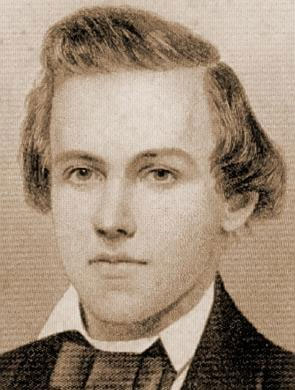
A Chess Champion’s Dominance—and Madness
December 12, 2011
By the time Paul Morphy was felled by a stroke on July 10, 1884, he had become an odd and familiar presence on Canal Street in New Orleans: a trim little man in sack suit and monocle, muttering to himself, smiling at his own conceits, swinging his cane at most who dared approach. Sometimes he would take a fancy to a passing woman and following her for hours at a distance. He lived in fear of being poisoned, eating only food prepared by his mother or sister, and he believed that neighborhood barbers were conspiring to slit his throat. His family tried to have him committed to an asylum, but he argued his sanity so convincingly that the authorities declined to admit him. It had been a quarter-century since he became a world-renowned chess champion, and for the last decade of his life he was loath to discuss the game at all.
No one could say with certainty what prompted Morphy’s slow decline, but the discovery of his genius in 1846 remained legendary. Morphy, at age 9, was sitting on his family’s back porch as his uncle and father, a justice on the Louisiana State Supreme Court, played chess. After several hours, the men declared the match a draw and moved to sweep away the pieces. Morphy stopped them. “Uncle,” he said, “you should have won that game.” He maneuvered the pieces and explained: “Here it is: check with the rook, now the king has to take it, and the rest is easy.” And he was right.
Soon afterward, Major General Winfield Scott, who had a reputation as a skilled player, stayed in New Orleans for five days while he was en route to the Mexican War. He asked an acquaintance at the chess club on Royal Street to find him a worthy opponent, and at eight o’clock that evening Scott found himself sitting across from Morphy, who wore a lace shirt and velvet knickerbockers. Scott, believing he was the victim of a prank, arose in protest, but his friends assured him that Morphy was no joke. He checkmated Scott in ten moves.
Soon afterward, Major General Winfield Scott, who had a reputation as a skilled player, stayed in New Orleans for five days while he was en route to the Mexican War. He asked an acquaintance at the chess club on Royal Street to find him a worthy opponent, and at eight o’clock that evening Scott found himself sitting across from Morphy, who wore a lace shirt and velvet knickerbockers. Scott, believing he was the victim of a prank, arose in protest, but his friends assured him that Morphy was no joke. He checkmated Scott in ten moves.
Morphy had an astounding memory, capable of recording every factor he deemed pertinent to his play—openings, defenses, even entire games—but he also had an intuitive grasp of the possibilities. He could visualize the board several plays deep, anticipating and capitalizing on even the slightest misstep. “The child had never opened a work on chess,” wrote Morphy’s uncle, Ernest Morphy, to the editor of chess magazine La Régence, which published one of Morphy’s early games. “In the openings he makes the right moves as if by inspiration, and it is astonishing to note the precision of his calculations in the middle and end game. When seated before the chessboard, his face betrays no agitation even in the most critical positions; in such cases he generally whistles an air through his teeth and patiently seeks for the combination to get him out of trouble.” The prodigy next took on Johann J. Lowenthal, a political refugee from Hungary who was well known in European chess circles. Morphy, in his French vernacular, described Lowenthal’s reaction at losing to him in one word: “comique.”
Full article here.
Nakamura is more talented than Morphy.