Trying to win a piece with 1.f3 runs into 1…Qb6 pinning the knight on d4. So maybe first 1. Bc7 and only then 2.f3 although I don’t like the fact that black can pin the bishop to the queen.
ok, i saw a promising line, like this: 1. Rxe4 dxe4 2. Nxe6 Rxe6 3. Bc4 Qd7 4. Rd1 Qf7 5. Qxe4 Re8 6. Rd6 i think this should winsome material in the other lines as well. greets, jan
1 Rxe4 d5xRe4 2 Nxe6 Rxe6 3 Bc4 pins the Rook to the King, and after black defends the Rook, 4 Qxe4 picks up the pawn and attacks the rook again. 5 Re1 can be brought to bear on the Rook next if needed, and if the king has come up to f7 to defend, the white queen can even come in and snatch the undefended pawn at h7 at some point.
1.Rxe4! dxe4 2.Nxe6! and Black would be very well advised not to take back
After all 2…Rxe6 3.Bc4 Qd7 4.Qxe4 Kf7 5.Re1 Re8 6.g3!! with the idea of f4 and then f5 and Black has no way to go out of the bind, White can prepare a safe square on a2 by a3 at some moment The exchange of queens by Qc6 does not bring Black any relief.
Protecting the Bishop by putting the Queen on a square that White’s Rook can’t badger, and allowing the other Rook to join the defense later if needed.
4 Qxe4 Re8 5 Re1 Kf7
Black’s pieces, except for the Bishop, are tied down to the defense of the Rook. White now maneuvers around to make inroads.
6 Bd5!
This move’s purpose will be clear later.
6…. h5
Black removes the h pawn from the sights of White’s Queen.
White now improves the position of his dark squared Bishop.
7 Bb8 a6 8 Ba7
Now we see the purpose of 6 Bd5. Black’s Queen can’t get to c6 to force White’s Queen away.
8 … Qd6 9 Bc5
White’s Bishop finishes its journey and gets into a strong position, where it blocks Black’s dark-squared Bishop from entering the fight.
9… Qd7 10 Qf5
Moving the Queen out of the line of sight of the Rooks, giving White more flexibility later. White has time to prepare, as Black isn’t going anywhere.
10… h4
As good as anything else. Black moves the h pawn to where it’s protected. 10 … Bf8? is no good, because White simply takes the Bishop, and Black can’t recapture without losing valuable protection for the Rook on e6.
11 f4 Qc8
As good as Black has.
Taking the pawn by 11 … gxf4 is no good because of 12 Qh5+ Kg8, 13 Qe8+! Qxe8, 14 Rxe6, and the Queen has nowhere to hide from the discovered check.
Nor will 11… Bh6 work, as after 12 fxg5, Black can’t recapture the pawn, due to Qh7#.
With the given move, Black threatens to take the Bishop with check.
12 Re3
White moves the Rook to a better square and prevents 13… Qxc5, which now loses the Queen.
12… Bh8
Not that thrilling, but Black is practically in Zugzwang. Biding time with 12 … Qd7 loses to 13 fxg5 Qc8, 13 Rxe6 (yes, the engines say that 13 b4 mates a move sooner), and now 13… Rxe6, 14 Bxe6 Qxe6, 15 g6+ wins the Queen, or 13…Qxc5+, 14 Kh1, and Black can’t handle all of White’s mating threats.
13 Qh7+ Bg7 14 f5 Qxc5
Everything else reaches the same basic result. With this move, Black tries to keep White’s Rook out of action.
15 fxe6+ Rxe6 16 Bxe6+ Ke8
16… Kf8 is also met by Qg8+
17 Qg8+ Qf1
Black is a Rook down, but at least hopes for a game to play.
18 Bf5+ Kd8 19 Qc4!
Black can only delay mate at c8 for one move by giving up the Queen.
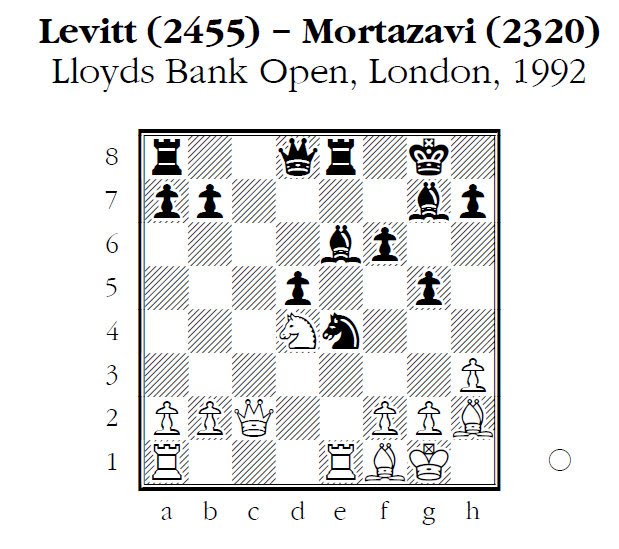


Trying to win a piece with 1.f3 runs into 1…Qb6 pinning the knight on d4. So maybe first 1. Bc7 and only then 2.f3 although I don’t like the fact that black can pin the bishop to the queen.
ok, i saw a promising line, like this:
1. Rxe4 dxe4
2. Nxe6 Rxe6
3. Bc4 Qd7
4. Rd1 Qf7
5. Qxe4 Re8
6. Rd6
i think this should winsome material in the other lines as well.
greets, jan
Rxe4! de Nxe6 Rxe6 Bc4 (the main point) Qb6 Qxe4(!) and white has the better game.
1 Rxe4 d5xRe4
2 Nxe6 Rxe6
3 Bc4 pins the Rook to the King, and after black defends the Rook, 4 Qxe4 picks up the pawn and attacks the rook again. 5 Re1 can be brought to bear on the Rook next if needed, and if the king has come up to f7 to defend, the white queen can even come in and snatch the undefended pawn at h7 at some point.
1.Rxe4! dxe4 2.Nxe6! and Black would be very well advised not to take back
After all 2…Rxe6 3.Bc4 Qd7 4.Qxe4 Kf7 5.Re1 Re8 6.g3!! with the idea of f4 and then f5 and Black has no way to go out of the bind, White can prepare a safe square on a2 by a3 at some moment The exchange of queens by Qc6 does not bring Black any relief.
Win a pawn with Rxe4, follow by Nxe6, Bc4 and Qxe4
White’s combination ends up winning a Pawn.
1 Rxe4! dxe4
2 Nxe6 Rxe6
3 Bc4 Qb3
Protecting the Bishop by putting the Queen on a square that White’s Rook can’t badger, and allowing the other Rook to join the defense later if needed.
4 Qxe4 Re8
5 Re1 Kf7
Black’s pieces, except for the Bishop, are tied down to the defense of the Rook. White now maneuvers around to make inroads.
6 Bd5!
This move’s purpose will be clear later.
6…. h5
Black removes the h pawn from the sights of White’s Queen.
White now improves the position of his dark squared Bishop.
7 Bb8 a6
8 Ba7
Now we see the purpose of 6 Bd5. Black’s Queen can’t get to c6 to force White’s Queen away.
8 … Qd6
9 Bc5
White’s Bishop finishes its journey and gets into a strong position, where it blocks Black’s dark-squared Bishop from entering the fight.
9… Qd7
10 Qf5
Moving the Queen out of the line of sight of the Rooks, giving White more flexibility later. White has time to prepare, as Black isn’t going anywhere.
10… h4
As good as anything else. Black moves the h pawn to where it’s protected. 10 … Bf8? is no good, because White simply takes the Bishop, and Black can’t recapture without losing valuable protection for the Rook on e6.
11 f4 Qc8
As good as Black has.
Taking the pawn by 11 … gxf4 is no good because of 12 Qh5+ Kg8, 13 Qe8+! Qxe8, 14 Rxe6, and the Queen has nowhere to hide from the discovered check.
Nor will 11… Bh6 work, as after 12 fxg5, Black can’t recapture the pawn, due to Qh7#.
With the given move, Black threatens to take the Bishop with check.
12 Re3
White moves the Rook to a better square and prevents 13… Qxc5, which now loses the Queen.
12… Bh8
Not that thrilling, but Black is practically in Zugzwang. Biding time with 12 … Qd7 loses to 13 fxg5 Qc8, 13 Rxe6 (yes, the engines say that 13 b4 mates a move sooner), and now 13… Rxe6, 14 Bxe6 Qxe6, 15 g6+ wins the Queen, or 13…Qxc5+, 14 Kh1, and Black can’t handle all of White’s mating threats.
13 Qh7+ Bg7
14 f5 Qxc5
Everything else reaches the same basic result. With this move, Black tries to keep White’s Rook out of action.
15 fxe6+ Rxe6
16 Bxe6+ Ke8
16… Kf8 is also met by Qg8+
17 Qg8+ Qf1
Black is a Rook down, but at least hopes for a game to play.
18 Bf5+ Kd8
19 Qc4!
Black can only delay mate at c8 for one move by giving up the Queen.
In fact once Qc6 White must play Bd5 otherwise f5! will be available for black.