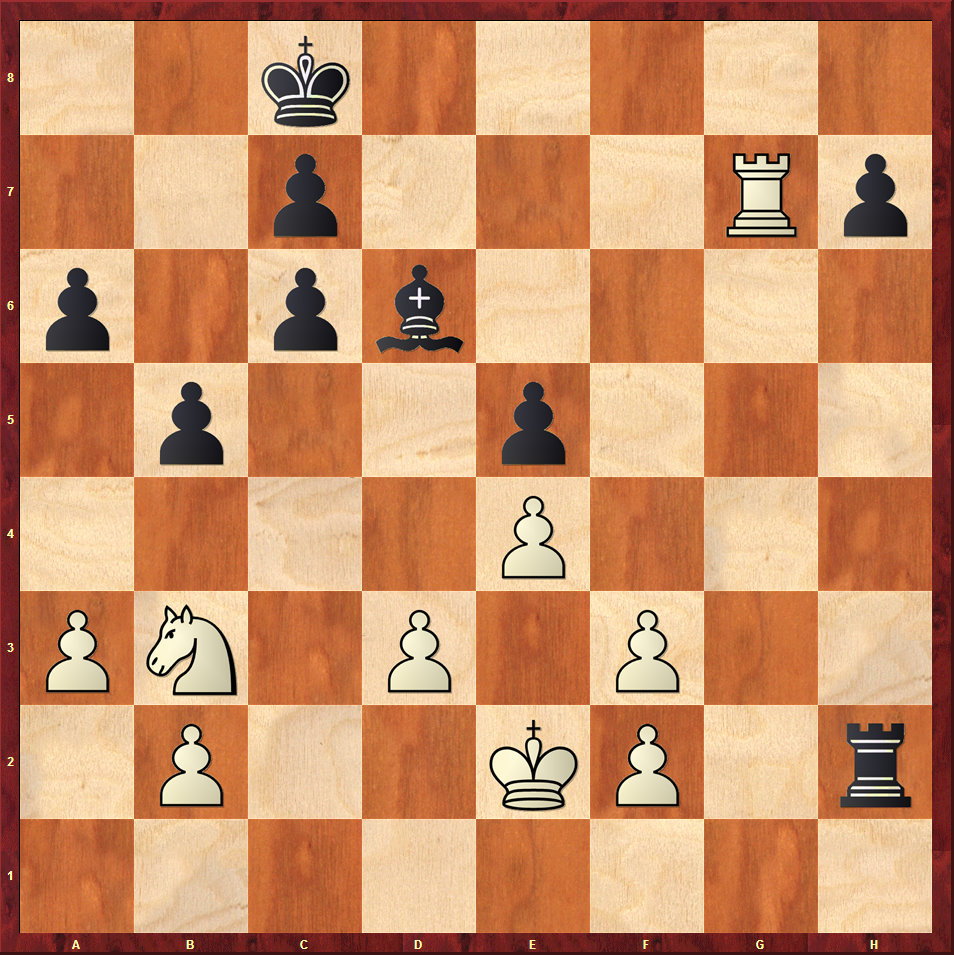
White to move. How should White proceed?
2k5/2p3Rp/p1pb4/1p2p3/4P3/PN1P1P2/1P2KP1r/8 w – – 0 23
(Fischer – Rubinetti)

Chess Daily News from Susan Polgar

White to move. How should White proceed?
2k5/2p3Rp/p1pb4/1p2p3/4P3/PN1P1P2/1P2KP1r/8 w – – 0 23
(Fischer – Rubinetti)
This is all about advancing the right pawns in the right order and grabbing a winning initiative.
1. f4 !, exf4
2. d4 !, Kd8
and now
3. Na5, c5
4. e5 !, Bf8
5. Nc6+, Ke8
6. Rxc7 and white wins
Erik Fokke
Amsterdam, Netherlands
i saw a nice combination, but i’m not sure, how effective it is:
1. Rg8+ Kb7
2. Na5+ Kb6
3. b4 threatening Rb8+ followed by Nc6#.
actually black can play:
3. … Ka7
4. Nxc6+ Kb6
5. Na5+ or
1. … Kd7
2. Ra8 will win the a-pawn, but i’m not sure, whether that really is a good idea, the outside passed pawn makes me worry. greets, jan
f4..intending d4 and e5 looks pretty good.
Took me a while to see a viable plan here. To me, the key is the vulnerability of the bishop, who doesn’t have much range of action without either getting bagged, or allowing the knight to go hopping through the queen side gobbling up pawns. In this position, white must mobilize d and e-pawns. This is quite complicated due to the numbers of variations, but they are all fairly straightforward in nature once you are working through them:
1. f4!
Now, black has what I consider to be two basic options, take at f4 or try to generate counterplay. For counterplay, black might try a move like Rh1 threatening Rb1, or play a move like c5 that threatens c4, or black might try playing Rh4 to threaten Rf4, or black might try pushing the h-pawn. Let’s look at each option and see how they might play out:
1. …..ef4
2. d4
This is the point of 1.f4- play d4 and e5. The question is, how can black save his bishop- the only square from which the bishop can be safe, f8, is still going to be death after Rg8 which pins and wins it. I basically see the moves of c5, Rh3, Rh1, and f3 (trying to induce a mistake like Kf3). I am forced to consider each since it isn’t at all clear to me which is best:
2. …..c5
3. e5
I looked at Nc5, but I don’t see a clear advantage for white in that line. Continuing:
3. …..f3
I will show the problems with every other plausible move here when I finish with what I consider black’s best alternative here. Continuing:
4. Ke1
Here, Ke3 and Kf3 throws away the advantage, in my opinion, after black takes at d4 with check (4.Ke3 cd4 5.Ke4 Rf2 6.ed6 cd6 7.Nd4 Rb2 8.Nf3 Ra2=) or (4.Kf3 Rh3 5.Rg3 Rg3 6.fg3 c4 7.ed6 cb3 8.dc7 Kc7 9.Ke3 Kd6-+ and zugzwang is coming to kill white in this line; or 7.Nc1! Be7 when this looks about even to me, but complicated). Continuing with the main line:
4. …..c4
(or Rh1 5.Kd2 c4 6.Na5 and white has the upper hand). Continuing:
5. Na5 c3
Here, I don’t really think black has much hope with a move like Be5 as the passed e-pawn and the piece advantage should eventually force black to give up the rook, too; and a move like Ba3 might lead to a similar kind of endgame we see below:
6. bc3
Might be forced, but I am not sure. Continuing:
6. …..Ba3
And black has managed to save the bishop for the moment, but white has a strong initiative with the passed e-pawn. Continuing:
7. e6 Rg2 (Kd8 8.Nc6 Ke8 9.Rg8+-)
8. Rh7 Rg8 (seems forced to me)
9. d5
And, I think white has the advantage here, but there is a lot of work left to do here. I think white will win the f-pawn, he can probably cut the king off from the queening squares of d8 or e8 with Nc6. The main problem is the passed a-pawn, but the knight at c6 has a5 covered for a while.
I will pick this up in my next comment due to length.
In my previous comment, I outlined the following beginning:
1. f4 ef4
2. d4 c5
3. e5 f3
And, I think I had shown, at the very least, that white grabs the initiative and the advantage, though it wasn’t clearly won, even through what I considered the best line for black through 9 moves.
The main deviations from the line that I didn’t cover occur at moves 3 and 1 for black. At move 3, black could have tried a move like c4 or Rh3, but they both looked worse to me than f3:
3. …..c4
4. Na5 Rh3 (Rh1 no better)
5. ed6 cd6
6. Nb7 Rb3 (only hope?)
7. Nd6 Kb8
8. Rb7 Ka8
9. Rh7 Rb2
10.Kf3 Ra2
11.Kf4 Rf2
12.Ke4 c3
Here, Ra2 loses quickly to 13.Kd5! as the white king comes without delay to b6 and the the black king is going to be mated in 6 moves if black takes at a3. Even if the rook doesn’t come back to defend his king, he most likely gets mated anyway, but the rook must give himself up to prevent the quicker mates. Continuing:
13.Rc7 c2
14.Nf5
Best, I think, since it holds onto white’s a-pawn (Kd3 might lose a3 to Rf3+). Continuing:
14. ….Kb8
15.Rc5 Kb7
16.Ne3 and this position is completely hopeless for black- white will win at c2 and hold both of his remaining pawns. Back at move 3, black does a bit better with
3. …..Rh3
4. Na5 cd4
5. ed6 cd6
6. Rf7 d3 (what else?)
7. Ke1
Here, Kd2 is a bit worse due to black’s reply of Rf3 threatening f2 pawn. Continuing:
7. …..Rh1
Here (Rf3 8.Rh7 d2 9.Kd1 Rf2 10.Nb3 should win for white). Continuing:
8. Kd2 Rb1 (what else now?)
9. b4 Rb2 (best I think)
10.Kd3 Rf2 (the point of 9. ..Rb2)
11.Ke4 Ra2 (trying for draw)
12.Rf4 Ra3
13.Kd5 should win for white.
Unfortunately, I am out of time at the moment (family wants to go for lunch before the afternoon matinee to see Tangled. I will finish this later.
how about 1. f4 – ef 2. d4 otherwise 2.f5
Anonymous,
I looked at that line, but Kd7 seems better for black, and Ra8 doesn’t seem to give white much since black can now play Rh1 followed by Rb1 attacking white’s main weakness- the unprotected queen pawns.
1. f4 ef
2. d4
and not much can be done against e5
No quick decisive move here, I think.
One plan is to try and trap the black bishop. For example,
1. f4 exf4
2. d4! and e5 is coming next.
I suspect the fiendish 1.f4 is the key move. The point is that the B is short of squares so exf4 is met by d4 and then e5. I think white wins the B by force in that line.
But it is very fiddly. Black has other replies (eg a5) and in lots of lines can pick up pawns for the piece.
Still I can’t see anything better for white.
cant see anything concrete either / probably f4 with the threat f5 so that black must take on f4 followed by either d4 with the threat e5 or after taking on f4 directly e5 with the plan to get the sqare c5 for the Knight / of course after Rg8 first. But whats the deal on all this…? Cant see it – not in just a minute.
Oh! Fischer vs Rubinetti, Buenos Aires 1970
I remember I’ve studied this match (I stopped playing in the chess tournaments when I was 22, in 1986 and the Ruy Lopez, exchanges variation was necessary to know her) and there aren’t ”Tal” fireworks, but after 1. f4! all the ways take to white’s victory, I think.
Sweet greetings, Susan.
Stefano
I think i’ll go for f4:
1. f4 ef4
2. d4 f6+
3. Ke3 c5
4. e5 cd4+
5. Kd4 advantage to white
1.f4, exf
2.d4, f3 check
3.Ke3, with idea
4.e5
1.f4, exf
2.d4, f3 check
3.Ke3, with idea
4.e5
f4 exf (if not f5)
d4
and the threat of e5 wins the bishop and the game.
f4 and then d4
why so complicated, it’s not really a tactic but is there anything wrong with f4 + d4?
1.f4, exf
2.d4, f3
3.Ke3, with idea
4.e5
The position doesn’t look to me tactical at all. Maybe I’m missing something, but it’s all looks like a matter of pawn pushing, so it’s more strategy than tactics.
I got lazy after getting back from the movie, and just looked the game up. I wanted to see how Fischer handled it. He played f4 just like I thought. Rubinetti took at f4, and Fischer followed up with d4. At this point, Rubinetti played just about the worst of the moves he could have picked from amongst the plausible:
1. f4 ef4
2. d4 Kd8? (to protect B at f8)
Fischer now made short work of things:
3. Na5 c5 (no good options now)
4. e5 Bf8 (nothing holds)
5. Nc6 Ke8
6. Rc7 and Rubinetti resigned since Fischer is just going to play d5 if black plays a move like Rh6, and if black takes d4, it looks like mate to me:
6. …..cd4
7. e6 and to prevent mate by Rc8, black can only throw away material to delay it, and only for about 4 or five moves max.
The only one that makes any sense to me is
f4 if exf4
d4 & unless I’m missing something
the bishop seems trapped
Haven’t checked what happens after
Rg1 & goes after the Q-side pawns
1. f4, is a good move! if 1…exf4 d4, and e5 …
____________________________________
Susan, I admire you and your sisters big hugs to you, that God enlighten you!