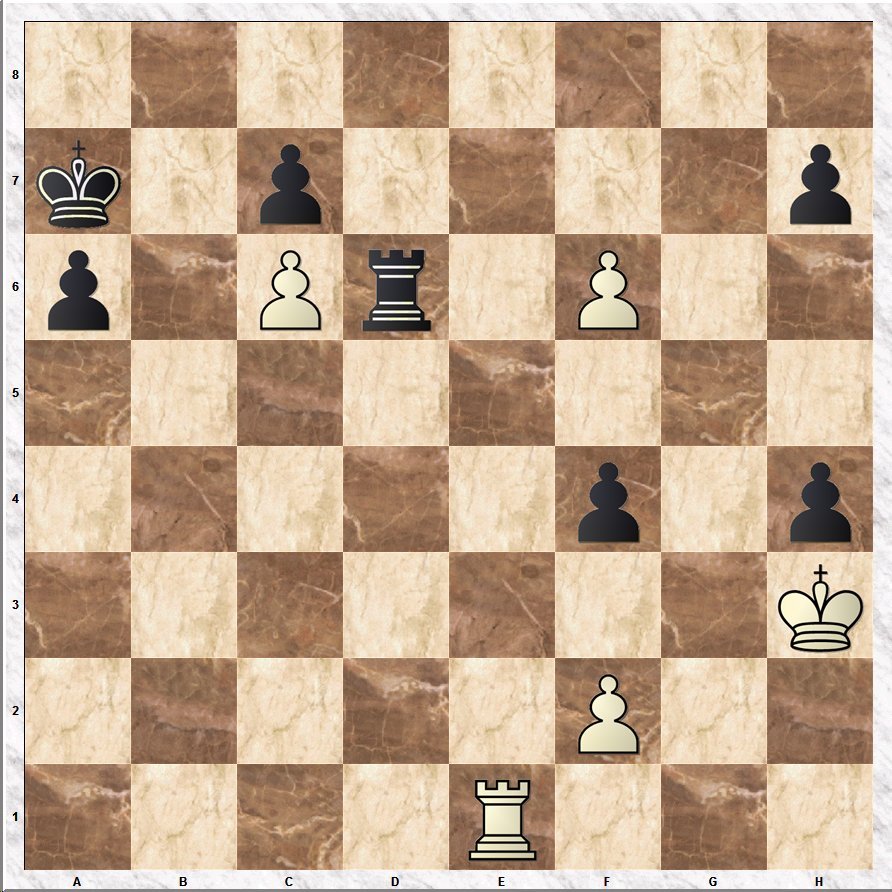
White to move. What is the best continuation for White?
Hint: This is a hard puzzle
8/k1p4p/p1Pr1P2/8/5p1p/7K/5P2/4R3 w – – 0 1
Bron, 1971

Chess Daily News from Susan Polgar

White to move. What is the best continuation for White?
Hint: This is a hard puzzle
8/k1p4p/p1Pr1P2/8/5p1p/7K/5P2/4R3 w – – 0 1
Bron, 1971
White does not have much options.To start with f7 is ideal.
1)f7,Rf6
2)Re7,Kb6
3)Kxh4,h6(if ..Kxc6 then
Re6+)
4)f3,Rf5
5)Kg4,Rf6
6)Kh5,Kxc6
7)Re6+,Rxe6
8)f8=Q
Sankaran Krishnamrthy
1)f7 dont see a way black can stop from queening the pawn
This is way to hard.
Well, I would think that white needs to find a way to preserve the f6-pawn if he is to win or draw this as allowing Rxf6 means allowing rook or king taking at c6, too. I can see only one way to accomplish this goal for white:
1. f7 Rf6 (Rd8?? 2.Re8 wins)
2. Re7
Ok, first goal accomplished- we have advanced the f pawn one square and protected it. In addition, we have forced black to basically tie his rook to f6/f5. I think black’s next move is also forced by the threat of Rc7 creating two passed pawns, and white will then force the black king to take at c8 allowing Re8+ and winning the black rook.
2. …..Kb6 (Kb8?? 3.Re8+ wins)
Here, for the moment, c6 is indirectly protected by the threat of Re6+ as long at black’s rook is at f6. Now, it is time for white to bring the king forward to attack the black rook on the f-file. He needs, however, to not leave the h4 pawn behind, so
3. Kh4
The threat, of course, is 4.Kg5 driving the rook from the f-file and it’s guard on f8. There seems to be only one possible defense to this- h6 which takes the g5 square from the king- the combo of the rook at f6 and the pawn at g6 forms a barrier against the king, but I am already seeing the solution as I work through this problem. In addition, 3. …Kc6 is too slow for black and loses quickly to 4.Kg5 or 4.Re6:
3. …..h6 (see Rf5 below)
Here, white has a couple of possible waiting moves like Kg4 (getting into contact with the f-file to limit the black rook’s mobility- you still want to protect c6 with the Re6 threat) or f3 to accomplish much the same mobility-limiting on the black rook. Honestly, just looking at it at this point, I can’t tell what works and what doesn’t, so I will have to play through them both:
4. Kg4 f3 (a5 see below)
And, now, it is hard to find a useful move for white. The point of black’s fourth move was to prevent Kf3 bringing the king up the e-file). Kh4 or Kh5 just don’t do anything, and black is threatening to advance the a-pawn (his counterplay option at the moment. All I can think to do is to bring the king around the back of his backward f-pawn:
5. Kh3
Now, black has two options- a5 or h5. The point of h5 is to create the exact same barrier of rook and pawn separated by a file that exists right now at f6 and h6, but on f5 and h5. The reason to do this is to get the rook off of f6 allowing Kc6 (prevented so far by the threat of Re6+). Even now, I am starting to see the weakness of white’s 4th and 5th moves. All in all, since a5 can be played at any future point, I see no reason not to play h5 now and take advantage of white’s error.
5. …..h5
6. Kh2 Rf5
And now the c6-pawn is threatened. It is impossible for me to find any plan that has much hope of holding this. White’s king can’t leave the h-pawn unattended, black is going to have passed a and c-pawns. I think we need to retrace our steps back to white’s 4th move, at least, and find another move. I will continue this in my next comment.
At first it looks as if the White c- and f-pawns are weak, that the Black king will easily gobble the
c-pawn, and that the Black rook will be able to adequately watch the f-pawn from behind on the
f-file. But there are few flies in the ointment, that were perhaps fairly easy for me to spot, since I’ve seen a number of endgame studies where domination is the theme.
After the first moves, which appear forced, it looks like in the resulting position White can exploit the fact that the Black rook doesn’t have a whole lot of squares to move to.
1. f7 Rf6
2. Re7 Kb6
Black must not allow her c-pawn to be taken.
3. Kxh4
Threatens Kg5, to force the Black rook off the f-file.
3…. h6 preventing Kg5
4. f3
An important move to stop the Black f-pawn from moving to f3, giving the Black rook space to move on the f-file. The White king has to move further down the board to attack
the Black rook, and when it does so now, the Black rook won’t be able move to f4 to both stay on the f-file, watching the White f-pawn, and to evade the White king.
It is also apparent at this point that as long as the Black rook remains on the 6th rank that if Black plays Kxc6, White will immediately play Re6+, when
after Rxe6, White queens the f-pawn. Black can try to counter this by playing:
4…. Rf5 but after
5. Kg4 the rook has to return to f6
5…. Rf6
6. Kh5
And now the Black rook can’t go back to f5 because of Kg6.On the other hand, the White king cannot immediately go after the Black rook now, because the h-pawn still prevents that. So White has to find another way to go after the
Black rook.
In the meantime, Black still can’t take the c-pawn due to Re6+, so Black might as well push the a-pawn here:
6…. a5
7. Re8 threatens to queen the f-pawn
7….. Rxf7
8. Kg6
And this is a really neat example of the domination theme: the rook was forced to capture the f-pawn, but now finds itself trapped. It can’t go to d7 because of the
c-pawn, seemingly so weak, but immune to capture all this time. It can’t go to f4 because of the Black
pawn there which was prevented earlier from moving to f3. And it can’t go to any other squares because of the combined coverage of the White king and rook.
Lucymarie
In my previous comment, I had outlined a plan for the first three moves:
1. f7 Rf6 (Rd8?? 2.Re8 wins)
2. Re7 Kb6 (Kb8?? 3.Re8+ wins)
3. Kh4 h6 (see Rf5 below)
Here, white needs a waiting move of some sort, in my opinion, and I had shown that Kg4 didn’t really work as it gave time for black to maneuver his rook off of f6 to allow black to take at c6. The other possible waiting move was 4.f3, so lets see how this changes things.
4. f3
From here, there are options for black and I will have to take them each in order for a full solution.
Option 1 with 4. ….Rf5:
4. …..Rf5
5. Kg4 Rf6
6. Kh5
Now, black cannot play Rf5, so he is left with Kb5, Kc5 (coming around the c-pawn) or a5 (counterplay):
6. …..Kb5
7. Rc7 a5 (Kb6 8.Re7 should win)
8. Ra7! Kb6 (Kc6? 9.Ra6+)
9. c7! and white queens. Clearly, black cannot give up c7 at move 6, so this takes care of 6. …Kc5, too. Continuing at move 6 with a5:
6. …..a5
Now, here, I was stumped for over an hour. I was completely convinced I had the first three moves correct, so was reluctant to give up and start over. Then it hit me like a bolt from out of the blue- that rook was pretty trapped at f6, and even more trapped if he were at f7 and white had control of the 8th rank!!
7. Re8!! Rf7 (pawn queens if else)
8. Kg6! and black’s rook is lost since every possible square of retreat is covered by the white rook, king or c-pawn.
So, option 1 with 4. Rf5 isn’t going to hold for black. But I have feeling nothing else is going to work either, but lets be thorough. Continued in my next comment.
So, in my previous two comments, I had established the line below up to black’s fourth move, and had shown that one of black’s options led to loss of his rook to a very, very clever trapping motif- one not easy to see, but now, once found, lets see if the same motif can be used in the other options for black at move 4.
1. f7 Rf6 (Rd8?? 2.Re8 wins)
2. Re7 Kb6 (Kb8?? 3.Re8+ wins)
3. Kh4 h6 (see Rf5 below)
4. f3
I had shown that 4. ….Rf5 failed to hold in Option 1.
Option 2 with 4. …..a5:
4. …..a5
5. Kh5
If the previous motif is to work, white must maneuver to close off Rf5 and threaten Re8 and Kg6 winning the black rook. Continuing:
5. …..a4 (Rf6 6.Kg6 wins)
6. Re8 Rf7
7. Kg6 wins the black rook as before.
Indeed, any move like 4. ….Kb5 or 4. …..Kc5 also loses to Rc7 as I showed before in my previous comments, so I don’t see any fourth move that holds for black. Almost his best looking option is to get into the queen vs rook endgame that starts with
4. …..Kc6
5. Re6 Re6
6. f8(Q)Rd6
7. Qf4
And this isn’t a walk in the park, but white should be able to advance the f-pawn and force black to eventually give up the rook for it to prevent a second queen.
The last loose thread in this is black’s 3rd move. I saw only one other move at that point I haven’t already discussed:
3. …..Rf5
4. Kg4 Rf6
5. Kg5 and it is over.
I really liked this puzzle. I was right at the edge of giving up when I noticed just how trapped the rook would be if he took the f7 pawn. I only found this motif because I was getting desperate and trying moves of white’s rook that left f7 unguarded.
1. f7 Rf6 2. Re7 Kb6 3. K:h4 h6 (white threatened 4. Kg5) seems more or less forced. Now white has options, 4.f3 seems sensible to restrict black’s choices. Note that black can’t play K:c6 since Re6+ R:e6 f8Q follows.
Suppose black pushes his a-pawn. If his K ever leaves b6, white has R:c7, so when the pawn reaches a4 white can attack it with Re4. If at the same time white’s K is on g4, he also threatens R:f4 either winning a rook or promoting the pawn. And with the white K on g4, the black R and h-pawn have no moves either.
So let’s say the game continues 4. f3 Rf5 5. Kg4 Rf6. White can now play 6. Kh5, and black can no longer move the rook while the white K tempos from g4-h5, so the a-pawn must move forward. 6…a5 7. Kg4 a4 8. Re4 R:f6 9. R:a4 K:c6 10. Ra6+ and 11. R:h6 looks losing for white though.
For a start, it appears that the best winning try would be 1.f7, forcing 1…Rf6, then 2.Re7, with the idea of Kxh4 followed by Kg5, which seems in time to overcome the idea of pushing the a-pawn (with or without Kb6 to protect the c pawn). But for now, weekend chores await. Phil
More enlightenment. After 1. f7 Rf6 2. Re7 3. K:h3 h6 4. f3 a5 5. Kh5 a4 6. Re8 R:f7 7. Kg6 traps the R. Now white has no particular problem in scooping up all the pawns and then promoting his f-pawn.
Very pretty!
I think the idea is something like 1.f7 Rf6 2.Re7 Kb6 3.Kxh4 (threatening Kg5) 3…h6 4.f3! (important to limit the scope of the Black rook) 4…Rf5 5.Kg4 Rf6 6.Kh5 a5 (I’d guess that capturing the c-pawn, allowing Re6+ and queens, also loses because White will have another passed f-pawn shortly) 7.Re8! Rxf7 8.Kg6 trapping and winning the rook.
f7 R-F6
R-E7 k-B6
Here are the full references :
Bron, Szachy, 1971, 2nd honorable mention.
And yes, very nice one.
PS to the webmasters : why don’t you mention neither the awards of studies nor ELO of players when you submit us positions to solve? Don’t tell us that databases are expensive because this is not a blog held by a half-starved student but by chess professionals. You can afford it. So do.