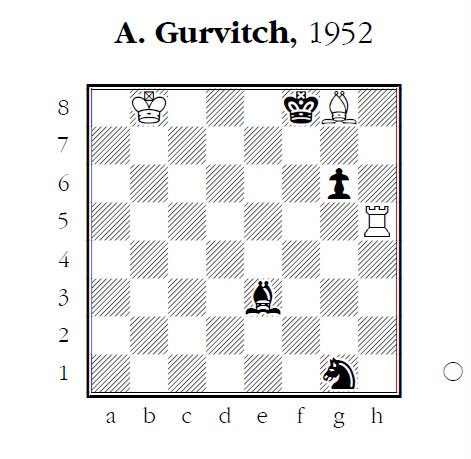
White to move and draw. This is a pretty difficult endgame. Can you find the saving line for White?
Source: ChessToday.net

Chess Daily News from Susan Polgar

White to move and draw. This is a pretty difficult endgame. Can you find the saving line for White?
Source: ChessToday.net
How about 1. Bh7 gxh7 2. Rxh7 1/2-1/2.
Or, if 1. Bh7 g7 2. Rf5+ Ke7 4. Re5+ and picking up the bishop.
What did I miss?
At first, I was absolutely convinced Rh8 draws, and that I had solved this “difficult brain challenge in about 5 seconds, but this is a very deceptive position, and much more complicated than I thought at first glance. First, the line as I saw it at the start:
1. Rh8 Kg7 (Bd4 is below)
2. Bh7
And it appeared that Kh8 3.Bg6 clearly draws (that position is a draw), but I did look at the move 2 alternatives for black since I realized black doesn’t have to cooperate by taking the rook. He can push the pawn since white’s two pieces are still en prise.
2. …..g5!
And now it appears that white has only Re8:
3. Re8? Bf4
4. Kb7 Kh7
And this is clearly won for black, though he will surely have to win by mating with a knight and bishop at some point after white gives up the rook for the pawn.
Also, white cannot attack the bishop immediately with 1.Rh3 for much the same reasons- he loses the bishop after black checks from f4 to give essentially the same losing ending as above.
So, the answer really does have to be in the Rh8 line. A bit of trial and error in the main line, and I basically stumbled blindly into a good looking idea. Let’s take it from the top:
1. Rh8 Kg7
2. Bh7 g5
3. Bf5! Kh8 (Bf4 won’t change it)
4. Bg4! Kg7
5. Kc7 Kf6
6. Kd6 Bf4
7. Kd5
Keeping control of e5 to keep the black king out. So, the bishop keeps the g-pawn from advancing, keeps the black knight from moving, and along with his king, keeps the black king from reaching him- black is just horribly weak on the white squares. He can make no progress:
7. …..Bg3 (keeping eye on d6)
8. Kd4
Here, Ke4 should draw, too. Continuing:
8. …..Ke7 (Be5/f2 9.Kd5)
9. Kd5 Kd8
10.Kc6
This is an obvious move to me- it takes advantage of the white bishop’s control of c8 to keep the black king from making the end around move to reach ranks 1-4 through the queenside. Also, I can’t be sure that white draws with anything else, though I suspect he might. This line is clear to me, however. Continuing:
10. ….Bf4 (waiting move)
11.Kb6
Again, obvious move to keep the black king from going around white’s king to reach the lower ranks. Here, I think that Kb7 will also draw- white just need keep the black king out of c7. In any case, black can’t get around on the queenside, he can’t move his pawn or knight, and he can’t beat the white king back to get through e5 either. This is surely drawn.
The last loose thread is back at move 3, where black can take c7 away from the white king, but this is just trading one tempo for another:
3. …..Bf4
4. Kb7 Kh8
5. Kc6 and it is clear that black’s king still can’t get through e5 before the white king guards it.
I am pretty sure this is the only drawing line white has.
1> Bh7 g7 (forced ,if anyother move than white will simply exchange on g6 with bishop, If cheque than white king will move to a8 and again same question of should there be g7 or not will arise and if not g7 than pawn will be gone)
2> f5+ and any of Ke7 or Ke8 will result in e5+ follwed by Rxe3 and g7 pawn can not queen due to h7 bishop .. May be this line is even winning for white so not an option for black.
Or
2> Pxh7 than Rxh7 and it is R vs Bishop and knight rook can be excahnged with any of minor piece and it is draw.
theme of my logic is force balck king to move to e7/e8 and e5 check will lead to bishop loss or else straight away excahnge bishop for pawn and than capture with rook.
The key is get rid of one of the two pieces that Black has by attacking the Knight or the Bishop continuously
1.Rh4 Kxg8 2.Kb7 Kg7 3.Rg4 Kh6 4.Rg3 Bc5 5.Kc6 Bd4 6.Rg4 Be3 7.Rg3 Bf2 8.Rg2 Ba7 9.Kb7 Bd4 10.Rg4 Bc5 11.Kc6 Ba7 12.Kb7 Bf2 13.Rg2 Nh3 14.Rh2 g5 15.Rxh3+ Bh4
I had some more time to think about this problem this morning. The following is the critical line:
1. Rh8! Kg7 (Bd4 is now below)
2. Bh7! g5
3. Bf5! Kh8
4. Bg4! Kg7 (Bf4+ changes nothing)
5. Kc7 Kf6
6. Kd6 Bf4
7. Kd5
Keeping the black king from crossing the 5th rank. In addition, I showed the following continuation in which black unsuccessfully tries to do an end around through the queenside to reach the lower ranks 1-4:
7. …..Ke7
8. Kc6 Kd8
9. Kb6 and white keeps control of the dark squares within reach of the black king, while his bishop controls the white squares, and black’s king cannot make progress. I wondered whether or not white actually needs to keep the king out, and I now see that he does. Let’s pick up the line above at move 9, but instead of Kb6, white allows the black king to come down the queenside:
9. Kd5? Kc7!
10.Kc5 Be3 (a waiting move)
11.Kd5
If 11.Kb5, then black plays Kd6-Ke5 etc. Continuing:
11. ….Bb6!
Probably not the only winning move, but this should be the most direct win- it allows the bishop access to d8 to protect the pawn from behind. We will see why in just a moment. Continuing:
12.Ke5
If white tries 12.Kc4, black plays Kd6, and it is now the white king who is cut off from the kingside. Of course, to remind you, if white tries a bishop move like Bh5 the knight gets free via h3. The other king moves are not really different than Ke5 since the black king just goes through c6 anyway. Continuing:
12. ….Kc6
13.Kf5
Or if 13.Ke4, black plays Kc5. Continuing:
13. ….Bd8 (Point 1 of Bb6 above)
14.Ke5 Kc5
15.Ke4 Kc4
16.Ke3 Bb6 (Point 2 of Bb6 above)
17.Ke4 Kc3
18.Kf5 Bd8 (Point 3 of Bb6 above)
19.Ke4 Kd2 and it is over. The knight will now be free via e2.
So, it was critical that white keep the black king out at move 9 with either Kb6 or Kb7.
I see some comments have appeared. Let’s deal with Ravi’s because I had serious problems this morning with this line that I had too hastily dismissed last night (and apparently called the 1.Rh3 line in my first comment). I should have looked at it then. As Ravi outlines above, it is much more complicated than I had thought at first:
1. Rh4 Kg8
2. Kb7 Kg7
3. Rg4 Kh6
Here, white draws if black tries g5, since Rg3 then attacks all three black soldiers. A better question is whether or not black wins with 3. …Kf6 rather than 3. …Kh6. I can’t answer this question. I spent about 2 hours this morning on both lines, and I can only half-way demonstrate that black wins with 3. …Kh6. Continuing with Ravi’s line:
4. Rg3 Bc5
5. Kc6 Bd4
6. Rg4
Ravi’s suggestion, but I think white does better with Kd5, but I think it will be clear below that this still loses. Continuing:
6. …..Nf3!
A hard move to find, especially if you have trouble visualizing knights, and I was actually looking for moves like this to protect the bishop, but it took me a long time to see the further effect of this move. Continuing:
7. Rf4
Two notes here- if the black king had played to f6 at move 3 instead of h6, this move would have occured with check- also this is the obvious continuation for white to attack both pieces, but now black has
7. …..Ne5! (an only move??)
8. Kd5 Bg1! (definitely only move)
And now what for white? He can’t take at e5 without allowing the winning skewer of Bh2 (check it out). If he tries 9.Rf1, black plays Bh2 protecting the knight since the reply of 10.Rh1 is met efficiently by Ng4 protecting the bishop. Also, 9.Rh4 is met by Kg5 and black will completely coordinate his pieces afterward. The best approach to me seems to be 9.Ra4:
9. Ra4 Nf3!
10.Ke4
If 10.Ra1, then Kg5 should win. If 10.Ra3, then Nh4 should win. If 10.Rg4, then Bb6 should win since the bishop can now reach d8 to find a temporary shield to allow black to get coordinated. Continuing:
10. ….Ng5
11.Kf4 Nf7!
It might be important to not let white tie black up with the pawn blocked. Continuing:
12.Kg3
Getting in front of the pawn, but this shouldn’t matter now:
12. ….Ne5
13.Ra1 Be3
14.Ra3
Or 14.Re1 Bf2! 15.Kf2 Nd3+ leads to a winning K+P ending for black. Continuing:
14. ….Bg5
15.Ra5 Bf6
16.Kf4 Kh5
17.Rb5
Again, the exchange at e5 leads to a winning K+P ending for black. Continuing:
17. ….g5
18.Kf5 Bh8
19.Rb7 Ng4
20.Rh7 Nh6
21.Ke4 Bf6
And I am going to stop here since there are already a lot of loose ends even in this, but I hope I have shown that black can avoid the problems Ravi identified in his comment- getting the knight is key in this line at move 6. This is not a trivial ending, but I have believe black wins from here- his pieces are now coordinated