
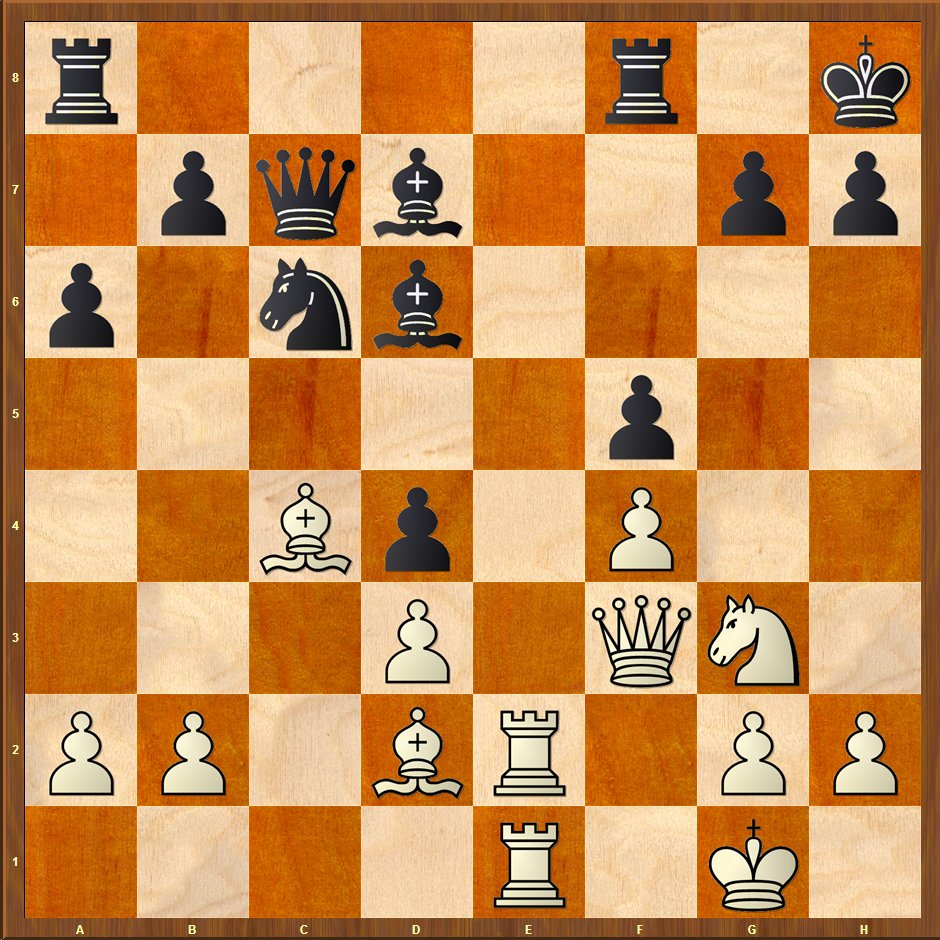
r4r1k/1pqb2pp/p1nb4/5p2/2Bp1P2/3P1QN1/PP1BR1PP/4R1K1 w – – 0 0
Since I started this blog back in May 2005, I have posted a few thousand chess puzzles involving various chess tactics and pattern recognition. As I have just started Polgar Chess University, I am introducing a new feature on this blog, “positional exercises”. This will help you understand chess a lot better.
Here is the first example. This was a game between Nimzovitsch and Rubinstein which took place in Dresden in 1926. It is White to move. There is no immediate tactic here. This is about understanding the position and finding the right plan. Take a few minutes to look at this position. Analyze it thoroughly and then see if you can come up with the best middlegame plan for White.
Don’t bother with your Fritz or Rybka. Just use your head and think this through. I will come back to give you the analysis later. Good luck!

I want to head fake an attack the black pawn on f5 but then go after the one on e4.
White would like to prevent black from contesting the e-file with his rooks. Black can’t yet do so because the f5 pawn is weak, so white has time for one move to stifle any black activity with his minor pieces. 1.a3 prevents black from moving the N or B to b4, and also vacates a2 for his bishop in case of Na4. Now if black plays g6 to protect f5, White plays Qd5. The threat of mate on g8 means that black cannot exchange more than one pair of rooks and leaves him rather paralysed and short of active moves
I wasn’t even close so I looked through the game http://www.chessgames.com/perl/chessgame?gid=1007481 and did not find the exact position shown so it seems the position is inspired by the game but did not actually occur.
Nh1-f2-g3-h5 activates the knight. 1.-Na5 2.Bxa5
Of course, the best plan was what was played in the game. Googling for the game will get you the answer you need.
The position is taken from Mark Dvoretsky’s article on “the worst piece” posted in yesterdays chesscafe (http://www.chesscafe.com/dvoretsky/dvoretsky.htm). This article has very nice discussion of this position. Dvoretsky noted that he changed the position from the game to remove a transpositional possibility that in the original position that detracts from its value as a training exercise.
mk
Its a great idea Susan ! I am sure it will help a lot of beginners/mid-level players.
Thanks a ton !
– Sudarshan
white’s worst piece is the Ng3
best square would be g5, so Nh1-f2-h3-g5
Famous game: Nh1 is the key!
a2-a3 is probably good; Ng3 is no that bad at all: it prevents Re8. in general exchanges are in blacks favour
the best way to tie the black up is placing the queen at d5, but immediately (or even after a2-a3) it achieves nothing because of Rad8 and black creates bxf4 threat preventing Qd5
so
a2-a3, then b2-b4
(a) black plays g7-g6 early. In this case Qd5 with Qg8 threat still preventing Re8; at the same time white can deploy the h pawn (h2-h4-h5) and Ng3 is placed very well in this case
(b) no early g6. Then starting Nh1-f2-h3-g5 (as in the original game) Note that h7-h6 by itself does NOT prevent Ng5 (hg qh5#). If black plays g7-g6, then struggle to push Qd5 through, and again h2-h4-h5. On h7-[h6]-h5 the knight goes back on the g5 trail
this sounds very slow but the position is very static and structured, i.e. allows for such a play…
alex
Sudarshan:
beginners? I recently talked to one IM known for extremely sharp tactical play (kings gambit and insane sicilian lines are his favourites, he just won a few crazy games in Russian team cup. He told me he read Nimzowitz’b books when he was a cl 2 player (ca 1700) and then again when he became a master and realized he didnt understand anything when he read and analyzed it for the first time. This stuff is not for beginners
I think a3 is the best move because it prevents Nb4, which will lead to a weak e-file.
If 1. Nh1 Nb4 2. Rc1 Bc6 then f2 is the best square for the queen and the knight on h1 is badly placed.
If 1. Nh1 Nb4 2. Bxb4 Bxb4 3. Rf1 Rae8 and e-file is lost for white.
Looking at this position, two things stand out immediately- (1) White has temporary control of the e-file and, (2) the knight at g3 is terribly placed.
If I were white to move, I would play a3 first to give the bishop a place to retreat. This secures the b4 square and opens the later possibility of playing b4. Secondly, I would consider the maneuver of N to h1-f2-h3-g5. This forces black to weaken the kingside with h6, or white gets control of e6 and f7.
White’s main weakness is the pawn at f4. At some point, g3 is going to be needed.
In any case, I applaud this new development for Ms. Polgar’s blog. Positional understanding is so overlooked in chess blogs- it is usually all tactics and fireworks.
“I think a3 is the best move because it prevents Nb4, which will lead to a weak e-file.”
Interestingly, this was Rybka’s suggestion – maybe she knows how to play positional chess too 😉
I think the emphasis on positional chess taken by GM Polgar is a great idea.
One idea would be 1. Qd5.
It keeps the black pieces tied up.
The knight cannot move because the pawn on d4 will fall. The black bishop cannot take the f4 pawn because of the bishop on d7.
And the rooks cannot challenge the e-file because the f5 pawn will fall.
However, I don’t really see a way for white to make progress if Black does nothing.
The suggested move, 1. Nh1, from several others, seems like a very Nimzovich move! Was it actually played?
‘The position is taken from Mark Dvoretsky’s article on “the worst piece” posted in yesterdays chesscafe (http://www.chesscafe.com/dvoretsky/dvoretsky.htm).’
Are you accusing her of stealing other people’s work?
“Are you accusing her of stealing other people’s work?”
I think he is responding to my post saying that the position did not occur in the actual game.
the dvoretsky article should have at least been cited…
“the dvoretsky article should have at least been cited…”
Chess websites often use each others’ puzzles. I think this is fairly common and accepted practice. But if you ask me, I agree with you.
First of all, I have an agreement with ChessCafe to use the material. I am also a long time columnist with ChessCafe.com.
Secondly, if I cited the source before I offer the answer, some players will go there to look up the answer instead analyzing things out of themselves.
Best wishes,
Susan Polgar
Susan, don’t worry about some of these anonymous who have nothing better to do than smear people. Ignore them.
It’s unfortunate that society has a lot of obnoxious idiotic trolls. They’ll do anything to destroy people’s lives and reputation for 15 seconds of fame.
White pluses:
1- the rooks are doubled on an open, central file.
2- the light-squared bishop is on a good diagonal.
3- the f-pawn is keeping Black pieces off of e5.
White minuses:
1- the d-pawn is isolated.
2- the knight on g3 has limited mobility and not doing much except for attacking the f-pawn.
3- the queen and dark-squared bishop are currently tied down to defending the f-pawn.
4- the dark-squared bishop has limited mobility.
5- the b-pawn is undefended.
White plan:
1- pile up on the Black pawn on d4 with the queen, knight and dark-squared bishop.
2- relocate the knight to f3, from where it attacks the pawn on d4, and can move to the outposts on e5 and g5.
3- protect the f-pawn by pushing the g-pawn to g3, thereby freeing up the queen and light-squared bishop.
Black pluses:
1- the bishops are raking, covering key squares along an open central file, preventing the White rooks from penetrating.
2- the queen and bishop form a battery on a useful diagonal.
3- the rooks are connected.
4- the d-pawn is keeping White pieces off of c3 and e3, and gives Black a bit more space.
5- the f-pawn is keeping White pieces off of e4.
Black minuses:
1- the king is in the corner, with limited mobility and subject to possible back-rank mate issues.
2- the rook on a8 is out of play.
3- the d-pawn is isolated and advanced, making more easily subject to attack.
4- the light-squared bishop currently has a mostly defensive role.
5- the b-pawn is weakened due to the advance of the a-pawn.
6- there is a hole on b6.
Black plan:
1- activate the rook on a8 and challenge the doubled White rooks.
2- overprotect the pawn on d4.