
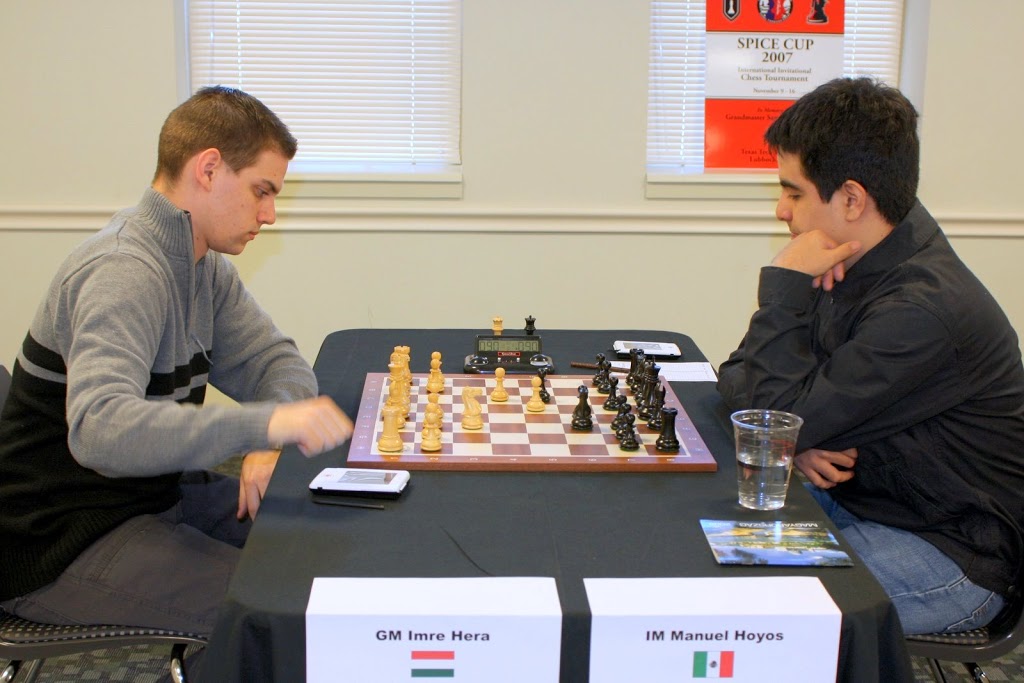
Special essay by Grandmaster Imre Hera of Hungary
This is from my column in ChessCafe this month (which covers Carlsen, Nepomniachtchi and game analysis) http://www.chesscafe.com/polgar/polgar.htm
People often ask me about what it takes to become a grandmaster and how they differ from a typical chess player. Here is an enlightening essay by Hungarian grandmaster Imre Hera. He is the first GM to receive a scholarship to Texas Tech University, and he hopes to attend in the fall of 2008.
How was a grandmaster born?
Everyone who wants to do something in a professional way knows well that success does not come easy. One has to work hard to achieve his goals and has to give up some of the comforts he is used to. When I was a child, the situation was quite the same and I learned this lesson at an early age.
I started playing chess at the age of 4. First, I learned the basics: the name of the squares, the pieces, the openings and the endings from my father. I was only 6 years old when a friend of our family asked me to give a simultaneous for a group of journalists during an event. Everybody was surprised when I defeated six of the eleven players and drew with three others. A daily newspaper wrote an article about the event and the official Hungarian chess magazine Sakkélet gave a full-page of coverage about me.
These first tastes of success encouraged both me and my father to put more effort into chess. When I turned 7, my father searched for a personal trainer to help develop my skills. As we were not a rich family, we had to save money for the trainer’s wage. Therefore, we did not buy as much clothes, toys, or accessories as other families did. First I was going to school in the mornings and had chess lessons in the afternoons. But as I developed more in chess, I needed more and more training sessions. My parents decided to put me in a ‘private pupil’ status, so that I had more time for chess. This meant having exams in Math and other subjects during the summer when other children were on their vacation.
My very first adult Hungarian team championship came in 1996. My debut couldn’t be better: I won the championship. Everybody who has achieved an aim for what he had worked for many years knows it well – that sweet taste of victory. And when one has tasted it for the first time, he wants it again. That success – still at the age of 10 – made me even more determined to become a better player.
My second big challenge was the 1996 world championship finals at Menorca. It was my second time traveling abroad. Traveling through Barcelona was a huge experience for me. My whole family supported me all the way – my mother accompanied me to Spain. In the end, I finished fifth in the tournament. Many of the competitors who appeared there already had their master or grandmaster titles by then.
After Spain things sped up: I was signed by a club participating in the Hungarian First Division – Matador – and was immediately given the third place in rank. In that same year I was invited to the ‘98 Rapid World Championship Finals in France. In the end, I won the world championship, which is one of the most favorite memories of my life so far. This can be better understood if one imagines that he is in EuroDisney – one of the children’s favorite places in Europe for free and finishes a competition with a perfect of 8 points out of 8 games. I was even interviewed by the Chinese National Television. When I finally got home, I was on the front page of the national sport newspaper and several other newspapers. For a while I felt like a star. In those days I also learned a lot about how to deal with success and how to put behind achievement when I had to go forward.
Though it seemed that success followed success in my life, there were always lows to bring me back to reality. Meanwhile I had graduated from primary school and started my secondary school in which they did not allow me to continue my studies as a private student. For that I had to focus less on chess for a long time. Little successes – like participating in the secondary school’s team – cheered me up during that time. Our school won the first place in the national “student Olympic” championship twice. For the second championship I requested from our trainer to share my knowledge with my teammates in order to help them develop into better players. I was also invited to other schools to give simultaneous exhibitions, but I did not take part any active tournaments. I just played team games.
School was not the only problem during those days. Two other shocking events happened to me: my parents divorced and our club went bankrupt – which of course meant that we had to give up participating in the First Division. I had to look for a new club for the first time in four years. Fortunately, my father not only taught me how to face success but failures as well, so I could get back on my feet.
Three years passed with practicing and I continued my path of collecting new championships. I won the European Rapid Championship trophy in Graz 2000. After secondary school, I decided to return to chess. I wanted to be an IM, as I had one norm before at the age of 11. I reached the international master level unexpectedly quickly in two months in 2005, which opened the gates for me to foreign championships. I got signed by a Polish, a Slovakian and a new Hungarian club. I had my first league victory with my Slovakian team (Komarno) in 2006 and in 2007 we repeated the victory.
My biggest challenge was to become an international grandmaster, which I reached at the 2007 European Individual Championship in Dresden. I even received an invitation to the final 128 in the World Cup in Khanty Mansysk, Russia. I saw some of the top players in the world there and had to fight against grandmaster Rublevsky. Unfortunately, he was a too big of a ‘fish’ for me to defeat.
Now, in the 14th year of my professional chess career, I have almost attained all that I wanted. I have signed with several clubs, earned the grandmaster title and several titles as well. But I am still far away from being number one in my sport and I still have plenty to learn. I saw many players who got stuck in development at my level. This happened because of laziness in some cases, while with some others it was because they could not set up new challenges for themselves. I do not want to lay back in my armchair because I feel that I can reach whatever I want in chess.
On the way home from Russia I was wondering on the plane whether all these efforts were worth it all. I have to say: totally. I have learned a lot about how to appear, how to communicate and how to behave among foreign people. I even learned how to live on my own – for a week or more – in a foreign country and be away from my family. Sometimes I feel like I should regret the many things that I gave up for practicing chess when I was a child, but the success that I have achieved has compensated that feeling.
With my short autobiography I wanted to show that one can achieve success (or even more) that one has dreamed of, but only if he works hard and brings his best to the game. That is the only way to become a ‘grandmaster’ in any aspect of life.
This was in my ChessCafe column this month. Click here to read my column this month.

This is a very nice and well written essay!
Good Job!
especially for someone who’s first language is not English
I was particularly impressed by Susan Polgar and/or Paul Truong advising Magnus Carlsen to stay humble.
I was also impressed by the fact that the spelling in the sentence was without exception correct.