Kc6-d6-e6-f5 wins (white wins some more pawns). If at an earlier point black does not check- but goes behind the passed a pawn- then white rook moves so that if rook takes pawn rook check swap rooks into winning pawn endgame.
A similar motif from a puzzle posted in August, and again this month:
1. Kc6 Rc2 2. Kd6 Ra2
On either move, if black takes at f2, white sacrifices the rook at g8 and queens the pawn to win. On move 2 and move 3, in this line, if black persists in checking from d2 and e2, white plays Ke6 and Kf5 to win the black pawns. So, black’s rook must return eventually to a2, but now white takes advantage of his more powerful king:
3. Rc8 Ra6
The key variation arises on 3. …Ra7 and I will discuss it separately. Continuing:
4. Rc6! Ra1 (or Ra2 or Ra3, etc.) 5. Rc7 Kf6 6. Rb7 Rd1 7. Kc7 Ra1 (Rc1 8.Kb8+-) 8. Rb6 Kb8 and black will lose his rook.
Back at move 3, black could liquidate the a-pawn and the two rooks, but this is a lost king and pawn ending for black as black’s king sucks:
3. …..Ra7 4. Rc7 Rc7 5. Kc7
Now, black can try two strategies- he can try to keep white’s king from winning at g5 by cutting him off, or black can make for f2 and get a counter attack, but both are lost (counter attack first):
The Black King is in a poor position and White can exploit that.
1. Kc7, Rc2 2. Kd7, Rd2 3. Ke7, Ra2 (continuing the check loses the Black pawns) 4. Rd8, Rxa7+ (not taking loses the rook) 5. Ke6, Ra6+ 6. Rd6 (this is when Black cannot continue with the checks and an exchange of the rooks loses all his pawns due to the poor position of King)
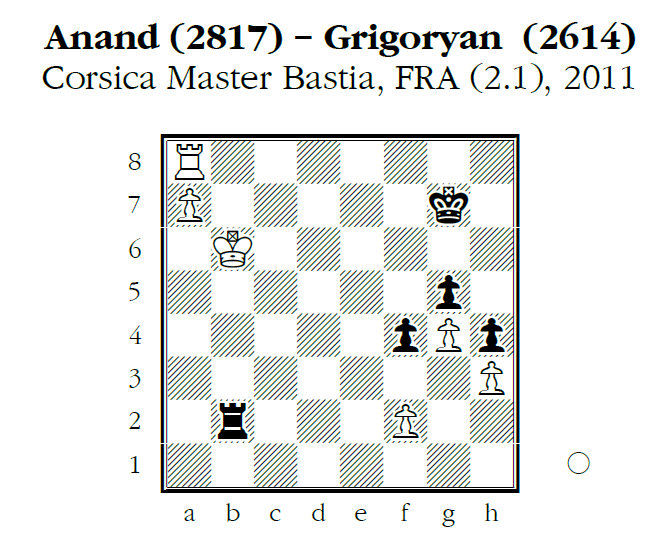


This is way to hard. I think it should be a draw with all the checks coming.
king should move towards rook with every check and then when no check is possible Rg8+ Kxg8 a8=Q+ wins for white
Kc6-d6-e6-f5 wins (white wins some more pawns). If at an earlier point black does not check- but goes behind the passed a pawn- then white rook moves so that if rook takes pawn rook check swap rooks into winning pawn endgame.
A similar motif from a puzzle posted in August, and again this month:
1. Kc6 Rc2
2. Kd6 Ra2
On either move, if black takes at f2, white sacrifices the rook at g8 and queens the pawn to win. On move 2 and move 3, in this line, if black persists in checking from d2 and e2, white plays Ke6 and Kf5 to win the black pawns. So, black’s rook must return eventually to a2, but now white takes advantage of his more powerful king:
3. Rc8 Ra6
The key variation arises on 3. …Ra7 and I will discuss it separately. Continuing:
4. Rc6! Ra1 (or Ra2 or Ra3, etc.)
5. Rc7 Kf6
6. Rb7 Rd1
7. Kc7 Ra1 (Rc1 8.Kb8+-)
8. Rb6 Kb8 and black will lose his rook.
Back at move 3, black could liquidate the a-pawn and the two rooks, but this is a lost king and pawn ending for black as black’s king sucks:
3. …..Ra7
4. Rc7 Rc7
5. Kc7
Now, black can try two strategies- he can try to keep white’s king from winning at g5 by cutting him off, or black can make for f2 and get a counter attack, but both are lost (counter attack first):
5. …..Kf6
6. Kd6! f3 (Kg6 7.Ke6; Kf7 7.Ke5)
7. Kd5
And the white g-pawn plays the key role- cutting off f5 against the black king. The rest of this line is left as an exercise for the curious.
Or, at move 5:
5. …..Kf7
6. Kd6
Most direct, and heading for e5/f5.
6. …..Kf6 (Kg6 7.Ke5; Kg7 Ke5)
7. f3
Here, 7.Kd5 wins too as a transpostiion to a line above. Continuing:
7. …..Kg6 (Kf7 8.Ke5 Kg6 9.Ke6+-)
8. Ke6 Kg7 (Kh6 9.Kf5; Kh7 9.Kf5)
9. Kf5 Kh6
10.Kf6 and g5 and the other black pawns will fall.
1.Kc6 Ta2 2.Tc8 Txa7 3.Tc7 Txc7 4.Kxc7 with opposition.
Hi Susan Polgar,
Well,White wins the game [ Variations exist ]
Example One
============
1.Ka5 Ra2+
2.Kb4 Rb2+
3.Ka3 Rb7
4.Rg8+ K*Rg8
5.a8(Q)+ Kh7
6.Q*R+ Ke6
7.Qb5 Kf6
8.Qf5+ Ke7
9.Q*g5+ Ke6
10.Q*f4 Kd5
11.f3 Ke6
12.Qg5 Kf7
13.f4 Kf8
14.f5 Kf7
15.Qg6+ Kf8
16.Qh7 Ke8
17.f6 Kf8
18.Qg7+ Ke8
19.Qe7++ Mate
Example Two
===========
1.Ka5 Ra2+
2.Kb4 Ra6
3.Kc5 Ra1
4.Kd5 Ra5+
5.Ke4 Kf6
6.Rf8+ Kg7
7.a8(Q) R*Qa8
8.R*Ra8 Kg6
9.Ra6+ Kh7
10.Kf5 Kg7
11.K*g5 Kf7
12.K*f4 Kg7
13.Kg5 Kf7
14.f4 Kg7
15.f5 Kf7
16.f6 Kf8
17.Ra7 Kg8
18.Kg6 Kf8
19.Ra8++ Mate
Example Three
=============
1.Ka5 Ra2+
2.Kb4 Ra6
3.Kc5 Ra5+
4.Kd6 Ra6+
5.Ke5 Kf7
6.Rh8 R*a7
7.Rh7+ Kh6
8.R*Ra7 Kh6
9.Ra6+ Kg7
10.Kf5 Kf7
11.K*g5 Kg7
12.K*f4 Kf7
13.Kg5 Kg7
14.f4 Kf7
15.f5 Kg7
16.Ra7+ Kf8
17.Kg6 Ke8
18.f6 Kd8
19.f7 Kc8
20.f8(Q)++ Mate
White wins the game [ Variations exist but White should win by denying repeated move draw ]
By
Venky [ India – Chennai ]
The Black King is in a poor position and White can exploit that.
1. Kc7, Rc2
2. Kd7, Rd2
3. Ke7, Ra2 (continuing the check loses the Black pawns)
4. Rd8, Rxa7+ (not taking loses the rook)
5. Ke6, Ra6+
6. Rd6 (this is when Black cannot continue with the checks and an exchange of the rooks loses all his pawns due to the poor position of King)