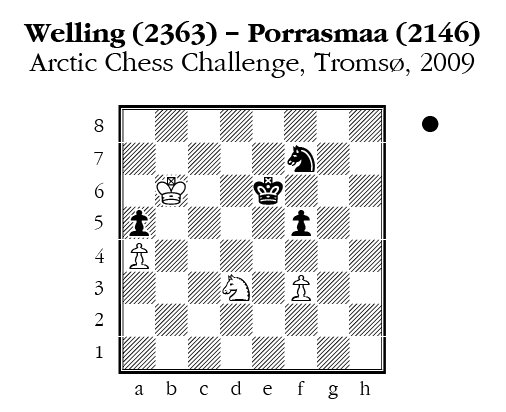
With these “reviews” I often check my files to see if I have worked on the previous postings of this problem, and in my files I found this problem, but with the notation that the position was incorrect. According to my notes, this position was reached with black to move. Is this correct or not?
It will be a super hot day in Tromso before I can work this one all the way out. But if I’m playing the Black pieces, I start out 1. .. Kd5 and after 2. Kxa5 I play 2. .. Kc4. After that, I’ll try to keep my king on the c-file, preventing White’s king from getting to the b-file, whereby White’s king blocks his own a-pawn. I don’t suppose Black can keep this up forever, since the White knight could prevent that. But if that happens, that should give my horse the opportunity to gobble up the white f-pawn in the meantime. It’s 10:30PM here in California, and I am not, repeat NOT going to work this out after a long, stressful day. [grin]
Now if only I can enter the characters to prove that I’m not a robot, I can go get some sleep!!
Simply counting moves, black might well try the exchange at e5 and reduce to a drawn endgame where white queens a move ahead, but black ends up with the drawn position holding a bishop’s pawn on the second rank. However, I think I can already see this might not work in this particular case since white has in reserve a truly classic mating motif in one of the lines:
1. …..Ne5 2. Ne5 Ke5 3. Ka5 Kf4 4. Kb4!
This is the only potential winning move, I am pretty sure. We will see why in just a moment, but suffice it to say that this is the king move that gets the white king closest to the action. Continuing:
4. …..Kf3 5. a5 Ke2
The key juncture. I am now sure that black is definitely lost after the first move. To draw this ending, black must get the pawn to f2, and have the possibility of putting the king on h1 when the new white queen first attacks the f2 pawn so that white cannot capture at f2 without stalemating black, however, the queen must keep checking black or pinning the pawn whenever the black king is on g1 threatening f1Q to draw. Normally, black would play Kg2 here and then keep pushing the f-pawn, however, when the pawn reaches f3, white will pin it with a8Q and gain the fatal tempo: [5. …Kg2 6.a6 f4 7.a7 f3 8.a8Q Kg3 9.Qe4 f2 10.Qh1!+-]. Of course, if black plays Kg3 at this position, he just hands white the tempo outright, and the white queen will go directly to h1 and cut the black king off from f1. However, Ke2 gives a very pretty ending for white where he just allows the new black queen to be born just prior to her husband’s death:
6. a6 f4 7. a7 f3 8. a8(Q)f2 9. Qg2
White should win with Qe4 here as well, but is not as elegant. With Qg2, white pins the pawn and threatens Qf1 if the black king moves anywhere other than e1:
So, black must choose a different move right from the start. On just 1st principles, I would definitely play 1. …Kd5 here knowing how the previous line loses (gains a tempo towards the white f-pawn).
1. …..Kd5 2. Ka5
I simply don’t see how white does better with any other move. If white plays 2.Nf4, black plays Kc4 and Ne5 after white has taken at a5 leading to a surely drawn ending. If white tries 2.Ne1, black just plays Ne5, and after white takes at a5, black then plays Kc5 trapping the white king on the a-file. Continuing:
2. …..Kc4 3. Nb2
Or 3.Nf4 Ne5 will win the white f-pawn. Continuing:
3. …..Kc5 4. f4
Or, more involved: [4.Ka6 Ne5 5.f4 Nd7 6.Kb7 Kb4 7.Kc6 Nf6 8.Kd6 Ne4 9.Ke5 Ng3 10.Nd1 Nh5 and both white pawns will fall unless white returns the knight to b2. In the original posting of this problem with the wrong side to move, this was very similar to one of the lines I worked on and couldn’t even find a convincing win there for white either. Continuing:
4. …..Nd6
I can’t be really sure, but this just looks best for black to me. It has in reserve the coverage of b7 so that the white king can’t go there if black has played Kc4 or Kb4, and it keeps the white knight out of c4. Continuing:
5. Nd3
Or [5.Ka6 Kc6 6.a5 Nb5 7.Nd3 Nc7 8.Ka7 Nb5 9.Kb8 Nd4 10.a6 Kb6 11.a7 Nc6 should draw easily]. Continuing:
5. …..Kc4 6. Ne5 Kb3!
I looked at other replies for black, and this is definitely the safest line. If black plays a careless Kc5, white plays Ka6, and the black king can’t play to c6 because the white knight has him cup off: [6. …Kc5? 7.Ka6 Ne4 8.a5! Nc3 9.Kb7 and I think black is going to be forced to give up the knight for the a-pawn. Continuing:
Even if it were white to move, I am not convinced, and was not convinced 3 years ago, that white could win this with 1. Kxa5. If anyone found a solution to the incorrect problem, I would be greatly interested.
1….K d6 is wining move. Using principle of opposition, black will not allow white king to come out and make space for white pawn to march ahead to become queen.


Susan,
With these “reviews” I often check my files to see if I have worked on the previous postings of this problem, and in my files I found this problem, but with the notation that the position was incorrect. According to my notes, this position was reached with black to move. Is this correct or not?
My bad 🙂 Yes, it is black to move. No wonder why no one found the solution 🙂 Thanks!
Susan
It will be a super hot day in Tromso before I can work this one all the way out. But if I’m playing the Black pieces, I start out 1. .. Kd5 and after 2. Kxa5 I play 2. .. Kc4. After that, I’ll try to keep my king on the c-file, preventing White’s king from getting to the b-file, whereby White’s king blocks his own a-pawn. I don’t suppose Black can keep this up forever, since the White knight could prevent that. But if that happens, that should give my horse the opportunity to gobble up the white f-pawn in the meantime. It’s 10:30PM here in California, and I am not, repeat NOT going to work this out after a long, stressful day. [grin]
Now if only I can enter the characters to prove that I’m not a robot, I can go get some sleep!!
Simply counting moves, black might well try the exchange at e5 and reduce to a drawn endgame where white queens a move ahead, but black ends up with the drawn position holding a bishop’s pawn on the second rank. However, I think I can already see this might not work in this particular case since white has in reserve a truly classic mating motif in one of the lines:
1. …..Ne5
2. Ne5 Ke5
3. Ka5 Kf4
4. Kb4!
This is the only potential winning move, I am pretty sure. We will see why in just a moment, but suffice it to say that this is the king move that gets the white king closest to the action. Continuing:
4. …..Kf3
5. a5 Ke2
The key juncture. I am now sure that black is definitely lost after the first move. To draw this ending, black must get the pawn to f2, and have the possibility of putting the king on h1 when the new white queen first attacks the f2 pawn so that white cannot capture at f2 without stalemating black, however, the queen must keep checking black or pinning the pawn whenever the black king is on g1 threatening f1Q to draw. Normally, black would play Kg2 here and then keep pushing the f-pawn, however, when the pawn reaches f3, white will pin it with a8Q and gain the fatal tempo: [5. …Kg2 6.a6 f4 7.a7 f3 8.a8Q Kg3 9.Qe4 f2 10.Qh1!+-]. Of course, if black plays Kg3 at this position, he just hands white the tempo outright, and the white queen will go directly to h1 and cut the black king off from f1. However, Ke2 gives a very pretty ending for white where he just allows the new black queen to be born just prior to her husband’s death:
6. a6 f4
7. a7 f3
8. a8(Q)f2
9. Qg2
White should win with Qe4 here as well, but is not as elegant. With Qg2, white pins the pawn and threatens Qf1 if the black king moves anywhere other than e1:
9. …..Ke1
10.Kc3 Ke2 (or f1Q 11.Qd2#)
11.Kd4 Ke1
12.Ke3 f1(Q) (f1N 13.Kd3+-)
13.Qd2#
So, black must choose a different move right from the start. On just 1st principles, I would definitely play 1. …Kd5 here knowing how the previous line loses (gains a tempo towards the white f-pawn).
1. …..Kd5
2. Ka5
I simply don’t see how white does better with any other move. If white plays 2.Nf4, black plays Kc4 and Ne5 after white has taken at a5 leading to a surely drawn ending. If white tries 2.Ne1, black just plays Ne5, and after white takes at a5, black then plays Kc5 trapping the white king on the a-file. Continuing:
2. …..Kc4
3. Nb2
Or 3.Nf4 Ne5 will win the white f-pawn. Continuing:
3. …..Kc5
4. f4
Or, more involved: [4.Ka6 Ne5 5.f4 Nd7 6.Kb7 Kb4 7.Kc6 Nf6 8.Kd6 Ne4 9.Ke5 Ng3 10.Nd1 Nh5 and both white pawns will fall unless white returns the knight to b2. In the original posting of this problem with the wrong side to move, this was very similar to one of the lines I worked on and couldn’t even find a convincing win there for white either. Continuing:
4. …..Nd6
I can’t be really sure, but this just looks best for black to me. It has in reserve the coverage of b7 so that the white king can’t go there if black has played Kc4 or Kb4, and it keeps the white knight out of c4. Continuing:
5. Nd3
Or [5.Ka6 Kc6 6.a5 Nb5 7.Nd3 Nc7 8.Ka7 Nb5 9.Kb8 Nd4 10.a6 Kb6 11.a7 Nc6 should draw easily]. Continuing:
5. …..Kc4
6. Ne5 Kb3!
I looked at other replies for black, and this is definitely the safest line. If black plays a careless Kc5, white plays Ka6, and the black king can’t play to c6 because the white knight has him cup off: [6. …Kc5? 7.Ka6 Ne4 8.a5! Nc3 9.Kb7 and I think black is going to be forced to give up the knight for the a-pawn. Continuing:
7. Nf3 Kc4
8. Kb6 Kb4! (only draw, I am sure)
9. a5 Nc4! (only draw)
10.Kc6 Ka5 (Na5 ok, too)
11.Kd5 Ne3 (Kb4 ok, too)
12.Ke5 Ng2 with Nxf4 coming next.
Even if it were white to move, I am not convinced, and was not convinced 3 years ago, that white could win this with 1. Kxa5. If anyone found a solution to the incorrect problem, I would be greatly interested.
1….K d6 is wining move. Using principle of opposition, black will not allow white king to come out and make space for white pawn to march ahead to become queen.
1…k d6 is winning move. Using principle of opposition, black will not allow white king to come out and make way for white pawn to become queen.